

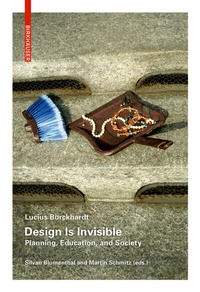
Design Is Invisible
Description

Mit
Design is Invisible
verwies Lucius Burckhardt als einer der ersten auf die Integrierbarkeit unsichtbarer Wirkkräfte: Sie bestimmen den Gebrauch der Gegenstände und sollten Bestandteil der Gestaltung sein. Was nützt etwa die schönste Straßenbahn, wenn sie in der Nacht nicht fährt? Burckhardt erweitert kurzerhand den Designbegriff, in diesem Fall um den Fahrplan, der ebenfalls optimiert werden kann.
Wie aktuell die zwischen 1965 und 1999 entstandenen Texte sind, kann man an der derzeitigen Architekturdebatte sehen. Probleme durch soziale Abgrenzung, ausgedünnte Regionen sowie Migrationsbewegungen können nur interdisziplinär gelöst werden. Die erstmals in englischer Sprache vorliegenden Texte öffnen dem internationalen Diskurs endlich den Zugang zu zentralen Quellentexten.
Reviews / Votes
Architects, Landscape Architects, Designers, StudentsMore details
Other editions
Additional editions
Persons
Lucius Burckhardt (1925-2003), Gründer der Spaziergangswissenschaft, lehrte Architekturtheorie in Kassel.
Content
- Intro
- Content
- Foreword by Silvan Blumenthal
- DESIGN
- Design Is Invisible (1980)
- Invisible Design (1983)
- Criteria For A New Design (1977)
- On the Design of Everyday Life (1979)
- Design - Rite and Expression of a Hopeful Society (1984)
- Design Implies Processes, Not Just Forms! (1970)
- The Grammar of Reality (1967)
- Urban Design and Its Significance for Residents (1975)
- Heritage Preservation Is Social Policy (1976)
- The Shortsighted and the Farsighted (1978)
- Quality . (1967)
- On the Production of Counter-productivity (1998)
- There's Nothing Simple about Simplicity (1998)
- All Over the Place (1994)
- An Ecological Innovation (1994)
- SOCIETY
- Good Taste (1986)
- Can A Shift In Tastes Be Planned? (1984)
- Beyond Utility Value (1986)
- . In Our Minds (1987)
- Dirt (1980)
- The Night Is Man-made (1989)
- Fake: The Real Thing (1987)
- Recycled Regionalism (1984)
- How Does Trash End Up In Museums? (1989)
- Color Is A Sign (1994)
- Good Form and Good Color (1994)
- Bad Form (1994)
- A Walk in Second Nature (1992)
- EDUCATION
- University Planning and Urban Planning (1968)
- Ulm Anno 5. On the Curriculum of the Ulm School of Design (1960)
- The Exhibition Medium (1965)
- documenta urbana - What Could That Mean? (1982)
- To Expect Quick Results from the Planned Reform Is to Underestimate the Braking Forces (1972)
- From Design Academicism to the Treatment of Wicked Problems (1973)
- On the Difficulty of Teaching Modesty (1979)
- The Minimal Intervention (1982)
- 75 Years of Bauhaus - On the Tame Approach to the Wicked Problem (1994)
- Not A New Bauhaus! (1993)
- A University Must Foster a Sense of Belonging and Hone Resistance at One and the Same Time (1996)
- Do Examinations Make for a Better Education? (1996)
- Problem-oriented Project-based Teaching (1999)
- The Sermon Given in St. Jacob's Church, Weimar, June 30, 1994
- Bibliography
- Biographies
- Index
