

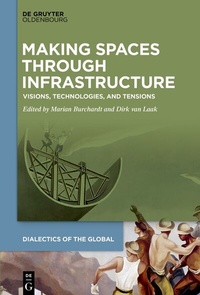
Making Spaces through Infrastructure
Description

Infrastructures are fundamental means through which societies create spaces, but little is known about the precise ways in which this occurs. How have infrastructures animated certain understandings of space? How do infrastructures stabilize, or undermine, the spatial formats in which we live, which shape our everyday practices and which regulate access to services and resources? And, conversely, how do spaces frame the ways infrastructural provision is organized? How do existing spaces shape infrastructural development and the scope and forms of access to vital services such as transport and water? In this volume, historians and sociologists draw on a range of fascinating case studies and provide compelling answers to these questions. Exploring, among others, the provision of irrigation water in nineteenth-century Los Angeles, the invention of airport transit zones, and the infrastructural practices of homeless people in Berlin, the book demonstrates how the making of spaces through infrastructure is deeply political. Intent on revealing uneven geographies of provision and hierarchies of access, the contributors highlight how infrastructures are products of global entanglements.
More details
Other editions
Additional editions
Persons
Marian Burchardt , Leipzig University, Leipzig; Dirk van Laak , Leipzig University, Leipzig.
Content
- Intro
- On the Series
- Contents
- 1 Making Spaces through Infrastructure - Introduction
- I Ordering Places and People: Infrastructure Projects and their Outcomes
- 2 Intersecting Infrastructures: Imperial Technology and East African Transport Labour, c. 1900
- 3 Playgrounds for Travellers: Infrastructure, Environment, and Spatial Transformation in the Americas, 1880s-1920s
- 4 Hydropower for a Modern Afghanistan: Soviet Aid to the Southern Neighbour in the 1960s
- 5 Reformatting a Socionatural Space: The Goulburn-Murray Irrigation District, Australia
- II Zones of Negotiation: Infrastructures and Social Practices
- 6 The Zanjas through Different Political Regimes: Infrastructure, Space, and Society in Nineteenth-Century Los Angeles
- 7 Roads for Whom? Tourism and Infrastructure in Post-colonial East Africa
- 8 Between Worlds: Perceiving the Inner-German Border as Infrastructure, 1945-1990
- 9 Fiction and Filter: The Emergence of Airport Transit Zones in the Twentieth Century
- 10 Staying under Bridges, Negotiating Barriers: Unhoused Berliners' Infrastructural Practices between Spatial Exclusion and Precarious Spatial Strategies
- III Conflicting Spaces: Infrastructures Old and New
- 11 Dreams and Realities of Infrastructural Leapfrogging: Airspace, Drone Corridors, and Logistics in African Healthcare
- 12 The Space of Datafied Societies: A New Horizon of Colonial Expansion?
- List of Abbreviations
- List of Contributors
- Index
