

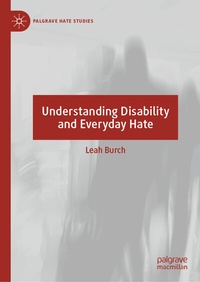
Understanding Disability and Everyday Hate
Description

This book examines disability hate crime. It focusses on key questions concerning the ways in which hate is understood and experienced within the context of the everyday, in addition to the unique ways that hate can hurt and be resisted. It introduces readers to questions surrounding the conceptual framework of hate and policy context in England and Wales, and extends these discussions to center upon the experiences of disabled people. It presents a conceptual reconsideration of hate crime that connects hate, disability and everyday lives and spaces using an affective (embodied and emotional) understanding of these experiences. Drawing on empirical data, this framework helps to attend to the diverse ways that disabled people negotiate, respond to, and resist hate within the context of their everyday lives. The book argues that the affective capacity of disabled people can be enhanced through their reflections upon hateful experiences andgeneral experiences of navigating a disabling social world. By working with the concept of 'affective possibility', this book offers a more affirmative approach to harnessing the everyday forms of resistance already present within disabled people's lives. It speaks to academics, students, and practitioners interested in disability, affect studies, hate crime studies, sociology, and criminology.
Reviews / Votes
" Understanding Disability and Everyday Hate is an insightful and engaging read that attends to the everyday realities of hate in the lives of disabled people. In acknowledgement of the under-reporting and under-researching of disability hate crime, the book starts with disability, utilising it as the key conceptual lens through which to ask broader questions about the meanings and locations of hate in contemporary society, as well as consider its affective possibilities for marginalised people. Most powerfully, the text engages with disabled people's own stories and experiences of hate, unearthing and giving voice to their own forms of mediation and management, as well as their potential for individual and collective approaches to resistance, rupture, and refusal. Characteristically, Burch takes a deeply ethical and compassionate but politicised approach to the unearthing of such painful stories, exposing the sensitivity, creativity, and emotional labour necessary in inquiry of this kind. By detailing these carefully through the text, she makes important contributions to disability research politics and practice. In short, this important text offers a timely re-conceptualisation of 'hate' and its broader application to the concept of 'hate crime', paying attention to politics and policy; environment, space, and place; affect, emotional and relationality; and bodies and otherness. In doing so, the text calls for more inclusive boundaries of hate crime - most critically, ones that are more responsive to the diverse and intersectional encounters of hate crime within the context of disabled people's everyday lives"- Dr Kirsty Liddiard, School of Education and Human, University of Sheffield, UK
"This text provides a vital and timely assessment of hate and hostility in the everyday lives of disabled people. Their experiences are centred and Burch examines the way that hate is embodied, how it circulates to drawlines between people and can (re)define the self. There is a powerful examination of strategies of resistance which make us ask questions about our reliance on policy and law to tackle hate crime. This will become a key text in disability studies, criminology and social policy. I look forward to recommending it to students and colleagues"
- Dr Hannah Mason-Bish , Senior Lecturer in Criminology, Co-Director of Centre for Gender Studies, University of Sussex, UK
" This is a necessary and utterly compelling book which shines a light on disabled people's experiences of 'everyday hate'. Rich in theoretical insight, methodological innovation and candid reflection, it places victims' lived realities front and centre of its analysis. In so doing, the book uncovers difficult truths and enables its readers to understand the nature and impacts of hostile behaviour from a seldom heard vantage point"
- Professor Neil Chakraborti, School of Criminology , University of Leicester, UK
More details
Other editions
Additional editions
Person
Leah Burch is a lecturer at Liverpool Hope University, UK, in the School of Social Sciences. She is also Professional Tutor teaching on the Health and Social Care BA Hons. As part of this role, she leads a series of Advanced Research Seminars on hate crime and is part of the British Society of Criminology Hate Crime Steering Committee. Her PhD was funded by the Economic and Social Research Council. During this project, she worked with disabled people to explore their meanings and experiences of everyday hate.
Content
