

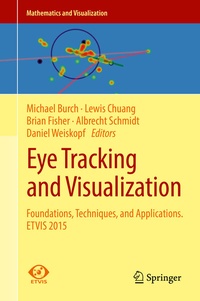
Eye Tracking and Visualization
Description

This book discusses research, methods, and recent developments in the interdisciplinary field that spans research in visualization, eye tracking, human-computer interaction, and psychology. It presents extended versions of papers from the First Workshop on Eye Tracking and Visualization (ETVIS), which was organized as a workshop of the IEEE VIS Conference 2015. Topics include visualization and visual analytics of eye-tracking data, metrics and cognitive models, eye-tracking experiments in the context of visualization interfaces, and eye tracking in 3D and immersive environments. The extended ETVIS papers are complemented by a chapter offering an overview of visualization approaches for analyzing eye-tracking data and a chapter that discusses electrooculography (EOG) as an alternative of acquiring information about eye movements. Covering scientific visualization, information visualization, and visual analytics, this book is a valuable resource for eye-tracking researchers within the visualization community.
More details
Other editions
Additional editions
Content
- Intro
- Preface
- ETVIS Workshop
- Review Process
- Organization of this Book
- Acknowledgements
- Reviewers and Members of the International Program Committee
- Contents
- Part I Visualization, Visual Analytics, and User Interfaces
- A Task-Based View on the Visual Analysis of Eye-Tracking Data
- 1 Introduction
- 2 The Eye-Tracking Visualization Pipeline
- 2.1 Data Acquisition
- 2.2 Processing and Annotation
- 2.3 Mapping
- 2.4 Interpretation
- 2.5 Gaining Insight
- 3 Categorization of Analysis Tasks
- 3.1 Where? - Space-Based Tasks
- 3.2 When? - Time-Based Tasks
- 3.3 Who? - Participant-Based Tasks
- 3.4 Compare
- 3.5 Relate
- 3.6 Detect
- 4 Example
- 5 Conclusion
- References
- Interactive Visualization for Understanding of Attention Patterns
- 1 Introduction
- 2 Understanding Emotion Regulation Strategies
- 2.1 The Study
- 3 Related Work
- 4 Glyph Visualization
- 4.1 Data Abstraction
- 4.2 State Graph
- 4.3 Sequence Graph
- 4.4 Visual Coordination: Synchronized Highlighting
- 5 Results
- 5.1 Comparison of Participants in Different Age Groups
- 5.2 Comparison of Participants in Different Conditioned Groups
- 5.3 Suggestions
- 6 Conclusion
- References
- The VERP Explorer: A Tool for Exploring Eye Movements of Visual-Cognitive Tasks Using Recurrence Plots
- 1 Introduction
- 1.1 Visualizing Eye Movements
- 1.2 Recurrence Plots
- 2 Design of the VERP Explorer
- 2.1 Heat Maps, Focus Maps, and Scatter Plots
- 2.2 Scan Paths
- 2.2.1 Identifying Fixations and Saccades
- 2.3 Alpha Patches
- 2.4 Interaction Techniques
- 3 Illustration of Use: Visual Search in Emergency Medical Checklists
- 3.1 Comparing Two Checklist Formats
- 4 Discussion and Conclusion
- References
- Gaze Visualization for Immersive Video
- 1 Introduction
- 2 Related Work
- 3 Workflow and Visualizations
- 4 Results
- 4.1 Video: RAFTING
- 4.2 Video: UM MENINO
- 5 Conclusion and Future Work
- References
- Capturing You Watching You: Characterizing Visual-Motor Dynamics in Touchscreen Interactions
- 1 Introduction
- 2 Visual-Motor Analytics Approach
- 2.1 Sample Visual-Motor Interaction Data
- 2.2 Equipment and Software
- 3 Modular Visualization Gauges
- 4 Modeling Visual-Motor Dynamics
- 5 Future Directions
- References
- Visualizing Eye Movements in Formal Cognitive Models
- 1 Introduction
- 2 Our Visualization Task
- 3 Adaptive Control of Thought-Rational (ACT-R)
- 4 Visual Analytics Dashboard
- 5 Virtual Embodiment of Model Eye Movements
- 6 Visualizing Eye Movements Strategies
- 7 Conclusion
- 7.1 Limitations
- 7.2 Future Work
- References
- Word-Sized Eye-Tracking Visualizations
- 1 Introduction
- 2 Related Work
- 3 Setting
- 4 The Design Space of Word-Sized Eye-Tracking Visualizations
- 4.1 Point-Based Visualizations
- 4.2 AOI-Based Visualizations
- 4.3 Combination and Extension
- 5 Prototype Implementation
- 6 Application Example
- 7 Discussion
- 8 Conclusion and Future Work
- References
- GazeGIS: A Gaze-Based Reading and Dynamic Geographic Information System
- 1 Introduction
- 2 Related Work
- 2.1 Geoparsing
- 2.2 Eye Tracking
- 3 GazeGIS Design and Implementation
- 3.1 Hardware
- 3.2 Software
- 3.3 Gaze Interaction
- 4 User Study
- 4.1 User Preference Evaluation
- 4.2 Gaze Patterns
- 4.3 Discussion
- 5 Intelligence Report Application
- 6 Extending GazeGIS
- 7 Conclusions
- References
- Part II Data and Metrics
- Unsupervised Clustering of EOG as a Viable Substitute for Optical Eye Tracking
- 1 Introduction
- 2 Methods
- 2.1 Dataset
- 2.1.1 Participants
- 2.1.2 Stimuli and Apparatus
- 2.1.3 Experimental Design and Procedure
- 2.2 Optical Eye Tracking
- 2.3 EOG-Based Eye Tracking
- 2.3.1 Preprocessing of EOG Data
- 2.3.2 Method 1: DB-Full
- 2.3.3 Method 2: GMM-Fix
- 2.4 Performance Measures
- 3 Results
- 3.1 Data Loss
- 3.2 Tracking Quality
- 3.2.1 Performance Scores of Recorded Sequences
- 3.2.2 Comparison of Recorded Sequences
- 4 Discussion and Outlook
- References
- Accuracy of Monocular Gaze Tracking on 3D Geometry
- 1 Introduction
- 2 Related Work
- 3 From 3D Positions to Pupil Coordinates
- 3.1 From Local 3D Positions to World-Camera Coordinates
- 3.2 From World Camera Coordinates to Pupil Positions
- 3.3 From Pupil Positions to View Cones
- 4 From Pupil Coordinates to Locations on an Object
- 4.1 Spatial Partitioning Tree
- 4.2 Implementation
- 5 Experiments
- 5.1 Accuracy of Calibration and Gaze Direction Estimation
- 5.2 Accuracy of 3D Gaze Position
- 6 Discussion
- References
- 3D Saliency from Eye Tracking with Tomography
- 1 Introduction
- 2 Related Work
- 3 Saliency Information Acquisition
- 4 Saliency Volume Construction
- 5 Experiment
- 6 Discussion
- References
- Visual Data Cleansing of Low-Level Eye-Tracking Data
- 1 Introduction
- 2 Related Work
- 3 Experiment Workflow
- 4 Modeling Uncertainty in Eye-Tracking Data
- 4.1 Background
- 4.2 Gaze Data
- 4.3 Signal and Event Data
- 5 Cleansing Technique
- 6 Visualization Technique
- 6.1 Stereo Plot
- 6.2 Space-Time Cube
- 7 Implementation
- 8 Case Study
- 9 Conclusion and Future Work
- References
- Visualizing Dynamic Ambient/Focal Attention with Coefficient K
- 1 Introduction
- 2 Background
- 3 Empirical Validation
- 3.1 Color Map Selection
- 4 Application
- 5 Aggregate Visualization
- 5.1 Empirical Validation Revisited
- 6 User Study
- 6.1 Discussion & Study Limitations
- 7 Conclusions
- References
- Eye Fixation Metrics for Large Scale Evaluation and Comparison of Information Visualizations
- 1 Introduction
- 2 Methods
- 2.1 Visualization Data
- 2.2 Eye-tracking Experiments
- 2.3 Metrics and Visualizations
- 3 Analyses
- 3.1 Summary Fixation Measurements
- 3.2 AOI Fixation Measurements
- 3.3 Coverage
- 3.4 Inter-observer Consistency
- 4 Conclusion
- Appendix
- References
- Index
