

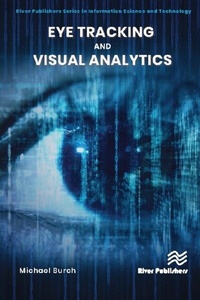
Eye Tracking and Visual Analytics
1st Edition
Published on 1. September 2022
300 pages
978-1-000-79672-8 (ISBN)
Description

Visualization and visual analytics are powerful concepts for exploring data from various application domains. The endless number of possible parameters and the many ways to combine visual variables as well as algorithms and interaction techniques create lots of possibilities for building such techniques and tools.
The major goal of those tools is to include the human users with their tasks at hand, their hypotheses, and research questions to provide ways to find solutions to their problems or at least to hint them in a certain direction to come closer to a problem solution. However, due to the sheer number of design variations, it is unclear which technique is suitable for those tasks at hand, requiring some kind of user evaluation to figure out how the human users perform while solving their tasks.
The technology of eye tracking has existed for a long time; however, it has only recently been applied to visualization and visual analytics as a means to provide insights to the users' visual attention behavior. This generates another kind of dataset that has a spatio-temporal nature and hence demands for advanced data science and visual analytics concepts to find insights into the recorded eye movement data, either as a post process or even in real-time.
This book describes aspects from the interdisciplinary field of visual analytics, but also discusses more general approaches from the field of visualization as well as algorithms and data handling. A major part of the book covers research on those aspects under the light and perspective of eye tracking, building synergy effects between both fields - eye tracking and visual analytics - in both directions, i.e. eye tracking applied to visual analytics and visual analytics applied to eye tracking data.
Technical topics discussed in the book include: * Visualization; * Visual Analytics; * User Evaluation; * Eye Tracking; * Eye Tracking Data Analytics;
Eye Tracking and Visual Analytics includes more than 500 references from the fields of visualization, visual analytics, user evaluation, eye tracking, and data science, all fields which have their roots in computer science.
Eye Tracking and Visual Analytics is written for researchers in both academia and industry, particularly newcomers starting their PhD, but also for PostDocs and professionals with a longer research history in one or more of the covered research fields. Moreover, it can be used to get an overview about one or more of the involved fields and to understand the interface and synergy effects between all of those fields. The book might even be used for teaching lectures in the fields of information visualization, visual analytics, and/or eye tracking.
The major goal of those tools is to include the human users with their tasks at hand, their hypotheses, and research questions to provide ways to find solutions to their problems or at least to hint them in a certain direction to come closer to a problem solution. However, due to the sheer number of design variations, it is unclear which technique is suitable for those tasks at hand, requiring some kind of user evaluation to figure out how the human users perform while solving their tasks.
The technology of eye tracking has existed for a long time; however, it has only recently been applied to visualization and visual analytics as a means to provide insights to the users' visual attention behavior. This generates another kind of dataset that has a spatio-temporal nature and hence demands for advanced data science and visual analytics concepts to find insights into the recorded eye movement data, either as a post process or even in real-time.
This book describes aspects from the interdisciplinary field of visual analytics, but also discusses more general approaches from the field of visualization as well as algorithms and data handling. A major part of the book covers research on those aspects under the light and perspective of eye tracking, building synergy effects between both fields - eye tracking and visual analytics - in both directions, i.e. eye tracking applied to visual analytics and visual analytics applied to eye tracking data.
Technical topics discussed in the book include: * Visualization; * Visual Analytics; * User Evaluation; * Eye Tracking; * Eye Tracking Data Analytics;
Eye Tracking and Visual Analytics includes more than 500 references from the fields of visualization, visual analytics, user evaluation, eye tracking, and data science, all fields which have their roots in computer science.
Eye Tracking and Visual Analytics is written for researchers in both academia and industry, particularly newcomers starting their PhD, but also for PostDocs and professionals with a longer research history in one or more of the covered research fields. Moreover, it can be used to get an overview about one or more of the involved fields and to understand the interface and synergy effects between all of those fields. The book might even be used for teaching lectures in the fields of information visualization, visual analytics, and/or eye tracking.
More details
Edition
1. Auflage
Language
English
Place of publication
London
United Kingdom
Publishing group
Taylor & Francis Ebooks
Target group
Professional and scholarly
Product notice
Reflowable
ISBN-13
978-1-000-79672-8 (9781000796728)
Copyright in bibliographic data and cover images is held by Nielsen Book Services Limited or by the publishers or by their respective licensors: all rights reserved.
Schweitzer Classification
Other editions
Additional editions
Michael Burch
Eye Tracking and Visual Analytics
Book
10/2024
1st Edition
River Publishers
€59.50
Article not available for order
Michael Burch
Eye Tracking and Visual Analytics
Book
10/2021
1st Edition
River Publishers
€176.40
Article not available for order
Person
Michael Burch
Content
Preface List of Figures List of Tables List of Abbreviations 1 Introduction 2 Visualization 3 Visual Analytics 4 User Evaluation 5 Eye Tracking 6 Eye Tracking Data Analytics 7 Open Challenges, Problems, and Difficulties References Index About the Author
