

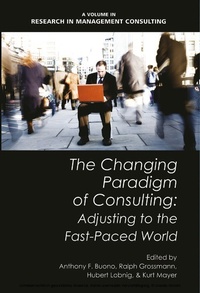
The Changing Paradigm of Consulting
Adjusting to the Fast-Paced World
1st Edition
Published on 1. May 2011
465 pages
978-1-61735-419-9 (ISBN)
Description

The 13th volume in the RMC series, The Changing Paradigm of Consulting, is based on the best papers presented at the Academy of Management's Management Consulting Division's fourth international conference (2009) on the underlying dynamics within the fast-paced world of business and management consulting. Held in Vienna, Austria, the conference brought together academicians, consultants and organizational practitioners to examine the changes taking place within the consulting field. The book's 19 chapters are divided into five sections that explore the emergence and implications of this new paradigm, delineating and illustrating the paradigm shift taking placing within consulting, exploring the ramifications for global consulting, examining the challenges inherent in attempts to capture collaboration and cooperation in inter-organizational networks, analyzing the push toward the professionalization - and professionalism - of consultancy, and assessing new approaches to management consulting, focusing on innovative instruments, tools and intervention frameworks. The book captures the myriad complexities and uncertainties faced by consultants and their clients and the concomitant search for appropriate mindsets, attitudes and orientations as well as methods, tools and techniques. As each of the chapters indicates, while there are significant challenges facing the consulting industry, there are also a number of promising frameworks and approaches that can help us successfully meet these challenges.
All prices
More details
Other editions
Additional editions
Anthony F. Buono | Ralph Grossman | Hubert Lobnig
The Changing Paradigm of Consulting
Adjusting to the Fast-Paced World
Book
05/2011
Information Age Publishing
€76.60
Article not available at the moment
Content
- Front Cover
- The Changing Paradigm of Consulting
- Adjusting to the Fast-Paced World
- A volume in Research in Management Consulting
- Series Editor: Anthony F. Buono, Bentley University
- CONTENTS
- Part I: The ParadigM shift in consulting
- 1. Delineating the Paradigm Shift
- 2. Expert Versus Process Consulting: Changing Paradigms in Management Consulting in Germany
- 3. Complementary Consulting: The Only Real Option for Managers
- 4. Changing the Paradigm of Crisis Management: How to Put OD in the Process
- Part II: consulting in a global context
- 5. Strategy Work in an International Setting
- 6. Organizational Development Across Borders and Cultures: A Solution-Oriented Systemic OD-Approach
- 7. Speculation on the Process and Practice of Organization Development in Hostile Environments
- Part iiI: collaboration, cooperation, and networks in consulting
- 8. Toward a Multidimensional View on Collaborative Processes: A Case Study of an International Alliance Formation
- 9. Beyond the Organizational Focus: Network Consulting in Regional Clusters
- 10. Focusing the Network Business Case: Making Use of Teamwork-Key Issues in Collaborative Systems and Consulting Networks
- 11. Consulting Interorganizational Relations: Collaboration, Organization Development, and Effectiveness in the Public Sector
- Part iv: in search of professionalism in management consulting
- 12. Critically Exploring Business Engagement in Academia: The Case of the U.K. Consulting Industry
- 13. Challenging Universal Criteria in Management Consulting: When Practices Meet Prescriptions
- 14. Developing Expertise and Social Standing in Professional Consulting
- 15. Acting as a Long-Term Consultant: Challenges for Professional Practice
- Part v: NEW APPROACHES TO MANAGEMENT CONSULTING: fRAMEWORKS, TOOLS, AND INSTRUMENTS
- 16. Solution-Preventing Tools Versus Solution-Supporting Tools
- 17. Maturity Grids as Tools for Change Management: Practitioner Guidance Through Field Experience
- 18. Consulting by Expertise in Organization Science: A Special Use of OD Know-How for Transorganizational Collaboration Systems in Public Services
- 19. Management Consultant Interaction With Private Equity: The Impact on Growth Development Patterns in Southeastern Europe
- Research in Management Consulting
- The Changing Paradigm of Consulting
- Adjusting to the Fast-Paced World
- edited by
- Anthony F. Buono Bentley University
- Ralph Grossmann University of Klagenfurt, Austria
- Hubert Lobnig Lemon Consulting
- and
- Kurt Mayer M/O/T School of Management, Organizational Development and Technology, Austria
- Information Age Publishing, Inc.
- Charlotte, North Carolina www.infoagepub.com
- Introduction
- Anthony F. Buono
- THE CHANGING PARADIGM OF CONSULTING
- The Paradigm Shift in Consulting
- Consulting in a Global Context
- Collaboration, Cooperation, and Networks in Consulting
- In Search of Professionalism in Management Consulting
- New Approaches to Management Consulting: Frameworks, Tools and Instruments
- ADJUSTING TO THE FAST-PACED WORLD
- REFERENCES
- PART I
- The ParadigM shift in consulting
- Table 1.1 Dimensions of Consulting Services
- Figure 1. 1. A portfolio of organizational consultancy.
- Delineating the Paradigm Shift
- Ralph Grossmann
- EXPERT VERSUS PROCESS CONSULTING APPROACHES
- Offering Know-How and Expertise Versus Facilitating the Process
- Introducing Expert-Based External Solutions Versus Developing Options With the System
- Diagnosing Problems Versus Supporting the Development and Implementation of Solutions
- Consulting the Management Versus Consulting the Whole System
- Performing Change as a Rational Process Versus Offering Containment, Helping to Express Emotions
- Buying Consulting Services Versus Building Trusting Relationships
- Conceptualizing Organizations and the Concepts of Change
- Linear Systems Versus Self-Developing Systems
- Growing Complexity Requires Systemic Approaches
- Innovative Organizational Patterns
- Developing the Capability for Change and Organizational Capability
- A Portfolio of Organizational Consultancy
- Content
- Process: Communication Structures
- Containment
- Time/Rhythm
- CONCLUSION
- NOTE
- References
- CHAPTER 1
- Figure 2. 1. Linear relation of environment and organization.
- Figure 2. 2. A circular relation of environment and organization.
- Table 2.1. Patterns of Strategy Development
- Expert Versus Process Consulting
- Changing Paradigms in Management Consulting in Germany1
- Thomas Schumacher
- Organization: CONSULTING's blind spot?
- The Rationalistic Approach
- The Constructivist Paradigm
- Illustration: Organizational Patterns in Strategy Development and the Role of the Consultant
- The role of the consultant in the two paradigms
- "The Lives of Others": How One Consulting Paradigm Views the Other
- The Paradigms in Management Consulting
- The Role of Consulting in a Self-Organizing System
- Changing Client Expectations: Unwilling Consultants?
- Changing paradigms or paradigmatic change?
- Content and Process: Will They Truly Meet?
- Conclusion
- NOTES
- references
- CHAPTER 2
- Table 2.2. Assumptions of Expert and Process Consulting
- Table 2.3. Characteristics of Expert and Process Consulting
- Figure 2. 3. Degree of expert and process orientation in different consulting.
- Figure 2. 3. Degree of expert and process orientation in different consulting.
- Figure 2. 6. The Tetralemma.
- Figure 2. 5. Process model for the concept of integrated consulting.
- Table 3.1. Interventions in Different Forms of Consulting
- Table 3.2. Integration-Complementarity in Managerial Decision-Making Processes
- Complementary Consulting
- The Only Real Option for Managers
- Othmar Sutrich and Martin Hillebrand
- SETTING THE SCENE FOR INTEGRATION AND COMPLEMENTARITY
- FIVE KEY ISSUES
- Managing Complexity: Problem or Solution?
- Organizational Awareness: A Strong Answer to Weak Signals
- The Current Crisis: A Strong Signal, Major Threat and Great Opportunity
- Handling Both the Threat and Opportunity in Risk
- Responsibility and Organizational Sustainability
- SEVEN PREMISES
- Premise 1: Complexity, Uncertainty, Risk, and the Speed of Change: Implications for New Forms of Decision Making and Consulting
- Premise 2: The Acceptance of Complementary Consulting
- Premise 3: Complementarity, Energy, and Complementary Consulting
- Premise 4: System Diagnosis
- Premise 5: Calculating More Quickly While Deciding More Slowly9
- Premise 6: Linking Complementary Consulting With Decision Making and Organizational Learning
- Premise 7: Consulting as a Cooperative Process
- COMPLEMENTARY CONSULTING IN PRACTICE
- Case Study 1: Complementary Consulting as a Craft-Help in Times of Crisis
- Case Study 2: The Need for Compensation in Systemic Processes
- Leitmotifs in Complementary Consulting
- Compensation: Filling in the Know-How Gaps in the Client System
- Compensation in Practice
- Compensation and Decision Making
- 1. Managers can be shown (both on a personal and a role-based level) the most constructive way of complementing each other through their different styles of decision making (i.e., the way they prefer to handle decisions
- see Lanzenberger & Sutrich, 2...
- 2. The people in the many different kinds of teams that build bridges between individuals and organizations can develop greater awareness of and willingness to complement each other by providing different perspectives on the actual decision to be made.
- 3. On the organizational level, consultants with a systemic attitude can provide complementary know-how, for instance, linking operational short-term performance improvements with strategy and the long-term fostering and development of organizational...
- Attitude
- The Reality of Decision making in Organizations
- acknowledgment
- NOTES
- References
- CHAPTER 3
- Figure 3. 1. The systemic loop (see Königswieser & Exner, 2002).
- Figure 3. 2. Decision process map.
- Figure 3. 3. Oscillating between traditional business consulting and systemic process consulting.
- Figure 3. 4. The Pentaeder model of the decision-making space in organizations.
- Figure 3. 5. The dimensions of compensation.
- Table 4.1. Diagnosis of Crisis Management Practices
- Changing the Paradigm of Crisis Management
- How to Put OD in the Process
- Carole Lalonde
- A DIAGNOSIS BASED ON FIVE CRISES
- Classification of the Material
- Research Questions
- 1. Do the crisis management approaches in the five cases reflect the guiding principles outlined in the literature in terms of planning and preparation, coordination, leadership, and the behavior of civil society?
- 2. What are the most common failings?
- 3. What type of contribution can OD make to enhance crisis management effectiveness and efficiency?
- RESULTS
- Planning/Preparedness
- Coordination
- Leadership
- Civil Society's Behavior
- Summary
- Conceptualizing an OD-BASED model for crisis management
- OD for crisis planning and preparedness
- OD for crisis coordination
- od for Crisis Leadership
- od for Civil Behavior in Face of Crises
- Conclusion
- Acknowledgment
- NOTES
- References
- CHAPTER 4
- Figure 4. 1. Resilience and crisis management.
- Part II
- Consulting in a global context
- Figure 5. 1. The new organizational design of ICL.
- Table 5.1. The New Organizational Design of ICL
- Strategy Work in an International Setting
- Entangling Top-Down and Bottom-Up Approaches via Continuous Conversations, Learning Cycles, and Semifinished Instruments
- Hubert Lobnig
- The context
- Creating the Approach
- Designing the Process
- The Kick-off Meeting: Unorthodox Methods in an Unclear Situation
- Applying strategic tools as "semi-finished instruments"
- Selecting and Tailoring the Instrument
- Analyzing Competitors: From Semifinished Instruments to Strategic Results
- Step 1: Defining Relevant Indicators for Comparison
- Step 2: Defining the Most Relevant Competitors
- Step 3: Assessing One's Own Company "in the Eyes of the Customer"
- Step 4: Assessing Selected Key Competitors "in the Eyes of the Customer"
- Step 5: Drawing Conclusions
- Step 6: Presenting the Results
- Integrating strategy consulting and organizational development: appropriate models and intervention tactics
- Setting the Context and Elaborating the Frame
- Focusing Learning and Meeting Resistance to Learn
- Guiding the Transfer and Anchors to the Home Base
- Conclusion
- acknowledgment
- References
- CHAPTER 5
- Table 5.2. Tool Kit of Strategic Instruments
- 2. Local teams are called to exchange views and perspectives ("everyone sees a bit of the elephant")
- 3. Recognize previously undisclosed options or threats.
- 2. Prioritizing a list of key indicators relevant for real estate leasing-helps to get a first orientation "at a glance."
- 2. Inventing that description in the group is a direct way of professional "sensemaking" -within the country units and across the whole company.
- 2. Performed in teams, it helps to create a strategic overview of the dynamics of the environment and the situation of the unit
- 3. Honest assessments inevitably lead to options for action.
- 2. Realistic assessment requires knowledge but also assumptions from the team
- 3. Teams learn how to assemble "subjective assumptions" into a more complete picture.
- 2. Provide key figures relevant for strategic decisions
- 3. Teams learn how qualitative assessments can be translated into financial planning.
- 2. Easy to compile, allows differentiation in the assessment
- 3. Compiles and evaluate the data in order to formulate a set of strategic directions for the country units.
- Table 5.3. Selected Indicators for Comparison
- Figure 5. 2. Process and intervention design.
- Table 5.4. "The Run of the Fire Brigade"
- Table 6.1. Problem-Oriented and Solution-Oriented Approaches
- Figure 6. 1. TSS: Higher-order learning in an intercultural team.
- Figure 6. 2. The cocreation of a consulting system.
- Organizational Development Across Borders and Cultures
- A Solution-Oriented Systemic OD Approach
- Marlies Lenglachner and Manfred Madl
- THEORETICAL CONCEPTS AND TOOLS
- The Solution-Oriented Systemic OD Approach
- 1. Systems are automatically organized within their own unique contexts that generate their specific meaning, culture, and language in accordance with their own rhythm (see Luhmann, 1996
- Maturana & Poerksen, 2004).
- 2. Systems are organized around business objectives, their solutions and their problems.
- 3. Systems develop their own characteristic internal logic and maintain it and interact with their environment accordingly.
- Solution-Oriented Attitude
- Higher-Order Learning
- coCreating a Higher-Order Learning Architecture
- Cocreation
- Experiential Learning
- The Change for More Approach
- The Seven Steps of Change for More
- 1. Starting situation, organizational diagnosis, environmental analysis, and definition of goals
- 2. Kick off, establishment of consulting system, definition of status quo and goals, and commitment
- 3. TSS roles, rules, and learning steps
- 4. TSS continuation, self-reflexive learning steps
- 5. Experiential learning exercise, environmental expectations
- 6. TSS cultural aspects, specific tools, and learning outcomes
- and
- 7. Lessons learned, conclusion, feedback, feed forward, and farewell ceremony.
- Fundamental Aspects of the Solution-Oriented Systemic OD Approach
- TEAM STAR for SUCCESS: TSS
- The Art of Solution-Oriented Systemic Leadership in Managing Across Cultures
- CASE STUDY
- Preparation Phase
- Learning Architecture
- Overview of Team Development Process
- Team Development Station 1: Kick-Off (September)
- 1. How do we see ourselves as a team?
- 2. Where are we now as a team?
- 3. Where do we want to go as a team and what do we need?
- Team Development Station 2 (November)
- Team Development Stations 3 and 4 (February/March)
- Team Development Station 5 (June)
- 1. What do I appreciate most about you in the BUMT?
- 2. What I would like to have more of you in the BUMT?
- Team Development Stations 6 and 7 (September/November)
- Masterpiece for All BUMT-Members
- Follow-Ups 1 and 2 (1 and 2 Years Later)
- CONCLUSION
- NOTE
- REFERENCES
- CHAPTER 6
- Table 6.2. Attitudes Toward Change: Discussion and Dialogue Orientations
- Figure 6. 3. Toward a solution-oriented change approach.
- Figure 6. 4. The Team Star for Success.
- Figure 6. 6. Overview of the team development process.
- Figure 6. 5. Composition of the business unit management team.
- Speculation on the Practice and Process of Organization Development in Hostile Environments
- Thomas C. Head, Peter F. Sorensen, Jr., and Therese F. Yaeger
- PASSIVE/DEFENSIVE CULTURAL VALUES
- Approval
- Conventional
- Dependent
- Avoidance
- AGGRESSIVE/DEFENSIVE CULTURAL VALUES
- Oppositional
- Power
- Competitive
- Perfectionistic
- CONCLUSION
- REFERENCES
- CHAPTER 7
- Toward a Multidimensional View on Collaborative Processes
- A Case Study of an International Alliance Formation
- Raymond P. A. Loohuis and Aard J. Groen
- THEORY
- The Adaptive Function
- The Goal Attainment Function
- The Integrative Function
- The Pattern Maintenance Function
- RESEARCH CONTEXT
- Alliance Design
- Research Methods
- Research Participants
- RESEARCH RESULTS AND OUTCOMES
- The Postformation Period
- DISCUSSION AND CONCLUSION
- NOTE
- References
- CHAPTER 8
- Table 8.1. The Four Functions: Mechanisms, Resources, and Managerial Interventions
- Figure 8. 1. The four functions of alliance conditions and three main phases of the alliance life cycle.
- Table 8.2. Literature Supporting the Processes Within the Four-dimensional Framework
- Figure 8. 2. Comparison of the two partners on each AGIL dimension.
- Table 8.3. Summarized Results of the Workshops
- part iii
- COLLABORATION, COOPERATION, AND NETWORKS IN CONSULTING
- Table 9.1. Network Consulting Versus Consulting Organizations
- Figure 9. 1. Multilevel approach in (analyzing) consulting networks in clusters.
- Figure 9. 2. Schematic representation of the XRA-Tech Network* within the Optics cluster in Berlin-Brandenburg displaying multiple embeddedness at different levels.
- Beyond the Organizational Focus
- Network Consulting in Regional Clusters
- Frank Lerch, Jörg Sydow, and Stephan Duschek
- SETTING THE STAGE: CONCEPTUAL THOUGHTS ON NETWORK CONSULTING
- Definitions and Characteristics
- Network Consulting in Clusters: A Very Peculiar Context
- RESEARCH SITE AND METHODOLOGY
- Research Setting
- A REFLEXIVE multiLEVEL APPROACH TO NETWORK CONSULTING IN CLUSTERS
- Consulting on Cluster Development
- Consulting on Network Development in Clusters
- Recursive Interplay Between Network and Cluster Development
- CONCLUSION
- NOTES
- REFERENCES
- CHAPTER 9
- Figure 9. 3. Reflexive network and cluster development process in five phases.
- Table 10.1. Consulting in Collaborative Systems
- Figure 10. 1. The Grossmann-Lobnig model for networks and collaborations.
- Focusing the Network Business Case
- Making Use of Teamwork-Key Issues in Collaborative Systems and Consulting Networks
- Hubert Lobnig
- Preparing the business case
- The Vienna Network for Workplace Health Promotion
- First Hypotheses
- Interviews With the Partnering Organizations
- First Workshop
- Reporting Back and Anchoring in the Home Organizations
- Finalizing the Business Case at the Second Workshop
- Making use of teamwork
- Facility Management Austria: Applying Team-Work to Leverage the Network
- The Planning Workshop
- The Kick-Off Workshop
- Review Meeting
- Lessons Learned
- Conclusions
- acknowledgments
- References
- CHAPTER 10
- Table 10.3. Agenda for the 2nd Workshop of the Viennese Network
- Table 10.3. (Continued)
- Table 10.2. The First Workshop of the Viennese Network for Workplace Health Promotion
- Table 10.4. FMA Task Force Model
- Figure 11. 1. Preliminary project set-up.
- Figure 11. 2. Different levels of cooperative commitment.
- Figure 11. 3. Diagnostic/proposition and decision making/safeguarding work project vessels.
- Figure 11. 4. Project set-up.
- Consulting Interorganizational Relations
- Collaboration, Organization Development, and Effectiveness in the Public Sector
- Ralph Grossmann, Karl Prammer, and Christian Neugebauer
- the Case Study
- Project Design
- Preliminary Design Study
- Simultaneous Focus
- Cooperation Commitment
- Project Effectiveness
- Parallel Transfer of Solutions
- Creating Cooperative Space
- Mode of Operation
- The Set-Up
- Methods of Operation
- The Transfer Committee
- Piloting and Evaluation
- SYSTEMWIDE IMPLEMENTATION: Securing the Long-Term Effect
- Conclusion
- References
- CHAPTER 11
- Figure 11. 5. Results for "discharge management" in districts in Cluster A: Process Step 1.
- Figure 11. 6. The developed cooperation structure.
- Table 12.1. Published Literature by Theme (2000-2008): Social Science Citation Index, January 2008
- Table 12.2. Analysis of Remaining Consultancy Articles
- Critically Exploring Business Engagement in Academia
- The Case of the U.K. Consulting Industry
- Joe O'Mahoney and Richard Adams
- An Arranged Marriage or True Love?
- Methodology
- U.K. Consultancy Challenges
- Strategic Change
- Operations Management
- Procurement
- People Management
- Innovation Management
- The Limits and Opportunities of Engagement
- Sector Analyses
- Practitioner Guidance/Case Studies
- Rhetoric, Control, and Identity
- Professionalization
- Summary
- acknowledgments
- NOTES
- References
- CHAPTER 12
- Part iv
- IN SEARCH OF PROFESSIONALISM IN MANAGEMENT CONSULTING
- Table 13.1. The Pros and Cons of Universal Success Criteria in Management Consulting: Summary of Contributions
- 1. Consultant's integrity, honesty and/or objectivity
- 2. Client's commitment to accomplish the mandate
- 3. Definition of a clear mandate
- 4. Client's maintenance of control in the fulfilment of the mandate
- 5. Relevance of consultant's skills regarding the assignment and the insertion in the profession as a whole
- 6. Fit or harmony in the client-consultant relationship
- 7. Importance of clarifying the responsibilities of both sides
- 8. Atmosphere of mutual respect and trust
- 9. Transferability of skills from consultants to client and/or improvement in client capabilities
- 10. Commitment and experience of team members
- 11. Understanding of the internal and external environment of the client's organization
- Table 13.2. Analysis of the Cases Through The Universal Success Factors Perspective
- 1. Consultant integrity
- 2. Client involvement
- 3. Clear agreement
- 4. Client control
- 5. Consultant competence
- 6. Interpersonal fit
- 7. Clarity responsibilities of both sides
- 8. Respect and trust
- 9. Transferability of skills
- 10. Role of team members
- 11. Understanding of the internal and external environment of the client's organization
- Table 13.3. Analysis of the Cases Through the Critical Incidents Perspective
- Challenging Universal Criteria in Management Consulting
- When Practices Meet Prescriptions
- Carole Lalonde
- Case 1: Sainte-Camille social services for youth centre
- Case 2: Hirondelles Health Centre
- AnalysIS of the two cases
- Analysis of Universal Success Factors
- Analysis of Critical Incidents
- Expert Commentary
- The Importance of First and Diversified Contacts
- The Identification of the Client System is Crucial in Professional Bureaucracies
- The General Director's Underlying Motivations: Being Able to Go Beyond the Surface
- The Management Team's Dynamic and the Collective Character of Leadership in Professional Bureaucracies
- Utilization of the Consultant's Skills
- Student Commentary
- The Client-Consultant Relationship Dynamic
- The Consultant's Objectivity
- Lessons Learned: Reflecting on the Case Studies
- Conclusion
- acknowledgments
- NOTES
- References
- CHAPTER 13
- Figure 14. 1. Structure of the development process in phase 1.
- Figure 14. 2. Structure of the development process: Phases 1 and 2.
- Figure 14. 3. Structure of the complete development process.
- Developing Expertise and Social Standing in Professional Consulting
- Alfred Janes
- LEVELS OF KNOWLEDGE AND EXPERTISE
- Level 1: The Basis for Expert Know-How
- Level 2: General Process Models of Knowledge-Based Services
- 1. Generally, how was the consulting process structured (architecture, macro level)?
- 2. How were individual sections of the consulting task actually realized
- what instruments and methods were used for the task (design, mesolevel)?
- 3. What happens if something "didn't go the way it's supposed to" (intervention, microlevel)?
- Level 3: Personal Linking Patterns Between Expert Know-How and General Process Models of Knowledge-Based Services
- Developing professional know-how in the working life of a consultant
- Phase 1: Imprinting
- Professional Islands
- Phase 2: Optimizing the Professional Standard (Optimization)
- Professional Islands
- Phase 3: Innovation
- First Path: Confrontation with "Out-of-the-Box" Thinkers
- Second Path: Planned Structured Dialog Processes Between Colleagues ("Presencing")
- Professional Islands
- CONSULTANT KNOW-HOW AND THE PROFESSION OF CONSULTING: Some Considerations on the Social Standing of Consulting
- International Certification and Consulting's Social Standing
- Consulting as a Profession
- References
- CHAPTER 14
- Acting as a Long-Term Consultant
- Challenges for Professional Practice
- Dagmar Untermarzoner
- Shaping the profile of the long-term consultant
- Dilemmas in Short-Term Consulting
- Way Out 1: The Consultant as "Service Provider"
- Way Out 2: Consulting as a "Competitive Discipline"
- Way Out 3: The Consultant as "Transcendental Therapist"
- Attitudes of Long-Term Consulting
- Understanding the Client's Business
- Opening the Client to the Idea of the General Development of the Organization
- Integrating Strategic Processes and Personnel Development
- Investing in Cooperative Bonding: Specifics of the Client-Consultant Relationship in Long-Term Consulting
- Investing in Cooperation: Suspending Ambivalence
- Developing Cooperation
- Integrating Intimate and Strategic Interactions
- Constrained Relationships and Unsuccessful Change
- Bonding With the People in the Client's Organization
- The Consultant's Business Model: Implicit and Explicit Aspects of Running the Business
- Typical Patterns in Assignment
- Different Phases
- Types of Clients
- Managing One's Calendar
- Stepping Back as Developmental Intervention
- Expanding the Consultant's Team
- Copyright: Ownership of Ideas and Concepts
- FINAL comments: Qualification profile of the long-term consultant
- ACKNOWLEDGMENT
- References
- CHAPTER 15
- part v
- new approaches to management consulting: Frameworks, tools, and Instruments
- Figure 16. 1. Stability versus variability of dimensions.
- Solution-Preventing Tools Versus Solution- Supporting Tools
- Guenter Lueger and Peter Steinkellner
- THE RBV OF THE FIRM AND HRM
- EFFECTS OF TRADITIONAL PERFORMANCE APPRAISAL METHODS
- THE CREATION OF A "nonCHANGEABILITY TRANCE" THROUGH TRADITIONAL HR INSTRUMENTS
- Solution-Focused Assessment
- Evaluation of Solution Supporting Tools
- CONCLUSION
- ACKNOWLEDGMENTS
- REFERENCES
- CHAPTER 16
- Figure 16. 2. Difference-oriented analysis.
- Table 17.1. The Quality Management Maturity Grid
- Figure 17. 1. Phases and decision points of roadmap to develop maturity grids.
- Maturity Grids as Tools for Change Management
- Practitioner Guidance Through Field Experience
- Anja M. Maier, James Moultrie, and P. John Clarkson
- maturity grids as tools for change management
- Objectives
- Structure
- Maturity grids: origins, examples, benefits, and shortcomings
- Origins
- Work Orientation
- Mode of Assessment
- Intent
- Examples of Maturity Grids
- Organizational Culture
- Team Management
- Risk Management
- Data Management
- Benefits of Using Maturity Grids
- Supporting Creation of a High-Performance Environment
- Eliciting Different Perspectives
- Providing and Stimulating Reflection
- Providing a Guide for Decisions and Identifying Areas for Improvement
- Flexibility
- Speed
- Shortcomings of Maturity Grids
- Oversimplifying Complex Issues
- Lack of Causal Connections
- Implied Approaches to Change
- Developing and applying maturity grids: A Roadmap with four phases and decision points
- Two examples: The Design Audit and the Communication Grid Method
- The Design Audit
- Planning: Audience, Aim, Scope, and Success Criteria
- Development: Process Areas, Maturity Levels, Cell Descriptions and Administration Mechanisms
- Evaluation and Maintenance
- The Communication Grid Method
- Planning: Audience, Aim, Scope, and Success Criteria
- Development: Process Areas, Maturity Levels, Cell Descriptions, and Administration Mechanisms
- Evaluation and Maintenance
- Summary and conclusions
- ACKNOWLEDGMENTS
- References
- CHAPTER 17
- Table 17.2. Excerpt of the Design Audit: Summary Grid for "Requirements Capture"
- Table 17.3. Excerpt of the Design Audit: Detailed Grid of "Market Segmentation"
- Table 17.4. Excerpt of the Communication Grid Method: Grid for "Teamwork"
- Figure 18. 1. Dynamic and intermodal routing service for park and ride: Suggesting a route in response to user request.
- Figure 18. 2. From VEMA to ITS.
- Figure 18. 3. Double project structure of ITS and VIP.
- Figure 18. 4. ITS and its important environments.
- Consulting by Expertise in Organization Science
- A Special Use of OD Know-How for Transorganizational Collaboration Systems in Public Services
- Klaus Scala, Michael Stadlober, and Hans Fiby
- Collaboration Systems: A New Phenomenon of Organizing
- ITS VIENNA REGION: COOPERATIVE TRAFFIC CONTROL MANAGEMENT ACROSS SYSTEM BORDERS
- Key Success Factor I: Organizing Collaboration as an Independent Social System
- Key Success Factor II: Emphasizing and Balancing the Benefits for Stakeholders
- THE ROLE OF CONSULTING: NEW CHALLENGES
- A CONSULTING MODEL FOR TRANSORGANIZATIONAL VENTURES
- acknowledgment
- CHAPTER 18
- Figure 18. 5. A model of transorganizational consulting.
- Figure 19. 1. The transaction process.
- Figure 19. 2. Boliari EAD-Deal details.
- Figure 19. 3. Changes in market activity expectations.
- Figure 19. 4. Interaction and impact on growth development patterns in Southeast Europe.
- Management Consultant Interaction With Private Equity
- The Impact on Growth Development Patterns in Southeastern Europe
- Viktor Manev, Elena Todorova, and Milen Manev
- CRISIS, UNCERTAINTY, AND MANAGEMENT CONSULTANTS IN Southeastern EUROPE
- Precrisis Scenario
- Private Equity Funds: Business Model
- Management Consultancy Firms: Business Model
- Interaction and Impact on the Growth Patterns in South East Europe
- Current Market Overview: Southeastern Europe
- Banking System and Eastern Europe Borrowings
- Financial Flows
- PE Funds Focus Areas
- CHANGING BUSINESS MODELS
- The Private Equity Fund Business Model
- Knowledge Management
- Execution
- The Management Consulting Business Model
- Knowledge Transfer
- Execution
- CONCLUSION
- APPENDIX
- REFERENCES
- CHAPTER 19
- About the Authors
- Back Cover

