

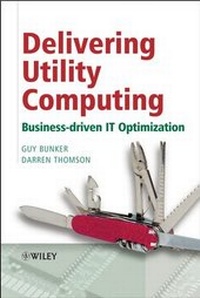
Delivering Utility Computing
Description

More details
Other editions
Additional editions
Persons
Content
About the Authors.
Foreword.
Acknowledgments.
Who Should Read This Book and Why?
List of Figures.
List of Tables.
Part One: Introducing Utility Computing.
1 Introduction.
2 What is Utility Computing?
2.1 Overview.
2.2 The Changing Role of IT.
2.3 Utility Computing.
2.4 Return on Investment.
2.5 Why Now?
2.6 It is Not All or Nothing.
2.7 Further Implications of Utility Computing.
2.8 Summary.
Reference.
3 Historical Trends, or 'Is Utility Computing Really New?'
3.1 Overview.
3.2 Back to the Beginning.
3.3 Connectivity: The Great Enabler.
3.4 The Web and the Return to Utility Computing.
3.5 Pay-As-You-Grow Data Processing.
3.6 Utility Computing and the Industry.
3.7 Summary.
4 The Utility Model in Detail.
4.1 Overview.
4.2 The Essentials of a Utility.
4.3 The Utility Model in Detail (An Analogy).
4.4 Should Information Services Be any Different?
4.5 Summary.
5 Service Level Agreements.
5.1 Overview.
5.2 An Everyday Event.
5.3 Defining Services and the Service Level Agreement.
5.4 Creating Complex Services.
5.5 Managing Services.
5.6 Sharing Risk with Suppliers.
5.7 Summary.
Part Two: Transformational Modeling.
6 Project Justification and Focus.
6.1 Overview.
6.2 Business Drivers and Project Justification.
6.3 How to Find Where to Start.
7 The Utility Computing Reference Model.
7.1 Overview.
7.2 The Service Layer.
7.3 The Process Layer.
7.4 The Organizational Layer.
8 A Maturity Model for Utility Computing.
8.1 Overview.
8.2 The Maturity Levels in Detail.
8.3 Creating a Utility Computing Scorecard.
8.4 Moving Up the Maturity Model (Generic Tasks).
9 A Transformational Approach.
9.1 Overview.
9.2 The Prepare Phase.
9.3 The Model Phase.
9.4 The Transform Phase.
9.5 The Operate/Innovate Phase.
10 Technology for Utility Computing.
10.1 Overview.
10.2 Virtualization.
10.3 Performance Monitoring.
10.4 Reporting.
10.5 Automation.
10.6 Chargeback Accounting.
10.7 Service Level Management.
10.8 Hardware.
10.9 Summary.
Reference.
Part Three: Implications of Utility Computing.
11 Cultural Implications.
11.1 Overview.
11.2 What to Expect, Getting Ready for Transformation.
11.3 Moving From Asset Ownership to Service Level Agreements.
11.4 Effective Corporate Communications.
11.5 Summary.
12 Developing a Successful Adoption Strategy.
12.1 Overview.
12.2 Types of Adoption Strategy.
12.3 Choosing a Partner.
12.4 The Comparison to Outsourcing.
12.5 Security.
12.6 Good Targets for Utility Computing Adoption.
12.7 Brown Field Versus Green Field Opportunities.
12.8 Using IT Consolidation as a Starting Point.
12.9 Summary.
13 Future Trends.
13.1 Overview.
13.2 Standards.
13.3 Packaged Solutions.
13.4 Service-Oriented Architecture.
13.5 Virtualization.
13.6 The End of Applications as we Know Them?
13.7 Grid Computing.
13.8 The Future: An Object Application Environment?
13.9 Summary.
14 Afterword: Avoiding the Pitfalls.
14.1 Overview.
14.2 Returning to Chaos.
14.3 Innovation.
14.4 Summary.
Appendix A: Case Studies.
A.1 Case Study: Dartmouth College's Campus-Wide Backup Utility.
A.2 Case Study: Digital TV Co's Disaster Recovery Utility.
A.3 Case Study: Arsenal Digital Solutions' Information Storage Utility.
A.4 Case Study: A Telecommunications Server and Application Utility.
Appendix B: Utility Computing Planning Forms.
B.1 Baselining.
B.2 Baselining 2.
B.3 User Department View.
B.4 IT View.
B.5 IT Technology Support.
B.6 IT Planning.
B.7 Cost Savings.
B.8 Hard Metrics.
Appendix C: Initial Utility Computing Reference Model Assessment.
C.1 Utility Reference Model Assessment.
C.2 Plotting Your Utility Assessment Results.
Appendix D: Stakeholders and Objections.
Glossary.
Index.
