

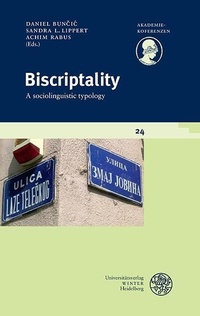
Biscriptality
A sociolinguistic typology
Published on 9. June 2016
425 pages
978-3-8253-7619-2 (ISBN)
Description

Serbs write their language in Cyrillic or Latin letters in seemingly random distribution. Hindi-Urdu is written in Nagari by Hindus and in the Arabic script by Muslims. In medieval Scandinavia the Latin alphabet, ink and parchment were used for texts 'for eternity', whereas ephemeral messages were carved into wood in runes. The Occitan language has two competing orthographies. German texts were set either in blackletter or in roman type between 1749 and 1941. In Ancient Egypt the distribution of hieroglyphs, hieratic and demotic was much more complex than commonly assumed. Chinese is written with traditional and simpli¿ed characters in different countries.
This collective monograph, which includes contributions from eleven specialists in different philological areas, for the ¿rst time develops a coherent typological model on the basis of sociolinguistic and graphematic criteria to describe and classify these and many other linguistic situations in which two or more writing systems are used simultaneously for one and the same language.
More details
Other editions
Additional editions
Book
06/2016
1st Edition
Universitätsverlag Winter
€52.00
Shipment within 5-7 days
Content
- Cover
- Title Page
- Copyright
- Contents
- Foreword by Daniel Buncic
- 1. Introduction (D. Buncic)
- 1.1. Scope of this study
- 1.2. Notes on terminology and conventions
- 1.2.1. Basic concepts
- 1.2.2. Script variants
- 1.2.3. Names for writing
- 1.2.4. Representation
- 2. History of theoretical research on biscriptality (D. Buncic)
- 2.1. The context: Sociolinguistics of writing
- 2.2. Concepts of biscriptality before the advent of sociolinguistics
- 2.2.1. Biscriptal documents
- 2.2.1.1. Greek philology: digraphic
- 2.2.1.2. Numismatics: biscriptu(r)al
- 2.2.1.3. Ancient American and Asian studies: bigraphic
- 2.2.2. Biscriptal languages
- 2.3. Sociolinguistic concepts of biscriptality
- 2.3.1. Concepts modelled on diglossia
- 2.3.2. Concepts independent of diglossia
- 2.3.3. Rare meetings of both traditions
- 2.3.4. The state of the art
- 3. A heuristic model for typology (D. Buncic)
- 3.1. Definition of biscriptality
- 3.2. The sociolinguistic axis: opposition type
- 3.2.1. Privative opposition
- 3.2.2. Equipollent opposition
- 3.2.3. Diasituative variation
- 3.2.4. Summary
- 3.3. The graphematic axis: system level
- 3.4. Synopsis
- 3.5. Adjacent phenomena excluded from the model
- 3.5.1. Biliteracy
- 3.5.2. Complex writing systems and graphic code-switching
- 4. Case studies
- 4.1. Digraphia
- 4.1.1. Medieval Scandinavia: diamesic digraphia (D. Buncic)
- 4.1.2. Early medieval Ireland: medial digraphia (D. Buncic)
- 4.1.3. Luvian: medial, diaphasic and/or diastratic digraphia (D. Buncic)
- 4.1.4. Poljica: diaphasic digraphia (D. Buncic)
- 4.1.5. Xiangnan Tuhua: gender-based digraphia? (D. Buncic)
- 4.1.6. Chinese: emerging digraphia? (D. Buncic)
- 4.1.7. Other cases of digraphia (D. Buncic)
- 4.2. Diglyphia
- 4.2.1. Russian diaphasic diglyphia (D. Buncic, E. Kislova, A. Rabus)
- 4.2.1.1. The introduction of civil type
- 4.2.1.2. The distribution of Old Cyrillic and civil type
- 4.2.1.3. The development in handwriting
- 4.2.1.4. Orthographic differences between Old Cyrillic and civil type
- 4.2.2. Japanese men's and women's hands: diastratic diglyphia (D. Buncic)
- 4.2.3. Other cases of diglyphia (D. Buncic)
- 4.3. Diorthographia
- 4.3.1. Thirteenth-century Novgorod: medial diorthographia (D. Buncic)
- 4.3.1.1. Medieval Novgorod and its orthographies
- 4.3.1.2. The two orthographies
- 4.3.1.3. Chronology of the vernacular orthography
- 4.3.1.4. The distribution of the two orthographies in the 13th century
- 4.3.2. Czech (16th-18th centuries): diamesic diorthographia (D. Buncic)
- 4.3.3. Other cases of diorthographia (D. Buncic)
- 4.4. Scriptal pluricentricity
- 4.4.1. Hindi-Urdu (C. Brandt)
- 4.4.1.1. Historical background
- 4.4.1.2. Present situation
- 4.4.1.3. Conclusion
- 4.4.2. Catholic and Orthodox Belarusian (A. Antipova, D. Buncic)
- 4.4.2.1. The Belarusian Latin alphabet before 1905
- 4.4.2.2. Belarusian scriptal pluricentricity
- 4.4.2.3. Biscriptality between 1941 and 1944
- 4.4.3. Serbo-Croatian as a scriptally pluricentric language (D. Buncic)
- 4.4.3.1. Croatia from the 11th to the 19th century
- 4.4.3.2. Bosnia and Herzegovina in the long 19th century
- 4.4.3.3. Yugoslavia since 1918
- 4.4.4. Manding and other cases of Ajami literacy in Africa (H. Pasch)
- 4.4.5. Late Egyptian during the 26th dynasty (S. Lippert)
- 4.4.5.1. The development of demotic out of hieratic in its historical context
- 4.4.5.2. The spread of demotic from north to south
- 4.4.6. Other cases of scriptal pluricentricity (D. Buncic)
- 4.4.6.1. Confessional pluricentricity
- 4.4.6.2. Diatopic pluricentricity
- 4.5. Glyphic pluricentricity
- 4.5.1. Orthodox, Muslim and Catholic Cyrillic in Bosnia (D. Buncic)
- 4.5.2. Medieval Latin (D. Buncic)
- 4.5.3. Other cases of glyphic pluricentricity (D. Buncic)
- 4.6. Orthographic pluricentricity
- 4.6.1. Simplified and traditional Chinese (H. Klöter, D. Buncic)
- 4.6.1.1. Overview
- 4.6.1.2. Two orthographies or glyphic variation
- 4.6.2. Bosnian, Croatian, Montenegrin and Serbian spelling (D. Buncic)
- 4.6.2.1. Croatian orthographies before standardization
- 4.6.2.2. Modern Croatian and Serbian
- 4.6.2.3. Bosnian and Montenegrin
- 4.6.2.4. Orthography and phonetics
- 4.6.3. English orthographic pluricentricity (D. Buncic)
- 4.6.4. German orthographic pluricentricity (D. Buncic)
- 4.6.5. Soviet and emigré Russian (D. Buncic)
- 4.6.6. Catholic and Protestant Upper Sorbian (D. Buncic)
- 4.6.7. Two schools of Polish orthography (D. Buncic)
- 4.6.8. Other cases of orthographic pluricentricity (D. Buncic)
- 4.7. Bigraphism
- 4.7.1. Serbo-Croatian/Serbian: Cyrillic and Latin (D. Buncic)
- 4.7.1.1. Serbo-Croatian between 1945 and 1991
- 4.7.1.2. Serbian in Serbia and Montenegro after 1991
- 4.7.1.3. Bosnia and Herzegovina after 1995
- 4.7.1.4. Excursus: Psycholinguistic consequences of bigraphism
- 4.7.2. Rusyn: Minority bigraphism (D. Buncic, A. Rabus)
- 4.7.3. Bigraphism in Africa: Ajami and Latin (H. Pasch)
- 4.7.4. Old Church Slavonic: Glagolitic and Cyrillic (D. Buncic, A. Rabus)
- 4.7.5. Egyptian (3000 bce to ca. 400 CE) (A. v. Lieven & S. Lippert)
- 4.7.5.1. Scripts and script variants used in ancient Egypt - hieroglyphs, hieratic and demotic
- 4.7.5.2. Ancient Egyptian and classical terminology as indicators for the perception of factors of script choice
- 4.7.5.3. Medial criteria - writing technique and writing surface
- 4.7.5.4. Text purpose
- 4.7.5.5. Associations of certain scripts and script variants with text types or language stages
- 4.7.5.6. Summary
- 4.7.6. Other cases of bigraphism (D. Buncic)
- 4.8. Biglyphism
- 4.8.1. German: blackletter and roman (J. Spitzmüller, D. Buncic)
- 4.8.1.1. Blackletter vs. roman: formal differences and typological delimitations
- 4.8.1.2. History of the script variants and emergence of German biscriptality
- 4.8.1.3. When does German biscriptality set in
- 4.8.1.4. Protestantism and the emergence of glyphic ideology
- 4.8.1.5. Biglyphism in German and nationalization of blackletter (1749-1941)
- 4.8.2. Czech: blackletter and roman (D. Buncic)
- 4.8.3. The Sorbian languages (D. Buncic)
- 4.8.4. Other cases of biglyphism (D. Buncic)
- 4.9. Biorthographism
- 4.9.1. Occitan: 'classical' and 'Mistralian' spelling (C. Weth, D. Buncic)
- 4.9.1.1. Occitan as a regional language
- 4.9.1.2. The 'Mistralian' orthography
- 4.9.1.3. The 'classical' orthography
- 4.9.1.4. Factors for script choice
- 4.9.2. Belarusian: Taraskevica and Narkamauka (D. Buncic)
- 4.9.3. Other cases of biorthographism (D. Buncic)
- 5. Diachronic observations (D. Buncic)
- 5.1. Biscriptality in the history of Serbo-Croatian
- 5.2. Biscriptality in the history of Belarusian
- 5.3. Semiotic values ascribed to writing systems
- 5.4. Power relations
- 6. Conclusion (D. Buncic)
- 6.1. Evaluation of the heuristic model
- 6.2. Relative frequencies of the types of biscriptality
- 6.3. The dynamics of the types of biscriptality
- 6.4. Perspectives
- Table of figures and their sources
- Works cited
- Indexes
- Index of languages
- Index of writing systems
- Index of personal names
