

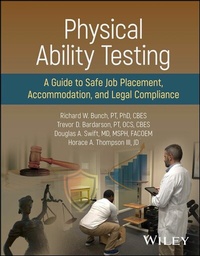
Physical Ability Testing
Description

A guide to implementing legally compliant physical ability testing (PAT) programs that prevent injuries, optimize performance, and ensure reasonable accommodations
In Physical Ability Testing: A Guide to Safe Job Placement, Accommodation, and Legal Compliance, a team of distinguished medical professionals delivers an expert discussion of the fundamentals of creating a PAT program. Explaining the perspectives of the employer, the authors detail the systematic steps in developing and administering legally valid, job-specific PATs and providing proper interactive accommodation reviews for new hires and incumbent employees.
The book covers testing policies and procedures that address methods to avoid discrimination and minimize disparate impact on protected classes such as individuals with disabilities, older adults, women (including those who are pregnant), and individuals affected by medical or behavioral health conditions such as substance use disorders or recent surgeries. It also provides critical information on defending test failure determinations based on the "direct threat" and "undue hardship" defenses.
Readers will find:
- A thorough introduction to the validation process best suited for a defensible PAT program
- Comprehensive explorations of PAT programs in a variety of industries
- Practical discussions of administering PATs, legal cases covering them, and published scientific literature related to work physiology
- Complete treatments of the validation processes used in ensuring PAT programs remain legally defensible
This book is perfect for human resource professionals, occupational physicians and nurses, physical therapists, occupational therapists, chiropractors, safety professionals, industrial hygienists, ergonomists, human factors specialists, and risk managers.
More details
Other editions
Additional editions
Persons
Richard W. Bunch, PT, PhD, CBES is a retired physical therapist and ergonomic specialist with a PhD in Human Neuroanatomy. He brings over 45 years of experience in physical ability testing, functional capacity evaluation, and ergonomics. He has held faculty appointments at LSU Medical Center and Tulane University School of Public Health, founded WorkSaver Employee Testing Systems, and developed the Certified Behavioral-Based Ergonomics Specialist (CBES) program.
Trevor D. Bardarson, PT, OCS, CBES is a Board Certified Orthopedic Physical Therapy Specialist, Strength and Conditioning Specialist, Spine Specialist, Certified Physical Ability/Functional Capacity Evaluator, and an Ergonomic Specialist with over 30 years of experience. He is the Owner/President of WorkSaver Employee Testing Systems LLC.
Douglas A. Swift, MD, MSPH, FACOEM is a Board-Certified Occupational Medicine Physician. He has over 40 years' experience in clinical occupational medicine and serves as an Associate Clinical Professor at Tulane University School of Public Health.
Horace A. Thompson III, JD is a labor attorney with over 40 years of courtroom experience as a lawyer and a judge.
Content
Preface xi
Acknowledgments xiii
1 Introduction to Physical Ability Testing 1
1.1 The Physical Ability Test 1
1.2 Impact of PATs on Safety 5
1.3 Qualifications to Perform a Physical Ability Test 5
1.4 Essential Job Functions - The Foundation of the PAT Program 5
1.5 Types of PATs 6
1.6 Contents of a Post-offer PAT 8
1.7 The Basic Design of the PAT Protocol 10
1.8 The Predictive Value of a PAT - Relation to "Direct Threat" Defense 10
1.9 Benefits of Physical Ability Testing 14
1.10 PAT vs Functional Capacity Evaluation 16
1.11 Validity of Effort During Functional Testing 16
2 Assessing Physical Ability to Work 21
2.1 Assessing the Gap Between Physical Ability and Work Demands 21
2.2 Employment Medical Examinations 23
2.3 Assessing Risk, Capacity, and Tolerance to Work 25
2.3.1 Assessing Work Risk 26
2.3.2 Assessing Work Capacity 26
2.3.3 Assessing Work Tolerance 27
2.4 Assessing Impact of Impairments and Disability on Work Ability 27
2.5 Lift Strength Capacity Tests 28
2.5.1 Isometric Lift Tests 29
2.5.2 Isokinetic Lift Tests 30
2.5.3 Dynamic Lift Tests 30
2.6 Cardiopulmonary Tests to Determine Work Fitness 30
2.7 Limitations of Medical Imaging for Assessing Physical Ability to Work 31
3 Avoiding Employment Discrimination 37
3.1 Employment Discrimination - Responsibilities of Employer and Evaluator 37
3.2 Discrimination Based on Disparate Impact of a PAT 38
3.3 PAT Compliance with Antidiscrimination Laws 38
3.4 Disparate Impact and the Four-fifths Rule 39
3.5 Discrimination Related to Disability - ADA and ADAAA 40
3.6 Discrimination Related to Drugs 42
3.7 Discrimination Related to Obesity 44
3.7.1 Addressing Obesity with PATs 45
3.8 Discrimination Related to Pregnancy 46
3.8.1 The Risks of Physical Ability Testing During Pregnancy 47
3.8.2 Recommended Lifting Limits During Uncomplicated Pregnancies 48
3.8.3 Lifting Thresholds for Pregnant Workers 49
3.8.4 Accommodating Pregnancy When Administering PATs 52
3.9 Discrimination Related to Age and Gender 54
3.9.1 Age-based Disparity 54
3.9.2 Gender-based Disparity 54
3.10 Discrimination Related to Hearing Disabilities 55
3.11 Discrimination Related to Visual Disabilities 56
3.12 Discrimination Related to Artificial Intelligence 58
3.12.1 How AI Technology Can Lead to Discrimination 58
3.12.2 Ai Compliance with Title VII 59
3.12.3 AI Compliance with ADA 59
4 Disability and Interactive Accommodation 67
4.1 Introduction 67
4.2 Accommodation Timing and Inquiries 68
4.3 Role of the PAT in Determining Accommodations 69
4.4 Initiating an Accommodation Review 70
4.5 Verifying a Covered Disability Under the ADA 71
4.6 When an Accommodation Request Is Reasonable 74
4.7 When an Accommodation Request Is Not Reasonable 75
4.8 Disclosing Information Regarding Accommodations 75
4.9 Choosing Accommodations - Employer vs Employee 76
4.10 Response Time to Provide Reasonable Accommodation 76
4.11 Reasonable Accommodations Related to the Hiring Process 76
4.12 Types of Accommodations Related to Performing Essential Job Functions 77
4.13 Accommodating Employees Covered by ADA and FMLA 79
4.14 Undue Hardship 80
4.15 Interactive Accommodation Review: Step-by-step Guide 80
5 Physical Demands Analysis 93
5.1 Introduction 93
5.2 Role of Ergonomics in Determining Essential Physical Demands 95
5.3 Project Planning 95
5.4 The PDA Process 97
5.5 Assessing Postural Demands 98
5.6 Assessing Repetitive Motions 99
5.7 Assessing Lift Demands 100
5.8 Assessing Multi-person Lifts 102
5.9 Assessing Carry Demands 103
5.10 Assessing Push and Pull Demands 103
5.10.1 Assessing Push/Pull Forces on Operating Valves 104
5.11 Assessing Climbing Demands 105
5.12 Assessing EE Demands 106
5.13 Assessing Balance and Coordination Demands 107
5.14 Assessing Vibration Exposure Demands 107
5.15 Assessing Vision and Hearing Demands 108
5.16 Assessing Environmental Demands 108
5.17 Summary of PDA Steps 109
5.18 The PDA Questionnaire 109
5.19 Memorializing and Maintaining Current PDA Data 112
5.19.1 Role for Healthcare Providers 112
5.19.2 Defining Essential Functions 112
5.19.3 Report Format and Level of Detail 113
5.19.4 Required Report Elements 113
5.19.5 Review and Finalization Process 113
5.19.6 Ongoing Updates 113
5.19.7 Organizational Structure of the FJD 113
6 Validating Physical Ability Tests 121
6.1 Introduction 121
6.2 Uniform Guidelines on Employee Selection Procedures and Test Validation 122
6.2.1 In summary 123
6.3 Fairness of Testing and Disparate (Adverse) Impact 124
6.3.1 Determining Disparate (Adverse) Impact of Test - The "Four-fifths Rule" 124
6.4 Work Environment Factors That Threaten Validity and Reliability 125
6.5 Testing Errors That Threaten Reliability 127
6.6 The Three Basic Methods for Validating PATs 128
6.6.1 Establishing Content Validity 129
6.6.1.1 Steps for Conducting a Content Validation of a PAT 130
6.6.2 Establishing Criterion-related Validity 134
6.6.2.1 Types of Criterion-based Validity 134
6.6.2.2 Steps for Conducting a Criterion-related Validation of a PAT 134
6.6.2.3 Summary 136
6.6.3 Establishing Construct Validity 137
6.6.3.1 Steps for Conducting a Construct Validation of a PAT 138
6.7 Combining Content and Criterion-related Validity 139
6.8 Cost and Time Involved with Content Validation vs Criterion-related Validation 140
6.9 Summary of Key Differences in Validation Approaches 140
6.10 Legal Challenges to Validated Physical Ability Tests 141
6.11 Steps Employers Can Take to Defend Against Legal Challenges 142
6.12 Unacceptable Evidence for Validity 145
6.13 Maintaining Ongoing Validity of a PAT Program 145
6.14 References That Support the Validation Process 146
7 Policies and Procedures for Test Evaluators 151
7.1 Introduction 151
7.2 The Role and Obligations of the Evaluator 152
7.3 Liability Considerations for Evaluators Administering PATs 152
7.4 Creation of PAT Protocols 153
7.5 Standardization of the Test Environment 153
7.6 Space and Equipment Requirements 154
7.7 Timing of Medical Inquiries 155
7.8 Qualifications for Administering a PAT 155
7.9 Verification of Identity of Test Recipient and PAT Protocol 156
7.10 Medical Consent and HIPAA Release Forms 156
7.11 Medical Inquiries and Health Questionnaires 157
7.12 Monitoring Heart Rate and Blood Pressure 159
7.12.1 Pretest Recordings 160
7.12.2 Monitoring Vitals During Testing 161
7.13 Conducting the Physical Examination 163
7.14 Accommodating Testing for Pregnant Individuals 164
7.15 Assessing Symptomatic Test Recipients 166
7.16 Assessing Test Recipients Taking Pain Medications 168
7.17 Performing Physical Ability Tests 168
7.17.1 Nonmaterial Handling Functional Tests 169
7.17.1.1 Hand Dexterity Test 169
7.17.1.2 Postural Tolerance Test 169
7.17.1.3 Walking Test 169
7.17.1.4 Stair Climbing Test 170
7.17.1.5 Crawling Test 170
7.17.2 Material Handling Functional Tests 170
7.17.2.1 Lift Test 170
7.17.2.2 Standardizing the Lift 171
7.17.3 Progressive Dynamic Lift Test Methodology 174
7.17.4 Policy for Lift Boxes 175
7.17.5 Lift Test Policy for Assessing Target or Maximum Lift Capacity 176
7.17.6 Performing Multiple Dynamic Lift Tests - The "Top-down" Method 176
7.17.7 Carry Test 177
7.17.8 Push-Pull Tests 177
7.17.9 Isokinetic and Isometric Lift Tests 178
7.18 Testing with Physician-imposed Functional Restrictions 178
7.19 Scoring Test Outcomes - Pass/Fail Determinations 179
7.20 Discharge and Release 179
7.21 PAT Outcome Notification 180
8 PAT Policies and Procedures for Employers 185
8.1 Creation of a Policies and Procedures (P&P) for Physical Ability Testing 186
8.2 Identification of the P&P Document 188
8.3 Key Operational Definitions 189
8.4 Purpose and Objectives 190
8.5 Scope 190
8.6 Eligibility and Applicability 190
8.7 Accommodating Test Procedures 191
8.8 Test Design and Content 191
8.9 Medical Hold 192
8.10 Pass/Fail Determination 192
8.11 Validation 193
8.11.1 Validation of Essential Job Functions 193
8.11.2 Validation of the PAT Protocol 193
8.11.3 Monitoring Test Outcomes for Disparate Impact 195
8.12 Assignment of PAT Program Responsibilities 195
8.13 Qualifications of Test Evaluators 196
8.14 Medical Inquiries 197
8.15 Test Notifications and Instructions 198
8.16 Conditional Job Offer Acknowledgment 199
8.17 Process for Acquiring Test Results 202
8.18 Drug Testing 202
8.19 Pain Medications 202
8.20 Compliance with Medication-assisted Treatment for Opioid Use Disorder 203
8.21 Identification of Disability and Accommodations 204
8.22 Returning from Extended Medical Leave and FMLA 204
8.23 PATs Following FMLA Leave 204
8.24 Medical Hold and Release Requirements 205
8.25 Pregnancy 206
8.26 Epilepsy/Seizure Disorders 206
8.27 Retesting 207
8.28 Addressing Conflicting Medical Opinions Regarding Work Ability 208
8.29 Addressing Employee-Doctor Conflict with Imposed Work Restrictions 208
8.30 Accommodations for Language Impaired, Mute, Deaf, and Blind Job Applicants 209
8.31 Interactive Accommodation Review Following Test Failure 210
8.32 Denial of Employment/Withdrawal of a Conditional Job Offer 210
8.33 Artificial Intelligence in Hiring 211
8.34 Data Management and Confidentiality 212
8.35 Monitoring Program Effectiveness 214
8.36 Final Approval and Signatures 215
9 Legal History of Occupational Health Protection 219
9.1 Introduction 219
9.2 Federal Employers Liability Act of 1908 (FELA) 220
9.3 National Labor Relations Act of 1935 (NLRA) (Wagner Act) 221
9.4 Federal Tort Claims Act (FTCA) 221
9.5 Section 502 of the Labor Management Relations Act of 1947 (Taft-Hartley Act) 221
9.6 Coal Mine Safety Act of 1952 221
9.7 Longshoremen's and Harbor Workers Compensation Act of 1958 222
9.8 National Foundation of the Arts and Humanities Act of 1965 222
9.9 Metal and Nonmetallic Mine Safety Act of 1966 222
9.10 Construction Safety Act of 1969 222
9.11 Occupational Safety and Health Act of 1970 222
9.12 General Duty Clause of the OSH Act of 1970 223
9.13 OSHA Guidelines on Medical Screening and Surveillance 224
9.14 OSHA HAZWOPER Standard at Hazardous Waste Sites of 1986 224
9.15 OSHA Screening and Monitoring of Hospital Workers 225
9.16 Title VII of the Civil Rights Act of 1964 225
9.17 Age Discrimination in Employment Act of 1967 (ADEA) 226
9.18 Section 504 of the Rehabilitation Act of 1973 226
9.19 Americans with Disabilities Act of 1990 (ADA), Amended Act (2008) and EEOC Guidance 226
9.20 ADA - Medical Inquiries and Examinations 228
9.21 ADA - Employee Health Programs 230
9.21.1 Summary 231
9.22 ADA - Disclosure of Medical Information 231
9.23 ADA - Non-medical Exams 231
9.24 ADA - Medical Information Related to the Job and Consistent with Business Necessity 232
9.25 ADA - Medical Response to Request for Accommodation 232
9.26 ADA - Standard for Triggering a "For Cause" PAT for Employees 232
9.27 ADA - Employee's Failure to Respond to Valid Medical Inquiry 233
9.28 ADA and Family and Medical Leave Act of 1993 (FMLA) 233
9.29 ADA and Collective Bargaining Agreement 234
9.30 DOT Exams and FMLA 235
9.31 Pregnancy Discrimination Act of 1978 (PDA) 235
9.32 Pregnant Worker Fairness Act of 2022 (PWFA) 236
9.32.1 Comparing the PWFA and ADA 236
9.32.2 Impact of the PWFA on PATs 237
9.32.3 Avoiding Discriminatory FFD Tests 237
9.32.4 Health-related Tests and Pregnancy 237
9.32.5 Medical Examinations and Confidentiality 237
9.32.6 Workplace Safety Considerations 237
9.32.7 EEOC Enforcement 237
9.32.8 Summary 238
9.33 The Health Insurance Portability and Accountability Act of 1996 (HIPAA) 238
9.34 Genetic Information Nondiscrimination Act of 2008 (GINA) 239
Appendix 1: EEOC Employment Tests and Selection Procedures 245
Appendix 2: Job Applicants and the ADA 251
Appendix 3: Uniform Guidelines on Employee Selection Procedures (1978) 259
Appendix 4: Enforcement Guidance on Disability-related Inquiries and Medical Examinations of Employees under the ADA 283
Appendix 5: Part 1630 - Regulations to Implement the Equal Employment Provisions of the Americans with Disabilities Act (ADA) 303
Appendix 6: The Americans with Disabilities Act and the Opioid Crisis: Combating Discrimination Against People in Treatment or Recovery 367
Appendix 7: What You Should Know About the Pregnant Workers Fairness Act 373
Appendix 8: Hearing Disabilities in the Workplace and the Americans with Disabilities Act 379
Appendix 9: Visual Disabilities in the Workplace and the Americans with Disabilities Act 395
Appendix 10: Enforcement Guidance on Reasonable Accommodation and Undue Hardship under the ADA 417
Index 457
Chapter 1
Introduction to Physical Ability Testing
Chapter Contents
- 1.1 The Physical Ability Test
- 1.2 Impact of PATs on Safety
- 1.3 Qualifications to Perform a Physical Ability Test
- 1.4 Essential Job Functions - The Foundation of the PAT Program
- 1.5 Types of Physical Ability Tests
- 1.6 Contents of a Post-offer Physical Ability Test
- 1.7 The Basic Design of the PAT Protocol
- 1.8 The Predictive Value of a PAT - Relation to Direct Threat Defense
- 1.9 Benefits of Physical Ability Testing
- 1.10 PAT vs FCE
- 1.11 Validity of Effort During Functional Testing
1.1 The Physical Ability Test
As employers aim to minimize workplace injuries and adhere to legal and industry standards, well-crafted Physical Ability Tests (PATs) have become a valuable tool in hiring, return-to-work assessments, and workforce management. A well-designed PAT is a standardized, validated evaluation that helps employers assess a candidate's physical fitness and their ability to perform tasks requiring strength, endurance, agility, balance, and coordination. The key benefit of PATs is ensuring that job applicants and employees can safely and effectively carry out their responsibilities, both with and without reasonable accommodations. This not only reduces the risk of injury but also boosts overall productivity. By using PATs, employers can confidently hire individuals who meet the physical demands of the job, fostering workplace safety and optimal performance. Over time, PATs have grown in popularity due to their effectiveness in decreasing job-related injuries, particularly work-related musculoskeletal disorders (WMSDs), while also improving job performance and employee retention [1, 2].
Although the term "Physical Ability Test," abbreviated PAT, has been chosen for use in this book, legal requirements to avoid employment discrimination have molded the design of employment tests and terminologies associated with them have varied. Table 1.1 provides a summary of the most common names applied to employment tests that involve assessments of physical abilities.
Table 1.1 List of common terms used to describe employment functional testing.
Adapted from http://www.aota.org/about-occupational-therapy/professionals/wi/capacity-eval.aspx#sthash.MT9W4fb3.dpuf.
Physical Ability Test (Assessment)
Physical Agility Test (Assessment)
Preemployment Test (Assessment)
Preemployment Ability Test (Assessment)
Preemployment Agility Test (Assessment)
Preemployment Functional Test (Assessment)
Post-offer Employment Test (Assessment)
Post-offer, Pre-placement Test (Assessment)
Conditional New Hire Test (Assessment)
Return to Work Test (Assessment)
Fitness for Duty Test (Assessment)
Functional Capacity Evaluation or Assessment
Physical Capacity Evaluation or Assessment
Work Capacity Evaluation or Assessment
Work Tolerance Test (Assessment)
Properly conducted PATs administered on a post-offer basis include health history questionnaires, physical examinations, baseline functional tests, and job-specific functional tests that are conducted in a safe, valid, and reliable manner. When designed correctly, the PAT can be a very effective type of employment test in compliance with federal regulations which prohibit the use of discriminatory employment tests and selection procedures.
The Equal Employment Opportunity Commission (EEOC), established by section 705 of the Civil Rights Act of 1964 (42 U.S.C. 2000e-4), enforces legal compliance to ensure employment tests, such as PATs, align with antidiscrimination laws. The EEOC provides helpful technical assistance documents such as Employment Tests and Selection Procedures [3] and Job Applicants and the ADA [4]. The technical assistance document Employment Tests and Selection Procedures provides a framework for employers to ensure their hiring practices and employment tests comply with federal laws related to discrimination. These guidelines aim to promote fairness, eliminate bias, and prevent discrimination in employment testing and selection processes. (A copy of Employment Tests and Selection Procedures is provided in Appendix 1.) The technical assistance document Job Applicants and the ADA provides guidance to individuals on how the Americans with Disabilities Act (ADA) protects job applicants with disabilities from discrimination. (A copy of Job Applicants and the ADA is provided in Appendix 2.)
The EEOC oversees that employers conduct physical ability tests fairly and avoid discrimination against applicants or employees based on their physical conditions or disabilities, unless there is a direct threat to workplace safety. Additionally, the Occupational Safety and Health Administration (OSHA) [5] regulates workplace safety standards, which can include guidelines for PATs to ensure employees' physical capacity to safely perform essential job functions.
When designing a PAT program, employers must understand the following issues that are targeted by the enforcement agency, EEOC, whenever there is a challenge to an employee testing process:
- Disparate Impact and Test Validation
- Disparate Impact: The EEOC focuses on disparate impact, which occurs when a test negatively affects certain groups disproportionately, even without intentional discrimination. For instance, a PAT could unintentionally disadvantage women or older workers if it is not properly validated or aligned with the actual job requirements.
- Test Validation: If a PAT shows a disparate impact on a protected group, the employer must prove the test is job-related and necessary for business operations. This is typically done through validation, which involves demonstrating through studies that the test accurately predicts job performance and is directly tied to the essential tasks of the job.
- Job-relatedness and Business Necessity
- Job-relatedness: Employers must ensure that a PAT is directly related to the specific duties of the job. For example, a strength test may be relevant for physically demanding roles but not for others.
- Business Necessity: The EEOC allows the use of a PAT with disparate impact if it serves a legitimate business need. The employer must show that the test is necessary for safe and efficient job performance and that no alternative, less discriminatory method would provide valid results.
- Reasonable Accommodation for Disabilities
- It is illegal for a covered entity to fail to provide reasonable accommodation for a known physical or mental limitation of a qualified applicant or employee with a disability, unless the entity can demonstrate that the accommodation would impose an undue hardship on the operation of its business (i.e., cause significant difficulty or expense for the operation of its business). Therefore, if a candidate with a disability cannot meet a particular physical requirement, the employer must work with the applicant to find accommodations to work.
- Gender and Age Discrimination
- PATs should avoid discrimination based on sex, gender identity, or age. For example, a PAT that disproportionately excludes women or older workers may be challenged unless the test requirements are directly related to the job. Strength tests that demand higher performance than necessary for the role may be questioned if they unnecessarily exclude these groups.
- Considerations for PAT Adjustments
- Employers should evaluate the actual job requirements and ensure that the PAT measures the necessary abilities without excluding qualified individuals from protected groups.
- Employers are also encouraged to assess alternative functional tests within the PAT protocol to ensure fairness and equality [3, 4].
Since PATs are often referred to as a type of fitness for duty examination, it is important to understand what constitutes being fit for duty, or fit for work. This understanding can be initiated by referring to the U.S. federal agency, OSHA, which is part of the U.S. Department of Labor [5]. According to the OSHA, fit for duty is defined as: "a physical, mental, and emotional state which enables the employee to perform the essential tasks of his or her work assignment in a manner which does not threaten the safety or health of oneself, coworkers, property, or the public at large" [6]. In a systematic review of reports published in scientific journals from the United States and Western Europe on the criteria and methods used to assess fitness for work, the most cited definition of assessment of fitness for work reported, with slight variations, correlated with this OSHA definition [7].
It should be clarified that although the mental and emotional states of employees are important aspects of being fit for duty, a PAT is focused on assessing the physical abilities of a person to perform a job safely. Therefore, from this perspective, an employee is deemed physically fit for duty when they demonstrate the physical abilities to safely and effectively perform essential job functions, with or without a reasonable accommodation. As such, when considering all the KSAO requirements of work (i.e., Knowledge, Skills,...
