

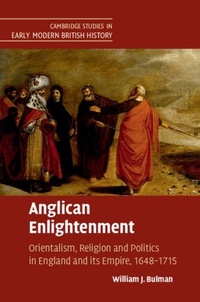
Anglican Enlightenment
Orientalism, Religion and Politics in England and its Empire, 1648-1715
Published on 13. May 2015
978-1-316-30959-9 (ISBN)
Description

This is an original interpretation of the early European Enlightenment and the religious conflicts that rocked England and its empire under the later Stuarts. In a series of vignettes that move between Europe and North Africa, William J. Bulman shows that this period witnessed not a struggle for and against new ideas and greater freedoms, but a battle between several novel schemes for civil peace. Bulman considers anew the most apparently conservative force in post-Civil War English history: the conformist leadership of the Church of England. He demonstrates that the church's historical scholarship, social science, pastoral care and political practice amounted not to a culturally backward spectacle of intolerance, but to a campaign for stability drawn from the frontiers of erudition and globalization. In seeking to sever the link between zeal and chaos, the church and its enemies were thus united in an Enlightenment project, but bitterly divided over what it meant in practice.
Reviews / Votes
'... Bulman's achievement is positively 'Thompsonian': the rescuing of Anglican scholars and scholarship, pastors and political operatives from the enormous condescension of (whig and revisionist) posterity. As such, Anglican Enlightenment ranks amongst the most important interventions in late seventeenth-century studies in the last decade, if not longer.' David Magliocco, Reviews in History 'Highly recommended. Upper-division undergraduates and above.' Choice 'In this engagingly written and impressively wide-ranging study, William J. Bulman goes much further than previous scholars to claim that Anglican clergy were early in the field in displaying the essential hallmarks of the Enlightenment. He powerfully argues that the Anglican Enlightenment was not simply a reactive Whig intervention of the 18th century, and that 'the Enlightenment' was created by leading Anglican divines of the late 17th century rather than by heterodox philosophers. ... This is a highly distinguished contribution to our understanding of both the Anglican Church and the Enlightenment.' Jeremy Gregory, The Church Times 'Bulman's analysis of 'enlightened' Anglicanism after the Restoration is a masterly result of exhaustive research. The Enlightenment is at last presented not as the all but exclusive prerogative of its most radical adherents, but as a widespread phenomenon, existing in countless variants forged by political circumstances.' Alastair Hamilton, The Times Literary Supplement 'The adept interpretation of neglected historical material is valuable enough. Its greater importance, however, lies in the subtle, but paradigm-altering move to look for enlightenment beyond the usual suspects, and to critically revisit received wisdom regarding the motivations which drove certain historical actors to globally reinterpret insularly European realities.' Samuel Nelson, Politics, Religion and Ideology 'Bulman's book provides us with a powerful case for the persisting erudition and theological commitments of figures in the Church in England after the crisis of the English revolution ... Too often historians have described what they observe in the histories, events, and texts of the period by adopting the perspectives of the sources they find most congenial ... For too long historians of ideas in particular - and especially those that elevate the 'liberal' afterlife of the texts of Spinoza and John Locke and others as significant and foundational - have ignored the flexibility and adaptability of the clerical minds who lived and wrote in the same intellectual culture. After Bulman this will not be a plausible assumption.' Justin Champion, Erudition and the Republic of Letters 'It is a book of great interpretive reach and is powered by enviable resources of erudition ... An outstanding and unusually ambitious monograph ... A genuinely pioneering and altogether revelatory study.' Brian Young, The Journal of Modern History 'This is an important and thought-provoking book which deserves to be taken seriously by scholars ... This book joins those by Grant Tapsell and Brent Sirota in making the case for the period as one which was marked by intellectual and religious vitality and cannot be ignored by scholars.' William Gibson, The English Historical ReviewMore details
Series
Language
English
Place of publication
Cambridge
United Kingdom
Publishing group
Cambridge University Press
Target group
Professional and scholarly
Illustrations
6 Halftones, unspecified; 6 Halftones, black and white
File size
6574,70 MB
ISBN-13
978-1-316-30959-9 (9781316309599)
Copyright in bibliographic data and cover images is held by Nielsen Book Services Limited or by the publishers or by their respective licensors: all rights reserved.
Schweitzer Classification
Other editions
Additional editions
William J. Bulman
Anglican Enlightenment
Orientalism, Religion and Politics in England and its Empire, 1648-1715
Book
05/2015
Cambridge University Press
€91.00
Shipment within 15-20 days
Person
William J. Bulman is an assistant professor at Lehigh University in Bethlehem, Pennsylvania, where he teaches European history and global studies. He received his Ph.D. in 2010 from Princeton University, where he received the Rockefeller Graduate Prize Fellowship and other honors. Between 2009 and 2012 he held research fellowships at Vanderbilt and Yale. His doctoral work was supported by the Mellon Foundation and the US Department of Education, and in 2012 he was among the two youngest scholars in eight disciplines to be awarded a Religion and Innovation in Human Affairs Grant from the Historical Society and the Templeton Foundation. His articles on the intellectual, religious, political, and cultural history of England and its empire have appeared in Past and Present, The Journal of British Studies, History Compass, and other venues. In addition to the themes covered in Anglican Enlightenment, his current research examines the changing nature of political practice and decision-making in the British Atlantic world between the late sixteenth and early nineteenth centuries. He is also co-editor of God in the Enlightenment (with Robert G. Ingram, 2016).
Content
Introduction: from learning to liberalism?; Part I. Foundations: 1. Literature and violence; 2. Empires, churches and republics of the globe; Part II. Culture: 3. Histories; 4. Universals; Part III. Religion: 5. The propagation of the faith; 6. The worship of God; Part IV. Politics: 7. Restoration; 8. Revolution; Conclusion: from pastor to spectator; Select bibliography; Index.
