

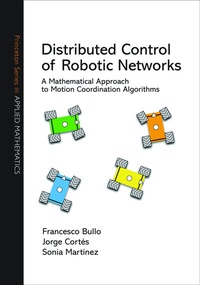
Distributed Control of Robotic Networks
A Mathematical Approach to Motion Coordination Algorithms
1st Edition
Published on 6. July 2009
320 pages
978-1-4008-3147-0 (ISBN)
Description

This self-contained introduction to the distributed control of robotic networks offers a distinctive blend of computer science and control theory. The book presents a broad set of tools for understanding coordination algorithms, determining their correctness, and assessing their complexity; and it analyzes various cooperative strategies for tasks such as consensus, rendezvous, connectivity maintenance, deployment, and boundary estimation. The unifying theme is a formal model for robotic networks that explicitly incorporates their communication, sensing, control, and processing capabilities--a model that in turn leads to a common formal language to describe and analyze coordination algorithms.
Written for first- and second-year graduate students in control and robotics, the book will also be useful to researchers in control theory, robotics, distributed algorithms, and automata theory. The book provides explanations of the basic concepts and main results, as well as numerous examples and exercises.
- Self-contained exposition of graph-theoretic concepts, distributed algorithms, and complexity measures for processor networks with fixed interconnection topology and for robotic networks with position-dependent interconnection topology
- Detailed treatment of averaging and consensus algorithms interpreted as linear iterations on synchronous networks
- Introduction of geometric notions such as partitions, proximity graphs, and multicenter functions
- Detailed treatment of motion coordination algorithms for deployment, rendezvous, connectivity maintenance, and boundary estimation
Written for first- and second-year graduate students in control and robotics, the book will also be useful to researchers in control theory, robotics, distributed algorithms, and automata theory. The book provides explanations of the basic concepts and main results, as well as numerous examples and exercises.
- Self-contained exposition of graph-theoretic concepts, distributed algorithms, and complexity measures for processor networks with fixed interconnection topology and for robotic networks with position-dependent interconnection topology
- Detailed treatment of averaging and consensus algorithms interpreted as linear iterations on synchronous networks
- Introduction of geometric notions such as partitions, proximity graphs, and multicenter functions
- Detailed treatment of motion coordination algorithms for deployment, rendezvous, connectivity maintenance, and boundary estimation
More details
Other editions
Additional editions
Francesco Bullo | Jorge Cortes | Sonia Martinez
Distributed Control of Robotic Networks
A Mathematical Approach to Motion Coordination Algorithms
Book
07/2009
Princeton University Press
€91.50
Shipment within 10-20 days
Persons
Francesco Bullo is professor of mechanical engineering at the University of California, Santa Barbara. Jorge Cortés is associate professor of mechanical and aerospace engineering at the University of California, San Diego. Sonia Martínez is assistant professor of mechanical and aerospace engineering at the University of California, San Diego.
Content
Preface ix
Chapter 1. An introduction to distributed algorithms 1
1.1 Elementary concepts and notation 1
1.2 Matrix theory 6
1.3 Dynamical systems and stability theory 12
1.4 Graph theory 20
1.5 Distributed algorithms on synchronous networks 37
1.6 Linear distributed algorithms 52
1.7 Notes 66
1.8 Proofs 69
1.9 Exercises 85
Chapter 2. Geometric models and optimization 95
2.1 Basic geometric notions 95
2.2 Proximity graphs 104
2.3 Geometric optimization problems and multicenter functions 111
2.4 Notes 124
2.5 Proofs 125
2.6 Exercises 133
Chapter 3. Robotic network models and complexity notions 139
3.1 A model for synchronous robotic networks 139
3.2 Robotic networks with relative sensing 151
3.3 Coordination tasks and complexity notions 158
3.4 Complexity of direction agreement and equidistance 165
3.5 Notes 166
3.6 Proofs 169
3.7 Exercises 176
Chapter 4. Connectivity maintenance and rendezvous 179
4.1 Problem statement 180
4.2 Connectivity maintenance algorithms 182
4.3 Rendezvous algorithms 191
4.4 Simulation results 200
4.5 Notes 201
4.6 Proofs 204
4.7 Exercises 215
Chapter 5. Deployment 219
5.1 Problem statement 220
5.2 Deployment algorithms 222
5.3 Simulation results 233
5.4 Notes 237
5.5 Proofs 239
5.6 Exercises 245
Chapter 6. Boundary estimation and tracking 247
6.1 Event-driven asynchronous robotic networks 248
6.2 Problem statement 252
6.3 Estimate update and cyclic balancing law 256
6.4 Simulation results 266
6.5 Notes 268
6.6 Proofs 270
6.7 Exercises 275
Bibliography 279
Algorithm Index 305
Subject Index 307
Symbol Index 313
Chapter 1. An introduction to distributed algorithms 1
1.1 Elementary concepts and notation 1
1.2 Matrix theory 6
1.3 Dynamical systems and stability theory 12
1.4 Graph theory 20
1.5 Distributed algorithms on synchronous networks 37
1.6 Linear distributed algorithms 52
1.7 Notes 66
1.8 Proofs 69
1.9 Exercises 85
Chapter 2. Geometric models and optimization 95
2.1 Basic geometric notions 95
2.2 Proximity graphs 104
2.3 Geometric optimization problems and multicenter functions 111
2.4 Notes 124
2.5 Proofs 125
2.6 Exercises 133
Chapter 3. Robotic network models and complexity notions 139
3.1 A model for synchronous robotic networks 139
3.2 Robotic networks with relative sensing 151
3.3 Coordination tasks and complexity notions 158
3.4 Complexity of direction agreement and equidistance 165
3.5 Notes 166
3.6 Proofs 169
3.7 Exercises 176
Chapter 4. Connectivity maintenance and rendezvous 179
4.1 Problem statement 180
4.2 Connectivity maintenance algorithms 182
4.3 Rendezvous algorithms 191
4.4 Simulation results 200
4.5 Notes 201
4.6 Proofs 204
4.7 Exercises 215
Chapter 5. Deployment 219
5.1 Problem statement 220
5.2 Deployment algorithms 222
5.3 Simulation results 233
5.4 Notes 237
5.5 Proofs 239
5.6 Exercises 245
Chapter 6. Boundary estimation and tracking 247
6.1 Event-driven asynchronous robotic networks 248
6.2 Problem statement 252
6.3 Estimate update and cyclic balancing law 256
6.4 Simulation results 266
6.5 Notes 268
6.6 Proofs 270
6.7 Exercises 275
Bibliography 279
Algorithm Index 305
Subject Index 307
Symbol Index 313
