

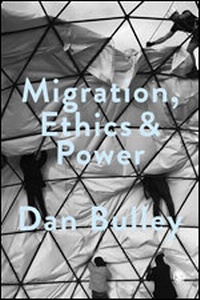
Migration, Ethics and Power
Spaces Of Hospitality In International Politics
1st Edition
Published on 3. November 2016
200 pages
978-1-4739-9441-6 (ISBN)
Description

In 2014, the ethics and politics of hospitality were brought into stark relief. Three years into the Syrian conflict, which had already created nearly 2.5 million refugees and internally displaced 6.5 million, the UN called on industrialised countries to share the burden of offering hospitality through a fixed quota system. The UK opted out of the system whilst hailing their acceptance of a moral responsibility by welcoming only 500 of the 'most vulnerable' Syrians. Given the state's exclusionary character, what opportunities do other spaces in international politics offer by way of hospitality to migrants and refugees?
Hospitality can take many different forms and have many diverse purposes. But wherever it occurs, the boundaries that enable it and make it possible are both created and unsettled via exercises of power and their resistance. Through modern examples including refugee camps, global cities, postcolonial states and Europe, as well as analysis of Derridean and Foucauldian concepts, Migration, Ethics and Power explores:
The process and practice of hospitality
The spaces that hospitality produces
The intimate relationship between ethics and power
This is a brilliantly contemporary text for students of politics, international relations and political geography.
Hospitality can take many different forms and have many diverse purposes. But wherever it occurs, the boundaries that enable it and make it possible are both created and unsettled via exercises of power and their resistance. Through modern examples including refugee camps, global cities, postcolonial states and Europe, as well as analysis of Derridean and Foucauldian concepts, Migration, Ethics and Power explores:
The process and practice of hospitality
The spaces that hospitality produces
The intimate relationship between ethics and power
This is a brilliantly contemporary text for students of politics, international relations and political geography.
Reviews / Votes
Dan Bulley explores how hospitality could be best managed for different types of migrations, examining the various reasons driving these decisions, and exploring the perspectives of countries and international organizations to help build an ethical structure of hospitality. He clearly explains why people move from one place to another; and the book helps structure an international ethics conception, and explicates the measures to be taken in this context. It is a valuable resource for students, researchers and those interested in contributing to the field with new studies. -- Yakup Sari We live in an age of humanitarianism, a time when the highest form of politics and the noblest form of citizenship is to help others. This book places this new pastoralism in a different light. What if all this saving, sheltering and caring is not a new softness tempering the harsh edges of power but increasingly one of power's most privileged mechanisms? Richly contextualized, incisive and provocative, this book will change the way we understand hospitality. To the history of social struggle it adds a new antagonism: host/guest, truly a dialectic for our time. -- William Walters Migration, Ethics and Space investigates the interaction of ethics and power in a range of spaces of hospitality that operate at and beyond the margins of the international state system. It astutely reveals that when people seek to cross borders or create spaces of their own, migration develops and hospitality is accessed, presumed, appropriated, or rebuffed. Dan Bulley's critical exploration and insightful analysis shows that while hospitality can be experienced as a right, a form of exchange, an act of compassion, or clandestine or abusive, it is always a matter of ethics, power and space. In this book, the everyday ethics of hospitality takes the form of diverse spaces-including homelands, refugee camps, global cities, postcolonial states, and a supranational community, from which the author uniquely explores the themes of post-sovereign ethics and power in international politics. Brilliantly perceptive and passionately engaged, Migration, Ethics and Space will be of great interest to those who are concerned with the everyday practices of hospitality, post-sovereign spaces, and international ethics and politics. -- Suzan Ilcan Dan Bully's SPACES OF HOSPITALITY is a highly original contribution to the ethics and politics of international hospitality. It is philosophically astute, conceptually innovative and is distinguished by the depth of its political and ethical attunement. -- Michael Shapiro Bulley's Migration, Ethics, and Space is a timely reminder that beyond the oft-discussed statist politics of the refugee crisis there is an ethical response to the refugee crisis that is already unfolding within, and beyond, states. That hospitality is productive of specific subjectivities and spaces, from which more hopeful and humane relations might form. This is the right book for the right moment. -- Jason Dittmer This book is an untimely if urgent invitation to think about migration as an ethical and political subject through the paradoxes of hospitality/hostility. With a persistent focus on spaces where such paradoxes are played out - ranging from mosques, camps, cities, borders, hotels, homes, and states - it provides a challenging perspective on sovereignty as spatial practice across frontiers. Both students and researchers in migration studies, refugee studies, international studies, and citizenship studies will immensely benefit from engaging with this invitation to think differently about *where* sovereignty is practiced and *how* it functions. -- Engin Isin This book provides a provocative discussion of hospitality as a key but often overlooked topic structuring the field of International Relations. From the refugee camp to the global city, this exploration provides a timely look into how various spaces are produced in relation to hospitality and the power relations within that both enable and limit its practice. Defining the "the crossing of borders" as the "hallmark of hospitality," this book will be an important read for those wishing to think seriously about the ethics of hospitality in light of growing numbers of people on the move but also out of place. -- Kim RygielMore details
Series
Edition
First Edition
Language
English
Place of publication
London
United Kingdom
Target group
College/higher education
Professional and scholarly
ISBN-13
978-1-4739-9441-6 (9781473994416)
Copyright in bibliographic data and cover images is held by Nielsen Book Services Limited or by the publishers or by their respective licensors: all rights reserved.
Schweitzer Classification
Other editions
Additional editions
Book
11/2016
1st Edition
SAGE Publications Ltd
€158.10
Shipment within 15-20 days
Person
Content
Introduction
Genocidal Hospitality: Homes, Hotels and Homelands
Humanitarian Hospitality: Refugee Camps
Flourishing Hospitality: Global Cities
Unconditional Hospitality: (Trans-)Jordan as Postcolonial State
(Auto)Immunising Hospitality: EUrope
Conclusion: Risking Critical Practices of Hospitality
Genocidal Hospitality: Homes, Hotels and Homelands
Humanitarian Hospitality: Refugee Camps
Flourishing Hospitality: Global Cities
Unconditional Hospitality: (Trans-)Jordan as Postcolonial State
(Auto)Immunising Hospitality: EUrope
Conclusion: Risking Critical Practices of Hospitality
