

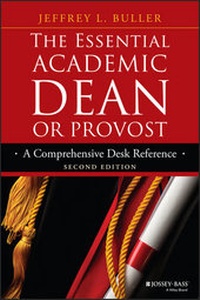
The Essential Academic Dean or Provost
Description

More details
Other editions
Additional editions
Person
Content
Preface
If academic leaders in higher education were like their depictions in the movies, few of us would willingly show our faces in public. Consider, for instance, the following unfortunate role models:
- Dean Peter Morgan Sr. (Charles Coburn) in Vivacious Lady (1938)
- Dean Vernon Wormer (John Vernon) in Animal House (1978)
- Dean Bradley (Eddie Albert) in Stitches (1985)
- Dean Martin (Ned Beatty) in Back to School (1986)
- Dean Walcott (Bob Gunton) in Patch Adams (1998)
- Dean Carl Cain (Obba Babatundé) in How High (2001)
- Dean Gordon "Cheese" Pritchard (Jeremy Piven) in Old School (2003)
- Dean Van Horne (Anthony Heald) in Accepted (2006)
- Dean Leakey (William Bogert) in Tenure (2008)
You can probably add several more of your favorite fictional deans to this list. Every single one of them is stuffy, stupid, mean, or all three. If a dean appears in most American movies, that dean will be the character who stands in the way of the young hero's desire to fulfill a dream. Fictional deans are often symbols of a hidebound tradition that undermines the true spirit of higher education; they end up as figures of ridicule because they're proven to be completely wrong about absolutely everything.
This is a book about how not to become that sort of dean.
Being a provost is even worse. Academic vice presidents are practically nonexistent in movies and on television. Outside of higher education, very few people even know that they exist. I once served with the title "dean of the college" and, in a year without raises, was asked if I wanted a title change since my work couldn't be compensated with added salary. "Sure!" I remember replying, "Make me the provost." When I was asked why I wanted that particular title, I replied, "Because every angry parent who calls the school always says, 'Get me the dean!' No one ever says, 'Get me the provost!'" Sadly, however, that anonymity is one of the few redeeming features of the position. At many institutions, being provost can feel like the worst job on campus. If a faculty member wins an award, the president gets to convey the honor; if a faculty member has to be fired, the provost has to convey the news. If someone receives a promotion, the letter comes from the president; if someone is denied a promotion, the letter comes from the provost. You get the picture: service as chief academic officer can often be a thankless business. But it's also a very important business, and the consequences of not being effective in the job are enormous.
While there are all kinds of differences in the work that deans and provosts do, there is one overriding similarity: they are the leading academic officer of a complex organization, either an independent college, a college within a university, or the university itself. It's also the case that although there are many career pathways to a presidency, the vast majority of provosts once were deans. Many of the personnel and budgetary issues that deans and provosts deal with are similar in nature even if they occur at different organizational levels. For this reason, it makes sense to address many of their responsibilities in the same book, and that's the approach I pursue here. I'll occasionally use the term dean as a shorthand way of saying "chief academic officer of an entity such as a college or university" because you can imagine how annoying the latter expression could become in a book of this length. While I'll try as much as possible to point out where strategies might diverge between what the provost or the dean does, in most cases I'll trust readers to make appropriate mental translations when my use of the word dean means something more like provosts, deans, directors, or anyone else in charge of a complex academic program.
Like its two companion volumes, The Essential Department Chair: A Comprehensive Desk Reference (2012) and The Essential College Professor: A Practical Guide to an Academic Career (2010), The Essential Academic Dean or Provost presents not academic theories about administrative leadership, but real-life situations that academic leaders face day in and day out. Its intended audience includes:
- Graduate students who are studying higher education administration and want to learn about the actual practice of college leadership as a complement to the theories they encounter in other works
- Faculty members and department chairs who are considering whether they might wish to pursue a higher administrative role and want to know how to prepare for these responsibilities and understand what they entail
- Current deans and provosts who want a reference manual in which they can find brief but highly informative discussions of the topics most relevant to their success as academic leaders
I recommend that those who are not yet deans or provosts consider working their way through this book sequentially; the first three chapters provide these readers with a good introduction to what they'll need to know in order to be prepared for a higher administrative role. The subsequent parts build on this earlier material and cover many duties that deans and provosts have. More experienced administrators will probably want to plunge right in and start with whatever topics are of immediate interest to them. This second edition contains an index (an important feature, missing from the first edition, which truly makes this version a comprehensive desk reference), as well as updated sources, material reflecting some recent changes in higher education, and improved cross-references designed to help those who read the book out of sequence locate where technical terms have been defined or related concepts have been discussed.
A number of resources have appeared since the release of this book's first edition, and I've benefited greatly from the insights of these authors and administrators. Since provosts and deans can benefit from their own library of important books on academic leadership, I acknowledge the following recent works that were particularly helpful to me and recommend that readers of this book also explore them:
- Dianne Dorland and Patricia Mosto's A Toolkit for Deans (Lanham, MD: Rowman & Littlefield, 2014)
- Larry Nielsen's Provost: Experiences, Reflections, and Advice from a Former "Number Two" on Campus (Sterling, VA: Stylus, 2013)
- The third edition of Laura Behling's The Resource Handbook for Academic Deans (San Francisco, CA: Jossey-Bass, 2014)
Each chapter of The Essential Academic Dean or Provost is as brief and self-contained as possible. My goal has been to provide readers with clear, concise recommendations that can be absorbed in ten minutes or less. You're busy, and I know that time is of the essence. One special feature of this book, pioneered in the first edition, is the scenario analysis that concludes each major part. In a scenario analysis, academic leaders are provided with a hypothetical case study designed to apply the principles explored in the previous chapters in that part, several considerations that may cause them to reevaluate how they might handle that situation, and a few recommendations about where to begin solving the problem presented by the study. It can be particularly beneficial to discuss a scenario analysis with a fellow administrator or a trusted mentor in order to determine how different administrative approaches might be brought to bear on the same challenging problem.
Scattered throughout the book are a number of essential principles that are formatted as follows.
Essential principles are the key rules that can help you succeed in a variety of administrative situations. These are the principles to which you'll want to give extra attention when you face your own administrative challenges. If you remember nothing else from this book, be sure that you've mastered all of these suggestions.
Essential principles are designed to be short and easily remembered, but they're not mere platitudes. They've all been tested in actual administrative situations and have proven their value. Even if you end up disagreeing with a few of these guidelines, they deserve your serious and thoughtful attention. Don't ignore them. At the request of many readers (including the anonymous reviewers for this edition), this edition has significantly more essential principles than the first edition did. They can provide a useful way of identifying parts in the book that are most relevant to your position. As you flip through the pages, notice which essential principles catch your eye. They're often keys to the chapters you'll find most valuable. If several of these observations have a particular resonance for you, consider writing them on sticky notes and attaching them to your door or computer monitor. They'll provide a daily reminder of what you can do to make continual progress in improving your academic leadership.
There are many people I want to thank for their roles in making The Essential Academic Dean or Provost possible. Carolyn Allard and Sheryl Fullerton, who served as editors for the first edition, and David Brightman, who served as editor of the second edition, made many valuable suggestions (and sometimes just...
