

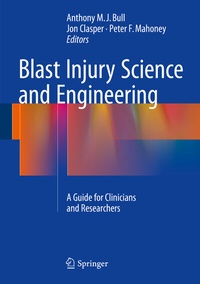
Blast Injury Science and Engineering
Description

This book aims to help clinicians who seek to conduct science and engineering based research on blast injuries as well as engineers and scientists who seek to apply their expertise to address blast injuries.
Blast injuries are prevalent. While the current conflict in Afghanistan is reaching its final stages, the legacy of landmines will sadly ensure that injuries and fatalities will continue to occur. The understanding of these injuries and the science behind their mitigation and treatment is a multi-disciplinary effort. Current knowledge has rapidly grown due to recent conflicts, yet the learning has not yet been captured in any formal way.
Reviews / Votes
"This multiauthored book describes the physics, materials response, engineering principles, and clinical impact of blast injury. . Basic scientists, materials specialists, clinical investigators, and clinicians treating victims of blast injury are an appropriate audience for this book from medical, engineering, military, and law enforcement agencies all based in the U.K. . Engineers will appreciate the mathematics of explosion force, while clinicians will find helpful reviews of physics and incident modeling." (David J. Dries, Doody's Book Reviews, September, 2017)More details
Other editions
New editions
Additional editions
Content
Part 1. Basic Science and Engineering.- 1. The fundamentals of blast physics.- 2. Biomechanics in blast.- 3. Behaviour of materials.- 4. Blast Loading of Cells.- 5. Biological Tissue Response.- Part 2. Weapon Effects and the Human.- 6. Blast Injury Mechanism.- Section 3. Principles of Investigating and Modelling Blast and Blast Mitigation.- 7. The examination of post-blast scenes.- 8. Clinical Forensic Investigation of the 2005 London Suicide Bombings.- 9. Modelling the blast environment and relating this to clinical injury- Experience from the 7/7 Inquest.- 10. The mortality review panel: a report on the deaths on operations of UK Service personnel 2002-2013.- 11. Physical Models- Tissue Simulants.-12. Physical Models- Organ models for primary blast.- 13. In Vivo Models of blast injury.- 14. Modelling Blast brain injury.- 15. Military wound ballistics base study: Development of a Skull/Brain Model.- 16. Surrogates of human injury.- 17. Computational methods in continuum mechanics.-18. Energised fragments: bullets and fragment simulating projectiles.- Part 4. Applications of blast injury research: Solving clinical problems.- 19. Coagulopathy and inflammation: an overview of blast effects.- 20. Foot and Ankle Blast Injuries.- 21. Traumatic Amputation.- 22. Testing and development of mitigation systems for tertiary blast.- 23. Pelvic blast injury.- 24. Behind Armour blunt trauma (BABT).- 25. Blast Injury to the Spine.- 26. Primary Blast Lung Injury.- 27. Regional effec
ts of explosive devices: The neck.- 28. Optimising the anatomical coverage provided by military body Armour systems.- 29. Blast injuries of the Eye.- 30. Hearing damage through blast.- 31. Peripheral Nerve Injuries.