

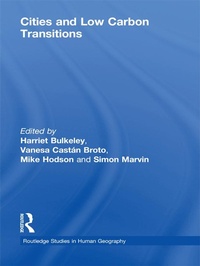
Cities and Low Carbon Transitions
Published on 14. December 2010
224 pages
978-1-136-88326-2 (ISBN)
Description

Current societies face unprecedented risks and challenges connected to climate change. Addressing them will require fundamental transformations in the infrastructures that sustain everyday life, such as energy, water, waste and mobility. A transition to a 'low carbon' future implies a large scale reorganisation in the way societies produce and use energy. Cities are critical in this transition because they concentrate social and economic activities that produce climate change related emissions. At the same time, cities are increasingly recognised as sources of opportunities for climate change mitigation. Whether, how and why low carbon transitions in urban systems take place in response to climate change will therefore be decisive for the success of global mitigation efforts. As a result, climate change increasingly features as a critical issue in the management of urban infrastructure and in urbanisation policies.
Cities and Low Carbon Transitions presents a ground-breaking analysis of the role of cities in low carbon socio-technical transitions. Insights from the fields of urban studies and technological transitions are combined to examine how, why and with what implications cities bring about low carbon transitions. The book outlines the key concepts underpinning theories of socio-technical transition and assesses its potential strengths and limits for understanding the social and technological responses to climate change that are emerging in cities. It draws on a diverse range of examples including world cities, ordinary cities and transition towns, from North America, Europe, South Africa and China, to provide evidence that expectations, aspirations and plans to undertake purposive socio-technical transitions are emerging in different urban contexts.
This collection adds to existing literature on cities and energy transitions and introduces critical questions about power and social interests, lock-in and development trajectories, social equity and economic development, and socio-technical change in cities. The book addresses academics, policy makers, practitioners and researchers interested in the development of systemic responses in cities to curb climate change.
Cities and Low Carbon Transitions presents a ground-breaking analysis of the role of cities in low carbon socio-technical transitions. Insights from the fields of urban studies and technological transitions are combined to examine how, why and with what implications cities bring about low carbon transitions. The book outlines the key concepts underpinning theories of socio-technical transition and assesses its potential strengths and limits for understanding the social and technological responses to climate change that are emerging in cities. It draws on a diverse range of examples including world cities, ordinary cities and transition towns, from North America, Europe, South Africa and China, to provide evidence that expectations, aspirations and plans to undertake purposive socio-technical transitions are emerging in different urban contexts.
This collection adds to existing literature on cities and energy transitions and introduces critical questions about power and social interests, lock-in and development trajectories, social equity and economic development, and socio-technical change in cities. The book addresses academics, policy makers, practitioners and researchers interested in the development of systemic responses in cities to curb climate change.
Reviews / Votes
"It is obvious that cities play a major role in climate change as both sources of problems and sites for solutions. What is less obvious is how to understand processes of urban transformation systematically, and how to frame analysis and practice in ways that offer hope for governing cities along low carbon pathways. This excellent volume, with contributions from leading scholars, puts key considerations on the table, and illustrates how social science can help address that governance challenge." - Adrian Smith, SPRU - Science & Technology Policy Research, University of Sussex"More details
Series
Language
English
Place of publication
London
United Kingdom
Publishing group
Taylor & Francis Ltd
Target group
College/higher education
Product notice
Reflowable
Illustrations
18 s/w Zeichnungen, 9 s/w Tabellen, 8 s/w Photographien bzw. Rasterbilder, 26 s/w Abbildungen
9 Tables, black and white; 18 Line drawings, black and white; 8 Halftones, black and white; 26 Illustrations, black and white
File size
4,86 MB
ISBN-13
978-1-136-88326-2 (9781136883262)
Copyright in bibliographic data and cover images is held by Nielsen Book Services Limited or by the publishers or by their respective licensors: all rights reserved.
Schweitzer Classification
Other editions
Additional editions
Harriet Bulkeley | Vanesa Castan Broto | Mike Hodson
Cities and Low Carbon Transitions
Book
11/2012
1st Edition
Routledge
€83.40
Shipment within 15-20 days
Harriet Bulkeley | Vanesa Castan Broto | Mike Hodson
Cities and Low Carbon Transitions
Book
12/2010
1st Edition
Routledge
€231.60
Shipment within 15-20 days
Persons
Harriet Bulkeley is a Professor at the Department of Geography, and Deputy Director of Durham Energy Institute, Durham University. Her research interests focuses on the nature and politics of environmental governance and on climate change and urban sustainability. She is co-author (with Michele Betsill) of Cities and Climate Change (Routledge, 2003), and currently holds an ESRC Climate Change Leadership Fellowship and a Philip Leverhulme Prize for Geography.
Vanesa Castan Broto is a Lecturer at the Faculty of the Built Environment, University College London. Her research interests focuses on how technology and environmental knowledge mediate the relationship between society and the environment. She has an inter-disciplinary background in engineering and social sciences.
Mike Hodson is Associate Director and Senior Research Fellow at the SURF Centre, University of Salford. His research interests focus on urban and regional transitions to low-carbon economies, the ways in which this may or may not happen and understandings of the lessons to be learned from such processes. He has developed projects funded by the European Commission, UK research councils, sub-national government and through private consultancy.
Simon Marvin is Carillion Chair of Low Carbon Cities, Professor at the Department of Geography and Deputy Director of Durham Energy Institute, Durham University. He is an expert on the changing relations between neighbourhoods, cities, regions and infrastructure networks in a period of resource constraint, institutional restructuring and climate change. Simon's research has been funded by the ESRC, EPSRC, international research foundations, the European Commission, commercial funders and many public agencies. He has co-authored of three internationally leading books on cities and infrastructure.
Vanesa Castan Broto is a Lecturer at the Faculty of the Built Environment, University College London. Her research interests focuses on how technology and environmental knowledge mediate the relationship between society and the environment. She has an inter-disciplinary background in engineering and social sciences.
Mike Hodson is Associate Director and Senior Research Fellow at the SURF Centre, University of Salford. His research interests focus on urban and regional transitions to low-carbon economies, the ways in which this may or may not happen and understandings of the lessons to be learned from such processes. He has developed projects funded by the European Commission, UK research councils, sub-national government and through private consultancy.
Simon Marvin is Carillion Chair of Low Carbon Cities, Professor at the Department of Geography and Deputy Director of Durham Energy Institute, Durham University. He is an expert on the changing relations between neighbourhoods, cities, regions and infrastructure networks in a period of resource constraint, institutional restructuring and climate change. Simon's research has been funded by the ESRC, EPSRC, international research foundations, the European Commission, commercial funders and many public agencies. He has co-authored of three internationally leading books on cities and infrastructure.
Content
1. Introduction Part 1 2. The Role of Cities in Technological Transitions: Analytical Clarifications and Historical Examples 3. Governing Urban Low Carbon Transitions 4. The Carbon Calculus and Transitions in Urban Politics and Political Theory 5. Can Cities Shape Socio-Technical Transitions and How Would We Know If They Were? Part 2 6. Urban Energy Transitions in Chinese Cities 7. The 'Eco-Cities' Freiburg and Graz: The Social Dynamics of Pioneering Urban Energy and Climate Governance 8. The Rise of Post-Nnetworked Cities in Europe? Recombining Infrastructural, Ecological and Urban Transformations in Low-Carbon Transitions 9. Living Laboratories For Sustainability: Exploring The Politics and Epistemology of Urban Transition 10. Municipal Bureaucracies and Integrated Urban Transitions to a Low Carbon Future 11. Community-led Urban Transitions and Resilience: Performing Transition Towns in a City 12. Building Liveable Cities: Urban Low Impact Developments as Low Carbon Solutions? 13. Conclusions
