

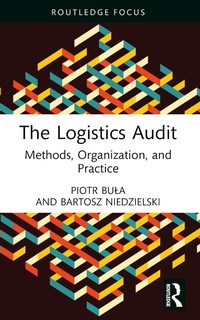
The Logistics Audit
Methods, Organization, and Practice
1st Edition
Published on 1. March 2023
152 pages
978-1-000-88075-5 (ISBN)
Description

Extraordinary technological progress, but also the experience gained from the global COVID-19 pandemic, force the future vision of the world's economic development to assume a close coexistence and intense interaction between production (manufacturing) and logistics and supply-chain management. This perspective requires that the current functioning of organizations will have to be radically remodeled so that they can face not only market competition but also the turbulent changes (volatility, uncertainty, complexity, and ambiguity - VUCA) that take place in their close environment. Therefore, in the next few years, one of the most important tools for improving organizations may become industry audits, especially the logistics audit.
This book explores the development, methods, and impact of logistics audits on organizations. In a holistic way, the book refers to topics such as internal audit, control, logistics system of enterprises, principles of conducting logistics audit and its problem areas (risk), logistics audit of procurement, production, warehousing, distribution, and supply chains, impact of the digital economy on organizations, and the European market for logistics audit services. Undoubtedly, the greatest asset of this book is that, in international terms, it is the first compact book devoted to the issue of logistics audit.
Unique and timely, the book will be an essential resource for academics and postgraduate students of logistics, supply-chain management, and global operations in particular.
This book explores the development, methods, and impact of logistics audits on organizations. In a holistic way, the book refers to topics such as internal audit, control, logistics system of enterprises, principles of conducting logistics audit and its problem areas (risk), logistics audit of procurement, production, warehousing, distribution, and supply chains, impact of the digital economy on organizations, and the European market for logistics audit services. Undoubtedly, the greatest asset of this book is that, in international terms, it is the first compact book devoted to the issue of logistics audit.
Unique and timely, the book will be an essential resource for academics and postgraduate students of logistics, supply-chain management, and global operations in particular.
More details
Series
Edition
1. Auflage
Language
English
Place of publication
London
United Kingdom
Publishing group
Taylor & Francis Ltd
Target group
College/higher education
Professional and scholarly
Illustrations
22 Tables, black and white; 19 Line drawings, black and white; 19 Illustrations, black and white
ISBN-13
978-1-000-88075-5 (9781000880755)
Copyright in bibliographic data and cover images is held by Nielsen Book Services Limited or by the publishers or by their respective licensors: all rights reserved.
Schweitzer Classification
Other editions
Additional editions
Book
10/2024
1st Edition
Routledge
€31.90
Shipment within 10-20 days
Book
03/2023
1st Edition
Routledge
€76.90
Shipment within 10-20 days
Persons
Piotr Bula is an Associate Professor and Head of the International Management Department at Krakow University of Economics (KUE), Poland, Vice-Rector for Projects and Cooperation (KUE), former Director of Cracow School of Business (CUE), Senior Research Professor in Business Management Department at the University of Johannesburg, South Africa, and Grand Valley State University scholarship holder. He is the author or co-author of more than 175 publications in economics and management. His research interests focus on aspects related to the application of artificial intelligence and neuromanagement, risk management, internal audit, international management, and logistics. A member of international organizations associating professors and business practitioners in the management area: EFMD, CEEMAN, IMDA, GBATA, EIBA, GSSI, IAMB, EECSA, SAIMS.
Bartosz Niedzielski is an Assistant Professor at Krakow University of Economics, Poland. He studied and conducted scientific activities, among other subjects, at the University of Greenwich (UK), University of Oxford (UK), London School of Economics (UK), Deggendorf Institute of Technology (DE), and Jagiellonian University (PL). He has over ten years of professional experience gained in global corporations in the BPO/SCC sector (mainly at HSBC). His research interests focus on aspects related to the application of artificial intelligence in organizations, management, and internal audit. He is the author or co-author of more than 50 scientific publications in economics and management, including the monograph entitled Management, Organizations and Artificial Intelligence: Where Theory Meets Practice (Routledge, 2021).
Bartosz Niedzielski is an Assistant Professor at Krakow University of Economics, Poland. He studied and conducted scientific activities, among other subjects, at the University of Greenwich (UK), University of Oxford (UK), London School of Economics (UK), Deggendorf Institute of Technology (DE), and Jagiellonian University (PL). He has over ten years of professional experience gained in global corporations in the BPO/SCC sector (mainly at HSBC). His research interests focus on aspects related to the application of artificial intelligence in organizations, management, and internal audit. He is the author or co-author of more than 50 scientific publications in economics and management, including the monograph entitled Management, Organizations and Artificial Intelligence: Where Theory Meets Practice (Routledge, 2021).
Content
Acknowledgments
Introduction
Chapter 1. Audit: a theoretical approach
1.1. Audit - definitions, types, objectives, mission
1.2. External audit vs. internal audit - similarities and differences
1.3. Evolution of internal audit against the background of audit generation
1.4. Internal audit and controlling - a comparative analysis
1.5. Internal auditor - role, tasks, standards, work
1.6. Control and analytical questions
Chapter 2. Logistics audit: a classical approach
2.1. The enterprise logistics system - definitions, types, treatments
2.2. Logistics audit, as an example of an industry audit
2.3. Logistic audit - organization, stages, procedures
2.4. Problem areas of the logistics audit
2.5. Logistics audit in the era of Industry 4.0
2.6. Control and analytical questions
Chapter 3. Logistics audit: a modular approach
3.1. Logistics audit of procurement
3.2. Logistics audit of production
3.3. The logistics audit of the warehouse
3.4. Logistics audit of distribution
3.5. Logistics audit of the supply chain
3.6. Control and analytical questions
Chapter 4. Logistics audit: a management approach
4.1. Audit - a tool for improving the organization
4.2. Logistics audit in the organization - analysis of the logistics system potential
4.3. Logistics audit in the organization - identification of risks in logistics processes
4.4. The impact of digitalization on the logistics audit
4.5. The current Polish and European market for logistics audit services
4.6. Control and analytical questions
Conclusion
Bibliography
Introduction
Chapter 1. Audit: a theoretical approach
1.1. Audit - definitions, types, objectives, mission
1.2. External audit vs. internal audit - similarities and differences
1.3. Evolution of internal audit against the background of audit generation
1.4. Internal audit and controlling - a comparative analysis
1.5. Internal auditor - role, tasks, standards, work
1.6. Control and analytical questions
Chapter 2. Logistics audit: a classical approach
2.1. The enterprise logistics system - definitions, types, treatments
2.2. Logistics audit, as an example of an industry audit
2.3. Logistic audit - organization, stages, procedures
2.4. Problem areas of the logistics audit
2.5. Logistics audit in the era of Industry 4.0
2.6. Control and analytical questions
Chapter 3. Logistics audit: a modular approach
3.1. Logistics audit of procurement
3.2. Logistics audit of production
3.3. The logistics audit of the warehouse
3.4. Logistics audit of distribution
3.5. Logistics audit of the supply chain
3.6. Control and analytical questions
Chapter 4. Logistics audit: a management approach
4.1. Audit - a tool for improving the organization
4.2. Logistics audit in the organization - analysis of the logistics system potential
4.3. Logistics audit in the organization - identification of risks in logistics processes
4.4. The impact of digitalization on the logistics audit
4.5. The current Polish and European market for logistics audit services
4.6. Control and analytical questions
Conclusion
Bibliography
