

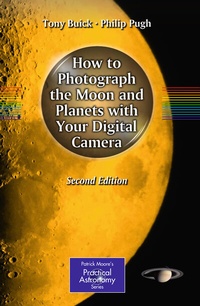
How to Photograph the Moon and Planets with Your Digital Camera
Description

Although astronomical CCD cameras can be very costly, digital cameras - the kind you use on holiday - on the other hand, are relatively inexpensive. Moreover, their technology - especially thermal noise, sensitivity (ISO number) and resolution - has progressed to a point where such cameras are more than capable of photographing the brighter astronomical objects.
Now Tony Buick has teamed up with fellow author and astro imager Phil Pugh, to produce a completely revised, updated, and extended second edition to How to Photograph the Moon and Planets with your Digital Camera, first published in 2006. The revisions take into account changing (and improving) camera technology, and some items which are now available commercially but which previously had to be home-made. The section of solar observing has been expanded to include observing by H-alpha light, and among the many additional sections are photographing the constellations, aurorae, and basic post-imaging processing.
Reviews / Votes
On the first edition (2006): Buick, an experienced amateur astronomer, uses his own images... to illustrate a variety of equipment... [N]ovice imagers can rest assured that the images here are what the beginner can realistically expect to achieve... I enjoyed this book, and learned from it too. --Peter Grego, in Popular Astronomy, July-September 2006 The color images he has produced - there are over 300 of them in the book - are of breathtaking quality. His book is more than a manual of techniques (including details of how to make a low-cost DIY camera mount) and examples; it also provides a concise photographic atlas of the whole of the nearside of the Moon - with every image made using a standard digital camera - and describes the various lunar features, including the sites of manned and robotic landings. --eBook30.comMore details
Other editions
Additional editions
Persons
Content
Note on the Second Edition by Philip Pugh.- Foreword by Sir Patrick Moore.- Preface.- Chapter 1: Introduction.- Chapter 2: Choosing Your Equipment.- Chapter 3: Setting Up.- Chapter 4: Photographing the Phases of the Moon.- Chapter 5: Identifiying Regions of the Moon.- Chapter 6: Techniques for Photographing the Moon.- Chapter 7: Photographing Lunar Events.- Chapter 8: Processing Lunar Images.- Chapter 9: Solar System Moons.- Chapter 10: Photographing the Planets.- Chapter 11: The Sun.- Chapter 12: Transits.- Chapter 13: And What Else?.- Chapter 14: A Few Final Words.- Appendix.- Glossary.- Index.
