

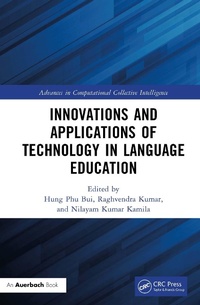
Innovations and Applications of Technology in Language Education
1st Edition
Published on 12. July 2024
228 pages
978-1-040-02219-1 (ISBN)
Description

The linguistics and language education world has recently experienced a rapidly proliferating interest in applying technology. This interdisciplinary area bridges the gap between two previously separate fields.
Innovations and Applications of Technology in Language Education is a collection of 12 chapters by an international group of language and linguistics education experts. Although technology in language education is a global interest, its practices should be contextualized. This book covers how language educational technology is currently applied, discusses how it should be applied, and gives directions for its future development.
Providing a critical review of respective current practices and perspectives, this book begins by presenting a set of research-based principles for developing second language teachers' professionalism. It then examines the use of technology to enhance students' English language skills. Acknowledging the advantages and disadvantages of AI-mediated communication, this book argues for the use of AI to facilitate communication in language education. It also proposes the use of AI to develop and administer language tests and suggests guidelines for practitioners to deploy AI in developing and administering language tests efficiently. This book concludes by discussing technology for specific purposes in second language education and the potential of computer-mediated communication (CMC) to enhance interaction between students.
Innovations and Applications of Technology in Language Education is a collection of 12 chapters by an international group of language and linguistics education experts. Although technology in language education is a global interest, its practices should be contextualized. This book covers how language educational technology is currently applied, discusses how it should be applied, and gives directions for its future development.
Providing a critical review of respective current practices and perspectives, this book begins by presenting a set of research-based principles for developing second language teachers' professionalism. It then examines the use of technology to enhance students' English language skills. Acknowledging the advantages and disadvantages of AI-mediated communication, this book argues for the use of AI to facilitate communication in language education. It also proposes the use of AI to develop and administer language tests and suggests guidelines for practitioners to deploy AI in developing and administering language tests efficiently. This book concludes by discussing technology for specific purposes in second language education and the potential of computer-mediated communication (CMC) to enhance interaction between students.
More details
Series
Edition
1. Auflage
Language
English
Place of publication
London
United Kingdom
Publishing group
Taylor & Francis Ltd
Target group
Professional and scholarly
Illustrations
31 Tables, color; 9 Line drawings, color; 3 Line drawings, black and white; 9 Halftones, color; 18 Illustrations, color; 3 Illustrations, black and white
ISBN-13
978-1-040-02219-1 (9781040022191)
Copyright in bibliographic data and cover images is held by Nielsen Book Services Limited or by the publishers or by their respective licensors: all rights reserved.
Schweitzer Classification
Other editions
Additional editions
Hung Phu Bui | Raghvendra Kumar | Nilayam Kumar Kamila
Innovations and Applications of Technology in Language Education
Book
approx. 12/2025
1st Edition
Auerbach
€95.00
Not yet published
Hung Phu Bui | Raghvendra Kumar | Nilayam Kumar Kamila
Innovations and Applications of Technology in Language Education
Book
07/2024
1st Edition
Auerbach
€242.30
Shipment within 10-20 days

Hung Phu Bui | Raghvendra Kumar | Nilayam Kamila
Innovations and Applications of Technology in Language Education
Book
05/2024
CRC Press
Unfortunately, price unknown
Available (delivery time upon request)
Persons
Hung Phu Bui holds a PhD in language education. He is now a lecturer and researcher at School of Foreign Languages, University of Economics Ho Chi Minh City (UEH University). Hung also serves as an editor for several international journals. His research interests have stretched across different aspects of second/ foreign language (L2) education and technology in language education. His recently published works have mainly concentrated on applications of cognitive linguistics in L2 acquisition, sociocultural theory in L2 acquisition, L2 students' interaction, L2 classroom assessment, teaching English for specific purposes, and computer-assisted language teaching and learning. Serving as the keynote and plenary speaker in many national and international conferences in the world, Hung has had opportunities to spread his knowledge and research interests to students, colleagues, and novice researchers in Asia.
Raghvendra Kumar is an Associate Professor in Technology at GIET University, India. He holds a PhD in applied technology. He spent his postdoctoral fellowship at Institute of Information Technology, Virtual Reality and Multimedia, Vietnam. He has served as an editor for many international journals and publishers (e.g., Springer, Taylor & Francis) and as a keynote speaker at many international renown conferences His research areas include computer networks, data mining, cloud computing and secure multiparty computations, and algorithms. He authored and edited 23 computer science books in the respective fields.
Nilayam Kumar Kamila is a lead software engineer in Capital One Wilmington, USA. He holds a PhD in applied technology. He received his multiple masters and certificates from India and United States of America. He is especially interested in educational technology. He has expertise on application development and innovative system designs. His publications mainly focus on applications of artificial intelligence in management, machine learning, and wireless sensor network. He has published many journal articles and book chapters with international large publishers, such as Elsevier and Springer. He has also attended several international conferences around the world. For further information about him, please contact nilayam.kamila@gmail.com.
Raghvendra Kumar is an Associate Professor in Technology at GIET University, India. He holds a PhD in applied technology. He spent his postdoctoral fellowship at Institute of Information Technology, Virtual Reality and Multimedia, Vietnam. He has served as an editor for many international journals and publishers (e.g., Springer, Taylor & Francis) and as a keynote speaker at many international renown conferences His research areas include computer networks, data mining, cloud computing and secure multiparty computations, and algorithms. He authored and edited 23 computer science books in the respective fields.
Nilayam Kumar Kamila is a lead software engineer in Capital One Wilmington, USA. He holds a PhD in applied technology. He received his multiple masters and certificates from India and United States of America. He is especially interested in educational technology. He has expertise on application development and innovative system designs. His publications mainly focus on applications of artificial intelligence in management, machine learning, and wireless sensor network. He has published many journal articles and book chapters with international large publishers, such as Elsevier and Springer. He has also attended several international conferences around the world. For further information about him, please contact nilayam.kamila@gmail.com.
Content
Editors. Preface. List of Contributors. Section I TECHNOLOGY-ASSISTED LANGUAGE EDUCATION. 1 Professional Learning for CALL Teachers: A Research-Based Approach. 2 Designing and Implementing WhatsApp Communication Tasks for the English as a Foreign Language Classroom: A Case Study. 3 Evaluation of ELSA Speak Used by Vietnamese University EFL Students. 4 Critical Appraisal of Artificial Intelligence-Mediated Communication in Language Education. 5 "Write It Out!": Using Digital Storytelling (DST) to Positively Engage Pre-Service EFL Teachers with Digital Content and to Enhance Their Writing Skills. 6 Revitalizing English Language Learning: An Exploration of ChatGPT's Impact on Student Engagement and Motivation. Section II TECHNOLOGY-ASSISTED LANGUAGE TESTING AND ASSESSMENT. 7 Technology-Based Language Testing: Principles and Future Directions. 8 Technology-Assisted Task-Based Second Language Assessment for Learning. 9 The Use of Artificial Intelligence in Language Test Development and Administration: What, How, and Why. Section III USING TECHNOLOGY FOR SPECIFIC PURPOSES IN LANGUAGE EDUCATION. 10 Using Asynchronous Computer-Mediated Communication to Increase Students' Out-of-Class Interaction. 11 Impacts of a Blended Learning Model on EFL Students' Engagement and English Proficiency: Evidence from IELTS Preparation Courses. 12 EFL Teachers' Informal Digital Learning of English and Its Effects on Their Instructional Willingness to Communicate in English. Appendix A: Pre-Test and Post-Test Questionnaires. Appendix B: Feedback Questionnaire on ChatGPT.
