

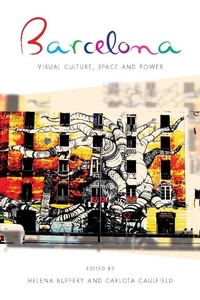
Barcelona
Visual Culture, Space and Power
1st Edition
Published on 15. April 2014
304 pages
978-1-78316-143-0 (ISBN)
Description

Barcelona: Visual Culture, Space and Power offers a unique approach to the history of the avantgarde in Barcelona, as well as its legacy in the post-war period. It presents the relationship between environment, identity and performance as explored by countercultural artists and communities from the 1960s to the present day.
More details
Series
Edition
1. Auflage
Language
English
Place of publication
Wales
United Kingdom
Product notice
Reflowable
Illustrations
Not illustrated
ISBN-13
978-1-78316-143-0 (9781783161430)
DOI
10.1234/b10452
Copyright in bibliographic data and cover images is held by Nielsen Book Services Limited or by the publishers or by their respective licensors: all rights reserved.
Schweitzer Classification
Other editions
Additional editions
Book
04/2014
University of Wales Press
€36.11
Shipment within 3-4 weeks
Book
06/2012
University of Wales Press
€25.00
Article exhausted; check for reprint
Content
- Intro
- Series Editors' Foreword
- Acknowledgements
- List of Illustrations
- List of Contributors
- Introduction: 'Butterflying Barcelona'
- Part I: Avant-Garde Histories and Catalonia
- Chapter 1: Breaking Boundaries: A Journey through the Catalan Avant-Garde
- Chapter 2: On the Starfish Road: Surrealism and the Paris-Barcelona Connection
- Chapter 3: The Lyrical Taboos of Guillem Viladot
- Chapter 4: Cafè Central: a groundbreaking independent publishing house in Barcelona. Interview with
- Part II: Butterflying Barcelona: The Environment
- Chapter 5: The Case for Obsolescence: Thinking Time and Space in Joaquim Jordà's Numax presenta
- Chapter 6: Whose Vanguardist City? The Barcelona Urban Model as Seen from the Periphery in José Luis
- viChapter 7: The Raval on Stage: Limits and Borders in Juan Mayorga's Hamelin
- Chapter 8: Translating the Enigma: Temporality and Subjectivity in Ventura Pons's Barcelona: un mapa
- Chapter 9: Empowerment by Visualization: Experiences from Barcelona
- Part III: Performing Barcelona
- Chapter 10: Tracing the City through the URBS Project
- Chapter 11: Performing Barcelona: Cultural Tourism, Geography and Identity
- Chapter 12: Absent Bodies and Objects
- Chapter 13: A Broken Mirror? Global-Local Images of Barcelona
- Chapter 14: Talking about Visual Poetry: Interviews with J. M. Calleja, Gustavo Vega and Xavier Cana
- Works Cited
- Figure 0.1. Xavier Canals during action poem 'Butterflying Barcelona', 15 March 2008. Photograph by
- Figure 1.1. 'Electrographic Poem' by Xavier Canals, for the Festival de Poesia Visual dels Països Ca
- Figure 1.2. 'Voyeur' by J. M. Calleja, 1978.
- Figure 1.3. Tarot cards by J. M. Calleja, Xavier Canals and Gustavo Vega. Image used for exhibition
- Figure 2.1. The Dalí brand used as part of a Turespaña campaign - 'Spain Marks'. Courtesy of TURESPA
- Figure 3.1. Object poem from the collection 'SELF', by Guillem Viladot. Courtesy of Fundació Lo Pard
- Figure 3.2. Figure 2. Object poem by Guillem Viladot, later entitled 'El principi del plaer'. Courte
- Figure 5.1. 'Celebrating the end of the Numax experience of self-management'. Still from Numax prese
- Figure 5.2. 'The space of work re-signified as lived space'. Still from Numax presenta, 1980. Courte
- Figure 5.3. 'Vacated space of work'. Still from Numax presenta, 1980. Courtesy of María Antonia Madr
- Figure 6.1. 'Barcelona's industrial chimneys transformed'. Still from En construcción. Courtesy of T
- Figure 6.2. ' Juani and Ivan's hands'. Still from En construcción. Courtesy of TV Ovideo.
- Figure 6.3. 'Barcelona's shadows'. Still from En construcción. Courtesy of TV Ovideo.
- Figure 7.1. The Romea Theatre in Carrer de l'Hospital, Barcelona. Courtesy of Animalario.
- Figure 7.2. Press photograph from Animalario production of Juan Mayorga's Hamelin. Courtesy of Anima
- Figure 8.1. Poster for Ventura Pons's Barcelona (un mapa). Courtesy of Ventura Pons.
- Figure 8.2. Characters screaming in front of Sagrada Família. Still from Barcelona (un mapa). Courte
- Figure 9.1. Women being trained as workshop moderators by the Institut Català de les Dones, 2004.
- Figure 9.2. Visualizing the city as a comfortable place for sports.
- Figure 9.3. Comparing the mobility patterns in Barcelona.
- Figure 9.4. Preparing for role play, identifying key arguments for each of the stakeholders. Photogr
- Figure 9.5. Choosing priorities from a longlist of items to improve the living environment.
- Figure 9.6. Representation of Plaça del Carme, Barcelona.
- Figure 9.7. Rare example of visualization without spatial dimension or critical reflection.
- Figure 10.1. Image from 'Geografies', part of Solo por placer. Photographed by Ros Ribas. Courtesy o
- Figure 10.2. Still from the 'movies' created for the URBS project. An urban intervention by dancers
- Figure 10.3. Stills from the performances of URBS#1/Casting.
