

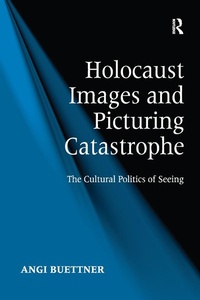
Holocaust Images and Picturing Catastrophe
The Cultural Politics of Seeing
Published on 5. December 2016
216 pages
978-1-351-93052-9 (ISBN)
Description

Holocaust Images and Picturing Catastrophe explores the phenomenon of Holocaust transfer, analysing the widespread practice of using the Holocaust and its imagery for the representation and recording of other historical events in various media sites. It investigates the use of Holocaust imagery in political and legal discourses, in critical thinking and philosophy, as well as in popular culture, to provide a fresh theorisation of the manner in which the Holocaust comes loose from its historical context and is applied to events and campaigns in the contemporary public sphere. Richly illustrated with concrete examples, including prominent, international animal rights activism, the Israeli-Palestinian conflict and the genocide in Rwanda, this book traces the visual rhetoric of Holocaust imagery and its application to events other than the genocide of Jewish people With its discussion of the wide range of issues arising with this form of 'Holocaust-transfer', the generalization of the Holocaust as a metaphor in representations of catastrophe, as well as in other cultural locations, Holocaust Images and Picturing Catastrophe will appeal to those working in the fields of holocaust studies, cultural and visual culture studies, sociology, and media studies.
Reviews / Votes
A Baker & Taylor Academic Essentials Title in Genocide Studies 'At last, an author who is not afraid to examine the politics of the use of Holocaust imagery. Buettner's ground-breaking study enables us to understand not only why these images, rather than other catastrophes, have come to hold such tremendous power but also how their use evokes affect in a wide range of recent catastrophes and causes. I highly recommend it.' Jon Stratton, Curtin University, Australia 'This is an exceptionally intelligent, brave and perceptive work of cultural criticism, which deals with a genre of traumatic visual imagery that helped define the last century, in order to demonstrate why we need to better understand the "politics of seeing" that shapes the production and cultural reception of images in the news.' Graeme Turner, University of Queensland, Australia 'Although Holocaust images can be open to interpretation and misinterpretation, they are also crucial to understanding in our search for explanations, for archival memory and attempts to curate impartial, objective resources such as the Legacy Project which is mentioned in the final chapter. With so many competing, charged emotions and beliefs, this cannot have been an easy book to write, but Buettner has succeeded in producing a thoroughly well-researched and original study which will particularly interest those working in the fields of cultural and media studies. Studies such as this are useful in understanding the way we see and look and the context in which images are presented. It can be recommended.' Online Information Review 'Holocaust Images and Picturing Catastrophe makes a worthwhile contribution to this emerging field of study. ... for those working in the fields of visual/ media studies and identity politics, Buettner's insights into the workings of visual analogy and the cultural reproduction of images, her deployment of a wide variety of examples, and her explication of the fundamental and multifaceted rolMore details
Language
English
Place of publication
London
United Kingdom
Publishing group
Taylor & Francis Ltd
Target group
College/higher education
Product notice
Reflowable
File size
1,53 MB
ISBN-13
978-1-351-93052-9 (9781351930529)
Copyright in bibliographic data and cover images is held by Nielsen Book Services Limited or by the publishers or by their respective licensors: all rights reserved.
Schweitzer Classification
Other editions
Additional editions
Book
11/2016
1st Edition
Routledge
€75.50
Shipment within 10-20 days
Book
10/2011
1st Edition
Routledge
€217.50
Shipment within 10-20 days
Person
Angi Buettner is Lecturer in Media Studies in the School of English, Film, Theatre, and Media Studies, at the Victoria University of Wellington, New Zealand
Content
Contents: Introduction: aftermaths and the afterlife of images; Aftermaths and the Holocaust; Holocaust into Holocausts; Never again: Rwanda, genocide, and the Holocaust; Leaving history behind: memorials and the dead of genocide; Leaving victims behind: animal rights, environmental catastrophe, and the limits of the Holocaust; The Holocaust as master theory; The act of looking: suffering the search for explanations, and the image as accusation; References; Index.
