

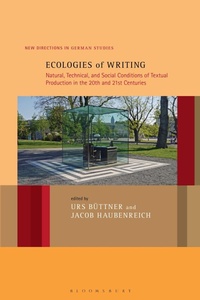
Ecologies of Writing
Natural, Technical, and Social Conditions of Textual Production in the Twentieth and Twenty-First Centuries
1st Edition
Published on 30. October 2025
240 pages
979-8-7651-2447-5 (ISBN)
Description

Drawing from case studies in 20th century German literature and theory, the contributors to this volume explore the multiple dimensions behind and alongside authorship that constitutes the "ecology" of writing.
Over the last few decades, a resurgence of interest in historical and contemporary writing processes, fueled in part by the development of digital media, has developed alongside the emergence of new conceptions of material-human agency and the environment. What would it mean to apply these conceptions to the phenomenon of writing? As the essays in this volume explore, writing is never the purely mental activity of a solitary mind; it is inherently socially embedded and always more-than-human.
Examining the early 20th century to the present, a period of dramatic media-technological transition in which writers become increasingly self-reflexive and responsive to the materials and changing environmental circumstances of their craft, Ecologies of Writing expands the frame to encompass the vast array of material, social, environmental, and economic influences that all inform the practice of writing. Case studies draw on German-language literature and theory, including works by Franz Kafka, Thomas Mann, and W. G. Sebald, and recent theories of human-material agency, media theory, and ecocriticism.
Over the last few decades, a resurgence of interest in historical and contemporary writing processes, fueled in part by the development of digital media, has developed alongside the emergence of new conceptions of material-human agency and the environment. What would it mean to apply these conceptions to the phenomenon of writing? As the essays in this volume explore, writing is never the purely mental activity of a solitary mind; it is inherently socially embedded and always more-than-human.
Examining the early 20th century to the present, a period of dramatic media-technological transition in which writers become increasingly self-reflexive and responsive to the materials and changing environmental circumstances of their craft, Ecologies of Writing expands the frame to encompass the vast array of material, social, environmental, and economic influences that all inform the practice of writing. Case studies draw on German-language literature and theory, including works by Franz Kafka, Thomas Mann, and W. G. Sebald, and recent theories of human-material agency, media theory, and ecocriticism.
More details
Series
Edition
1. Auflage
Language
English
Place of publication
United States
Publishing group
Bloomsbury Publishing Plc
Target group
Professional and scholarly
College/higher education
Illustrations
10 b&w illustrations
ISBN-13
979-8-7651-2447-5 (9798765124475)
Copyright in bibliographic data and cover images is held by Nielsen Book Services Limited or by the publishers or by their respective licensors: all rights reserved.
Schweitzer Classification
Other editions
Additional editions
Urs Buettner | Jacob Haubenreich
Ecologies of Writing
Natural, Technical, and Social Conditions of Textual Production in the Twentieth and Twenty-First Centuries
Book
approx. 11/2025
Bloomsbury Academic USA
€121.50
Not yet published
Persons
Urs Büttner is Feodor Lynen Fellow of the Alexander von Humboldt Foundation at the University of Oxford, UK. He previously held positions at Leibniz University Hannover, Free University Berlin and Heinrich Heine University Düsseldorf. He taught as Max Kade Professor at the University of Illinois at Urbana-Champaign and received a Visiting Scholarship at the Institute of Advanced Studies at the University of Durham.
Jacob Haubenreich is Assistant Professor in the Department of Modern Languages and Literatures at Johns Hopkins University, USA. He has previously held positions at Southern Illinois University, Carbondale and the College of the Holy Cross, as well as positions as Visiting Scholar at the Austrian Academy of Sciences and in the Marbach Weimar Wolfenbüttel Research Association.
Jacob Haubenreich is Assistant Professor in the Department of Modern Languages and Literatures at Johns Hopkins University, USA. He has previously held positions at Southern Illinois University, Carbondale and the College of the Holy Cross, as well as positions as Visiting Scholar at the Austrian Academy of Sciences and in the Marbach Weimar Wolfenbüttel Research Association.
Content
Introduction: An Expanded Perspective on Textual Creation
Urs Büttner (Heinrich Heine Universität Düsseldorf, Germany) and Jacob Haubenreich (Johns Hopkins University, USA)
Part I. Materialities
1. The Field of Writing: The Ambulatory Art of Noticing Third Nature in Sebald and Kinsky, Jason Groves (University of Washington, USA)
2. Street Writing and Contemporary German Streetscapes, Peter Schweppe (Montana State University, USA)
Part II. Mediality and Technical Devices
3. Lines of Force: Writing Theory and the Energetic Scripts of Modernism, Susanne Strätling (Freie Universität Berlin, Germany)
4. An Updated Superscript: Paradoxes of Writing Amidst Generative AI, Richard Gibson (Wheaton College, USA)
Part III. Mind and Body
5. "This Conflict between the Soul's Inclination and the Body's Capabilities": Writing Hygiene in Thomas Mann's Death in Venice, Urs Büttner (Heinrich Heine Universität Düsseldorf, Germany)
6. Immersion and its Discontents: Kafka's Ecology of Attention, Carolin Duttlinger (University of Oxford, UK)
Part IV. Social Conditions
7. In the Machine Room: Writing between Author and Editor, ca. 1900-2000, Ines Barner (ETH Zurich, Switzerland) translated by Eric Hounshell
8. Writing as Work: Towards a Theory of Literary Production, Carolin Amlinger (University of Basel, Switzerland)
Notes on Contributors
Index
Urs Büttner (Heinrich Heine Universität Düsseldorf, Germany) and Jacob Haubenreich (Johns Hopkins University, USA)
Part I. Materialities
1. The Field of Writing: The Ambulatory Art of Noticing Third Nature in Sebald and Kinsky, Jason Groves (University of Washington, USA)
2. Street Writing and Contemporary German Streetscapes, Peter Schweppe (Montana State University, USA)
Part II. Mediality and Technical Devices
3. Lines of Force: Writing Theory and the Energetic Scripts of Modernism, Susanne Strätling (Freie Universität Berlin, Germany)
4. An Updated Superscript: Paradoxes of Writing Amidst Generative AI, Richard Gibson (Wheaton College, USA)
Part III. Mind and Body
5. "This Conflict between the Soul's Inclination and the Body's Capabilities": Writing Hygiene in Thomas Mann's Death in Venice, Urs Büttner (Heinrich Heine Universität Düsseldorf, Germany)
6. Immersion and its Discontents: Kafka's Ecology of Attention, Carolin Duttlinger (University of Oxford, UK)
Part IV. Social Conditions
7. In the Machine Room: Writing between Author and Editor, ca. 1900-2000, Ines Barner (ETH Zurich, Switzerland) translated by Eric Hounshell
8. Writing as Work: Towards a Theory of Literary Production, Carolin Amlinger (University of Basel, Switzerland)
Notes on Contributors
Index
