

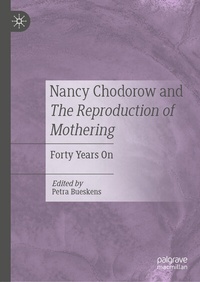
Nancy Chodorow and The Reproduction of Mothering
Description

This book analyzes Nancy Chodorow's canonical book The Reproduction of Mothering, bringing together an original essay from Nancy Chodorow and a host of outstanding international scholars-including Rosemary Balsam, Adrienne Harris, Elizabeth Abel, Madelon Sprengnether, Ilene Philipson, Meg Jay, Daphne de Marneffe, Alison Stone and Petra Bueskens-in a mix of memoir, festschrift, reflection, critical analysis and new directions in Chodorowian scholarship. In the 40 years since its publication, The Reproduction of Mothering has had a profound impact on scholarship across many disciplines including sociology, psychoanalysis, psychology, ethics, literary criticism and women's and gender studies. Organized as a "reproduction of mothering scholarship", this volume adopts a generationally differentiated structure weaving personal, political and scholarly essays.
This book will be of interest to scholars across the social sciences and humanities. It willbring Nancy Chodorow and her canonical work to a new generation showcasing classic and contemporary Chodorowian scholarship.
Reviews / Votes
"This edited volume consists of fifteen original chapters, including a substantial introduction by editor and coauthor Petra Bueskens. The chapters are organized into three sections that respectively represent the three generations of scholars who have been influenced by Chodorow and her work, and by The Reproduction of Mothering in particular. ... This is Chodorow's gift and, as this book reminds us, the gift of so many of her scholarly progeny." (Caroline Lundquist, Simone de Beauvoir Studies, Vol. 34 (1), 2023)
More details
Other editions
Additional editions
Person
Petra Bueskens is an Honorary Fellow in the School of Social and Political Sciences at the University of Melbourne, Australia and a psychotherapist in private practice.
Content
1.Introduction: The Reproduction of Mothering Turns Forty.- 2. Women Mother Daughters: The Reproduction of Mothering after Forty Years.- 3. The Reproduction of Mothering: Forty Years On.- 4. Reminiscing and Reflecting on Nancy Chodorow's The Reproduction of Mothering.-5. Thinking Back through our Mothers: Virginia Woolf, Nancy Chodorow, and Me.- 6. The Impact of Nancy Chodorow's The Reproduction of Mothering and its Implications for the Future.- 7. The Reproduction of Mothering: A Love Story.- 8. Mothering in Life and Therapy: An Appreciation of Chodorow's Lifelong Contribution. - 9.Mother Figures: On Becoming the Mother One Wishes One Had.- 10. The Production of Male Mothering. -11. Lesbian Desire and the Female Subject: Full Circle with Chodorow.- 12. Mother-Daughter Relations and the Maternal in Irigaray and Chodorow.- 13. Mothers Reproducing the Social: Chodorow and Beyond.- 14. Mirroring a Mother's Love: A Chodorowian Analysis of the Complicated Relationship Between Mothers and Nannies.- 15. The Reproduction of Mothering: Unlocking Italian Women's Fiction from the Fin-de-Siècle Onwards.
