

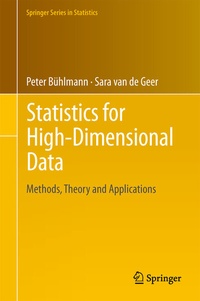
Statistics for High-Dimensional Data
Description

Modern statistics deals with large and complex data sets, and consequently with models containing a large number of parameters. This book presents a detailed account of recently developed approaches, including the Lasso and versions of it for various models, boosting methods, undirected graphical modeling, and procedures controlling false positive selections.
A special characteristic of the book is that it contains comprehensive mathematical theory on high-dimensional statistics combined with methodology, algorithms and illustrations with real data examples. This in-depth approach highlights the methods' great potential and practical applicability in a variety of settings. As such, it is a valuable resource for researchers, graduate students and experts in statistics, applied mathematics and computer science.
Reviews / Votes
From the reviews:
"This book is a complete study of l 1 -penalization based statistical methods for high-dimensional data . . Definitely, this book is useful. . its strong level in mathematics makes it more suitable to researchers and graduate students who already have a strong background in statistics. . it gives the state-of-the-art of the theory, and therefore can be used for an advanced course on the topic. . the last part of the book is an exciting introduction to new research perspectives provided by l 1 -penalized methods." (Pierre Alquier, Mathematical Reviews, Issue 2012 e)
"All Classical Statisticians interested in the very popular but a bit old methodologies like the Lasso (Tibshirani, 1996), its modifications like adaptive Lasso (Zou, 2006), and their theory, computational algorithms, applications to bioinformatics and other high dimensional applications. All such researchers would find this book worth buying. It is written by two outstanding theoreticians with flair for clear writing and excellent applications. . theory depends a lot on new concentration inequalities coming from the French probabilists. The book has good collection of these, with proofs." (Jayanta K. Ghosh, International Statistical Review, Vol. 80 (3), 2012)
More details
Other editions
Additional editions
Persons
Peter Bühlmann is Professor of Statistics at ETH Zürich. His main research areas are high-dimensional statistical inference, machine learning, graphical modeling, nonparametric methods, and statistical modeling in the life sciences. He is currently editor of the Annals of Statistics. He was awarded a Medallion lecture by the Institute of Mathematical Statistics in 2009 and read a paper to the Royal Statistical Society in 2010.
Sara van de Geer
has been a full professor at the ETH in Zürich since 2005. Her main areas of research are empirical process theory, statistical learning theory, and nonparametric and high-dimensional statistics. She is an associate editor of Probability Theory and Related Fields, The Scandinavian Journal of Statistics and Statistical Surveys and a member of the Swiss National Science Foundation and correspondent of the Dutch Royal Academy of Sciences.
She received the IMS medal in 2003 and the ISI award in 2005, and was an invited speaker at the International Conference of Mathematicians in 2010.
