

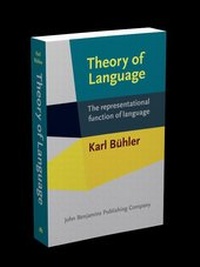
Theory of Language
The representational function of language
1st Edition
Published in 2011
XCVIII, 518 pages
978-90-272-8686-4 (ISBN)
Description

Karl Bühler (1879-1963) was one of the leading theoreticians of language of the twentieth century. Although primarily a psychologist, Bühler devoted much of his attention to the study of language and language theory. His masterwork Sprachtheorie (1934) quickly gained recognition in the fields of linguistics, semiotics, the philosophy of language and the psychology of language. This new edition of the English translation of Bühler's theory begins with a survey on 'Bühler's legacy' for modern linguistics (Werner Abraham), followed by the Theory of Language, and finally with a special 'Postscript: Twenty-five Years Later .' (Achim Eschbach). Bühler's theory is divided into four parts. Part I discusses the four axioms or principles of language research, the most famous of which is the first, the organon model, the base of Bühler's instrumental view of language. Part II treats the role of indexicality in language and discusses deixis as one determinant of speech. Part III examines the symbolic field, dealing with context, onomatopoeia and the function of case. Part IV deals with the elements of language and their organization (syllabification, the definition of the word, metaphor, anaphora, etc).The text is accompanied by an Introduction (Achim Eschbach); Translator's preface (Donald Fraser Goodwin); Glossary of terms; and a Bibliography of cited works.
More details
Other editions
Additional editions
Book
04/2011
John Benjamins Publishing Co
€47.70
Shipment within 10-15 days
Persons
Content
- Theory of Language
- Title page
- LCC data
- Table of Contents
- Preface: Traces of Bühler's Semiotic Legacy in Modern Linguistics
- 1. What is at stake?
- 2. Deixis differential: weak and strong
- 2.1. The function of deixis
- 2.2. Topic in adult competence and in early acquisition
- 2.3. Interim conclusion
- 3. Bühler's Organon model (Bühler 1934, English version 1990)
- 4. The linguistic model devised by Tokieda (1950)
- 5. Deictic and anaphoric perspectives of linguistic description
- 6. I-mode and D-mode
- 7. Referencing mode and the typological criterion
- 7.1. Reference to person
- 7.2. Language typologies in terms of do vs. become
- 7.3. The Japanese evaluating sentence, han-bun dan, and Bühler's origo concept
- 8. Pronouns and reflexives
- 8.1. Reflexives in Japanese: their non-anaphoric status
- 8.2. 'Personal pronouns' in Japanese: pronominal reference vs. full nominalreference
- 9. Indexicals
- 9.1. Indexicals and deictics
- 9.2. Pure indexicals and true demonstratives
- 9.3. Multiple indexing
- 10. Comparison
- 11. Conclusion
- References
- Editor's Introduction - Karl Bühler: Sematologist
- I.
- II.
- III.
- References
- 2. Manuscripts in Bühler's Literary Estate.
- 3. Archive materials and documents related to administrative processes.
- Notes
- Translator's Preface
- KARL BUHLER: THEORY OF LANGUAGE THE REPRESENTATIONAL FUNCTION OF LANGUAGE
- Preface
- Introduction: Theory of Language Yesterday and Today
- 0. Historical works
- 1. Paul's "Principles of the History of Language" - dependency on Descartes - natural sciences and history
- 2. Saussure's "Course" - substance-oriented thought in the nineteenth century
- 3. Husserl's programme in the "Logical Investigations
- PART I. The Principles of Language Research
- 1. Idea and Plan of the Axiomatics
- 1.0 Observations and the ideas guiding research
- 1.1 Exact recordings - three manners of understanding
- 1.2 Initial object of linguistic research - the conceptual world of the linguistic researcher
- 1.3 Axioms of language research
- 1.4 The four principles
- 2. The Model of Language as Organon (A)
- 2.0 Manners of appearance of the concrete speech event
- 2.1 Inadequacy of the causal view of substance-oriented thought
- 2.2 The new model: the three semantic functions of language
- 2.3 Expression and appeal as independent variables in addition to representation - the three books on language
- 3. The Significative Nature of Language (B)
- 3.0 The constructive model of language
- 3.1 The etyma of the words for sign
- 3.2 Direct analysis of the concept of sign - comparative psychology - a general formula
- 3.3 "Aliquid stat pro aliquo": two determinations
- 3.4 The principle of abstractive relevance, illustrated by phonology
- 3.5 The problem of abstraction
- 3.6 Two forms of material fallacy
- 4. Speech Action and Language Work
- Speech Act and Language Structure (C)
- 4.0 Inadequacy of previous dichotomies: the four-celled pattern
- 4.1 Speech action and language work - empractical speech - la parole
- 4.2 The work of art in language - the theory of speech action
- 4.3 The structures in language - criticism - structural survey in linguistics - the higher level of formalization - comparisons outside the linguistic realm - intersubjectivity
- 4.4 Theory of speech acts - Steinthal and Husserl - appreciation of Husserl's theory of acts - the social factor in language
- 5. Word and Sentence. The S-F-System of the Type Language (D)
- 5.0 The features of the concept of language
- 5.1 Analysis of a one-class system of communicative signals
- 5.2 The two-class system language - the dogma of lexicon and syntax
- 5.3 The productivity of field systems
- 5.4 Logic and linguistics
- PART II. The Deictic Field of Language and Deictic Words
- Introduction
- The signpost and the speech action
- The deictic field - modes of deixis
- Wegener and Brugmann as predecessors
- Speech about perceptual things
- Psychological analysis
- 6. The Psychological Foundations of the Modes of Positional Deixis in Indo-European
- 6.0 Brugmann's modes of deixis and the general problem
- 6.1 The myth of the deictic origin of language
- 6.2 *to-deixis and ille-deixis
- 6.3 The second and the third deictic mode
- 6.4 Natural deictic clues
- 6.5 Quality of origin and acoustic characterization of the voice
- 6.6 Directions in thou-deixis and istic-deixis
- 6.7 Yonder-deixis
- 6.8 A general question
- 7. The Origin of the Deictic Field and its Mark
- 7.0 The here-now-I system of subjective orientation
- 7.1 The meaning of the deictic words from a logical perspective
- 7.2 The words for 'here' and 'I' as cognates
- 7.3 The indispensability of deictic clues
- 7.4 The role of 'I' and 'thou'
- 7.5 The usual classification of the pronouns - criticism
- 7.6 The necessity of demonstration
- 8. Imagination-Oriented Deixis and the Anaphoric Use of Deictic Words
- 8.0 The second and third modes of deixis
- 8.1 Ocular demonstration and imagination-oriented deixis as a psychological problem
- 8.2 Subjective orientation when awake and its components
- 8.3 Spatial orientation and deictic speech
- 8.4 Movement of the origo in the tactile bodily image
- 8.5 Temporal orientation
- 8.6 The three types of imagination-oriented deixis
- 8.7 Psychological reduction
- 8.8 Displacements - dramatic and epic procedure
- 9. Egocentric and Topomnestic Deixis in Various Languages
- 9.0 The deictic field
- 9.1 The inclusive and exclusive 'we'
- 9.2 Coalescence of deictic particles with prepositions
- 9.3 Egocentric and topomnestic deixis - the class of 'prodemonstratives' - examples from Japanese and Amerindian languages
- PART III. The Symbolic Field of Language and the Naming Words
- The programme
- 10. The Sympractical, the Symphysical and the Synsemantic Field of Language Signs
- 10.0 The concept of surrounding field
- 10.1 Empractical speech
- 10.2 Materially attached names
- 10.3 An analogy with heraldry
- 10.4 Synsemantics of pictorial values in the painting
- 10.5 The question of the ellipsis
- 11. Context and Field Factors in Detail
- 11.0 Syntax from without from Miklosich to Wackernagel
- 11.1 Material clues and word classes
- 11.2 Hermann Paul's list of context factors - reorganization in three classes - the completeness of these classes
- 11.3 Plea for syntax from without
- 12. Symbolic Fields in Non-Linguistic Representative Implements
- 12.0 The comparative survey
- 12.1 Lexical signs and representational fields illustrated by two non-linguistic representational implements
- 12.2 The painter's pictorial field, the actor's representational field, and a remark on field values
- 12.3 The concept of the symbol - proposed definition
- 12.4 The relationship between picture and symbol, fidelity to the appearance and relational fidelity
- 12.5 The specificity of linguistic representation - analogy to the intermediary in the linguistic representational implement - the inner form of language
- 13. Onomatopoetic Language
- 13.0 There is no pictorial field in language
- 13.1 The devotees of sound symbolism
- 13.2 The pictorial potentials of the acoustic material
- 13.3 Limits of depiction in the structural law of language
- 13.4 An example from Werner's experiments
- 13.5 Two groups of onomatopoetic words
- 13.6 Older views of the import of sound symbolism
- 13.7 Wilhelm Oehl's studies - factors counting against this
- 14. The Conceptual Signs of Language
- 14.0 Prescientific and scientific concepts
- 14.1 The etymon - magical thought and naming - a result of psychology of thought: the spheres of meaning
- 14.2 Synchytic concepts
- 14.3 Incompatibility of radical nominalism with the core fact of phonology
- 14.4 J. St. Mill about species names and proper names
- 14.5 Husserl's doctrine of acts
- 14.6 The interest of language research in the objectivist analysis - Husserl's monadic construction - connotation and etymon
- 14.7 The living and governing etymon - concluding remarks on proper names
- 15. The Indo-European Case System as an Example of a Field Implement
- 15.0 Localist or logical, cases of inner determination, cases of outer determination
- 15.1 Mixed systems in Indo-European - Wundt on the declension of neuter nouns - an overly broad concept of case
- 15.2 Comparative review of the case systems of various language - what are outer and inner determination?
- 15.3 Criticism of Wundt's theory - connotations of the verb
- 15.4 Objective and subjective cases, the example of the lion's death
- 15.5 The category of action and an inner form of language
- 16. A Critical Review
- 16.0 The idea of the symbolic field
- 16.1 The discovery of syntactic schemata
- 16.2 Objective verification of observations by means of experiential psychology
- 16.3 Concluding remarks
- PART IV. The Make-up of Human Speech: Elements and Compositions
- Introduction
- Leibniz and Aristotle on synthesis and synthemata - summative wholes and Gestalten
- The constructive series: phoneme, word, sentence and compound sentence
- 17. The Materially Determined Formation of the Acoustic Stream of Speech
- 17.0 The law of articulation
- 17.1 Materially determined and grammatical formation
- 17.2 The acoustic theory of the syllable
- 17.3 The motor theory of the syllable - ballistic pressure pulses
- 17.4 Union of aspects - Stetson's criticism, counter-criticism - the resonance factor
- 17.5 The result
- 18. The Sound Shape and the Itemized Phonematic Description of Words
- 18.0 Phonemes as phonetic features
- 18.1 Comparison between phonematic and chemical elements
- 18.2 Sound shape and itemized description of word images
- 18.3 Phonetic characteristics and material recognition features
- 18.4 The number of syllables in German
- 18.5 The central idea of phonology
- 18.6 A new constancy law
- 19. The Simple and the Complex Word. The Characteristics of the Concept of the Word
- 19.0 The idea of the pure lexicon
- 19.1 Husserl's definition of simple meaning
- 19.2 The inflected word and the compound
- 19.3 The features of the concept word - proposed definition
- 19.4 The problem of the word classes
- 20. The Functions of the Article
- 20.0 Mark of case and gender, modulus of the symbolic and field value of words
- 20.1 History and theory of the article - the three functions according to Wackernagel
- 20.2 The article as a substantive formant from the perspective of language theory
- 20.3 *So-deixis as a parallel
- 21. The Summative And
- 21.0 Gestalt-theoretical remarks
- 21.1 "And" used in numerals as an example - "and" as a conjunction - results: "and" to bundle things, "and" to conjoin sentences and clauses
- 21.2 The pair compound
- 22. Language-Theoretical Studies on the Compound
- 22.0 The word with a compound symbolic meaning - Brugmann versus Paul
- 22.1 The result of the language-historical survey
- 22.2 Initial and final position in Schmidt's theory - criticism - new suggestion - law of correlation
- 22.3 Plea for a distinction between attributive and predicative compounds
- 22.4 Difference between nominal and verbal compounds
- 22.5 The interference of the positional factor with intonational and phonematic modulations - preference for final position in the Romance languages
- 22.6 The features of the concept of the word fulfilled by the compound
- 23. The Metaphor in Language
- 23.0 The sematological core of the theory of the metaphor
- 23.1 Psychological remarks - findings of historians of language - parallels outside of language - two metaphors by children
- 23.2 The physiognomic gaze - pleasure in functioning
- 23.3 The differential effect, the technical model of the double filter - the law of suppression - plasticity of meanings
- 23.4 Werner's taboo hypothesis - criticism: the metaphor and paraphenomena
- 23.5 General conclusion
- 24. The Problem of the Sentence
- 24.0 The philological idea of the sentence and grammar
- 24.1 Ries's definition - the denizen's quarter
- 24.2 Ries's three features treat different aspects
- 24.3 Examination of the older definitions - the grammatical concept of the sentence
- 25. The Sentence without a Deictic Field
- 25.0 The release of the utterance from the circumstances of speech - the feature of independence of the sense of the sentence
- 25.1 Correlational sentences (nominal sentences)
- 25.2 Self-sufficiency of the sense of the sentence - an analogy with the painting - the gradual release
- 25.3 Exposition and subject
- 25.4 The impersonal verbs
- 25.5 The third person
- 25.6 Absolutely deixis-free sentences in logic
- 26. The Anaphora
- 26.0 The joints of speech
- 26.1 The old view of the essence of anaphora and a new view - criticism of Brugmann
- 26.2 The word sequence in speech and the picture sequence in films
- 26.3 The dream-like staging of imagination in the film and the waking staging in speech
- 26.4 Wealth and poverty of anaphoric deixis
- 27. The Formal World of the Compound Sentence (a Sketch)
- 27.0 The problem: multiple roots of the variety of forms
- 27.1 Examples of lapidary and polyarthric speech - the emergence of the relative in Egyptian
- 27.2 Paul's type
- 27.3 Kretschmer's type - an early stage - generalized version
- 27.4 A comparison of the two types
- 27.5 The concept of hypotaxis - field breach - Marty's suggestion, newer studies
- 27.6 A new proposal: a theory of types
- Bibliography
- Glossary
- Index of names
- Index of topics
