

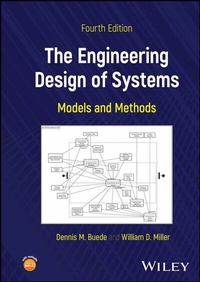
The Engineering Design of Systems
Description

Comprehensive resource covering methods to design, verify, and validate systems with a model-based approach, addressing engineering of current software-centric systems
The newly revised and updated Fourth Edition of The Engineering Design of Systems includes content addressing model-based systems engineering, digital engineering, digital threads, AI, SysML 1.0 and 2.0, digital twins, and GENESYS software. The authors explore system and software-centric architecture, allocations, and logical and physical architecture development, including revised terminologies for a variety of subsections throughout.
Composed of 15 chapters, this book includes important new sections on modeling approaches for middle-out engineering, reverse engineering, and agile systems engineering, with a separate section on emerging trends within systems engineering to explore the most update-to-date methods. The authors include comprehensive diagrams and a separate chapter on a complete exercise of the System Engineering process, ranging from the operational concept to integration and qualification.
To aid in reader comprehension and retention of concepts, the text is embedded with problems at the end of each chapter, along with relevant case studies.
Sample topics covered in The Engineering Design of Systems include:
- Structural system models to executable models, verification and validation on systems of systems, and external systems and context modeling
- Digital engineering, digital threads, artificial/augmented intelligence (AI), stakeholder requirements, and scientific foundations for systems engineering
- Quantifying a context and external systems' model, including intended and unintended inputs, both deterministic and non-deterministic
- Functional architecture development, logical and physical architecture development, allocated architecture development, interface design, and decision analysis for design trades
The Engineering Design of Systems is highly suitable as a main text for undergraduate and graduate students studying courses in system engineering design, systems architecture, and systems integration. The text is also valuable as a reference for practicing system architects, systems engineers, industrial engineers, engineering management professionals, and systems integrators.
More details
Other editions
Additional editions
Persons
Dennis M. Buede is currently Chief Innovation Officer, ITA International and a Fellow of the International Council on Systems Engineering (INCOSE). He has thirty-nine years' experience in both the theoretical development and engineering application of systems engineering and decision-support technologies.
William D. Miller is an Adjunct Professor for the School of Systems and Enterprises at Stevens Institute of Technology, USA. He has over forty-two years' experience in the conceptualization and engineering application of communications technologies.
Content
Preface ix
About the Companion Website xv
Part 1 Introduction, Overview, and Basic Knowledge 1
Chapter 1 Introduction to Systems Engineering 3
Chapter 2 Overview of the Systems Engineering Design Process 42
Chapter 3 Modeling and SysML Modeling 63
Chapter 4 Discrete Mathematics: Sets, Relations, and Functions 91
Chapter 5 Graphs and Directed Graphs (Digraphs) 105
Part 2 Design and Integration 127
Chapter 6 Requirements and Defining the Design Problem 129
Chapter 7 Functional Architecture Development 176
Chapter 8 Physical Architecture Development 210
Chapter 9 Allocated Architecture Development 238
Chapter 10 Interface Design 266
Chapter 11 Integration and Qualification 284
Chapter 12 A Complete Exercise of the Systems Engineering Process 310
Part 3 Supplemental Topics 323
Chapter 13 The Value of Systems Engineering 325
Chapter 14 Decision Analysis for Design Trades 339
Chapter 15 The Science and Analysis of Systems 380
Glossary 403
References 416
Historical References 429
Index 433
