

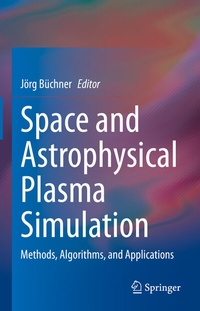
Space and Astrophysical Plasma Simulation
Description

This book is a collection of contributions covering the major subjects in numerical simulation of space and astrophysical plasma. It introduces the different approaches and methods to model plasma, the necessary computational codes, and applications in the field. The book is rooted in the previous work Space Plasma Simulation (Springer, 2003) and includes the latest developments.
It is divided into three parts and all chapters start with an introduction motivating the topic and its use in research and ends with a discussion of its applications. The chapters of the first part contain tutorials of the different basic approaches needed to perform space plasma simulations. This part is particularly useful for graduate students to master the subject. The second part presents more advanced materials for students and researchers who already work with pre-existing codes but want to implement the recent progresses made in the field. The last part of the bookdiscusses developments in the area for researchers who are actively working on advanced simulation approaches like higher order schemes and artificial intelligence, agent-based technologies for multiscale and multi-dimensional systems, which represent the recent innovative contributions made in space plasma research.
More details
Other editions
Additional editions
Person
Jörg Büchner is a researcher at the Max-Planck-Institute of Solar System Research (MPS), Göttingen and at the Center for Astrophysics and Astronomy of the Berlin Institute of Technology (ZAA, TU Berlin) in Germany. He obtained his Ph.D. in 1980, his Dr. sc. nat. degree in Berlin 1990. He habilitated in 1999 at the Georg-August University in Göttingen where he became adjunct Professor in 2005. He was visiting research Professor at UCLA Los Angeles (USA), at the University of Nagoya-Toyokawa (Japan), and an eminent Professor at the University of Tokyo (Japan). He is a distinguished visiting Professor at the University of Nanchang (China) and worked for the Max-Planck-Princeton Center for Plasma Physics (MPPC). His research focuses on the investigation of space and astrophysical plasma phenomena, in particular of the Sun and magnetospheres as well as of pulsars, on which he has authored over 280 papers. He has taken a major role in several international space physicsprojects. For more than 20 years he taught space physics, the physics of solar system plasmas and their numerical simulation to students at Göttingen and Berlin Universities over the whole range of topics covered by this book.
Content
Introduction to MHD simulations (solar system plasmas).- Hall-MHD plasma simulation.- Multi-fluid simulation.- Hybrid- kinetic approach.- Gyro-kinetic restricted kinetic simulation.- Eulerian Vlasov fully kinetic simulation.- Particle-in-Cell fully kinetic simulation.- Adaptive Global MHD Simulations.- Mesoscale HD and MHD simulations of the Interstellar Medium in Galaxies.- Coupling of Kinetic and MHD simulations.- Shock waves in space plasma.- Magnetic reconnection in space plasmas.- Higher-order numerical solutions of the continuum MHD equations.- Self-Adaptive algorithms for multiscale simulations - the discrete event technology.- Techniques for effective scientific visualization and discovery including illustrative examples from petascale simulation results.
