

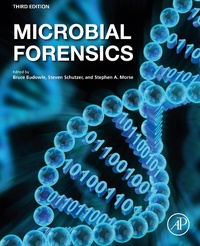
Microbial Forensics
3rd Edition
Published on 30. November 2019
526 pages
978-0-12-815380-2 (ISBN)
Description

Microbial Forensics, Third Edition, serves as a complete reference on the discipline, describing the advances, challenges and opportunities that are integral in applying science to help solve future biocrimes. New chapters include: Microbial Source Tracking, Clinical Recognition, Bioinformatics, and Quality Assurance. This book is intended for a wide audience, but will be indispensable to forensic scientists and researchers interested in contributing to the growing field of microbial forensics. Biologists and microbiologists, the legal and judicial system, and the international community involved with Biological Weapons Treaties will also find this volume invaluable.
- Presents new and expanded content that includes a statistical analysis of forensic data, legal admissibility and standards of evidence
- Discusses actual cases of forensic bioterrorism
- Includes contributions from editors and authors who are leading experts in the field, with primary experience in the application of this fast-growing discipline
More details
Other editions
Additional editions
Bruce Budowle | Steven E. Schutzer | Stephen A. Morse
Microbial Forensics
Book
12/2019
3rd Edition
Academic Press
€166.50
Shipment within 15-20 days
Previous edition
Bruce Budowle | Steven E. Schutzer | Roger G. Breeze
Microbial Forensics
E-Book
10/2010
2nd Edition
Academic Press
€78.95
Available for download
Content
1. The Kameido anthrax incident: a microbial forensic case studyARNOLD F. KAUFMANN AND PAUL KEIM2. The FBI's Amerithrax Task Force and the advent of microbial forensicsR. SCOTT DECKER AND TERRY L. KERNS3. Microbial forensic investigation of the anthrax letter attacks: how the investigation would differ using today's technologiesPAUL J. JACKSON4. Foodborne outbreaksE.W. BROWN AND M.W. ALLARD5. Forensic plant pathologyJACQUELINE FLETCHER, NEEL G. BARNABY, JAMES BURANS, ULRICH MELCHER, DOUGLAS G. LUSTER, FORREST W. NUTTER, JR., HARALD SCHERM, DAVID G. SCHMALE, III, CARLA S. THOMAS, AND FRANCISCO M. OCHOA CORONA6. Microbial source tracking: characterization of human fecal pollution in environmental waters with HF183 quantitative real-time PCRORIN C. SHANKS AND ASJA KORAJKIC7. Influenza forensicsANGELA CHOI AND ADOLFO GARCÍA-SASTRE8. Forensic public health: epidemiological and microbiological investigations for biosecurityALI S. KHAN, PHILIP S. AMARA, AND STEPHEN A. MORSE9. Forensic analysis in bacterial pathogensPAUL KEIM, JASON W. SAHL, TALIMA PEARSON, AMY VOGLER, CHARLES H. WILLIAMSON, DAWN BIRDSELL, RICHARD T. OKINAKA, JEFFREY T. FOSTER, AND DAVID M. WAGNER10. Genomic epidemiology and forensics of fungal pathogensDAVID M. ENGELTHALER AND ANASTASIA P. LITVINTSEVA11. Forensic human identification using skin microbiome genetic signaturesSARAH E. SCHMEDES, AUGUST WOERNER, AND BRUCE BUDOWLE12. Using microbiome tools for estimating the postmortem intervalHEATHER DEEL, SIBYL BUCHELI, AERIEL BELK, SAM OGDEN, AARON LYNNE, DAVID O. CARTER, ROB KNIGHT, AND JESSICA L. METCALF13. Select methods for microbial forensic nucleic acid analysis of trace and uncultivable specimensRACHEL E. KIESER AND BRUCE BUDOWLE14. The use of host factors in microbial forensicsSTEVEN E. SCHUTZER15. Toxin analysis using mass spectrometryTHOMAS A. BLAKE, SUZANNE R. KALB, RUDOLPH C. JOHNSON, AND JOHN R. BARR16. Ricin forensics: comparisons to microbial forensicsJEFFREY T. FOSTER, ROBERT L. BULL, AND PAUL KEIM17. Proteomics for bioforensicsERIC D. MERKLEY, BROOKE L. DEATHERAGE KAISER, DAVID S. WUNSCHEL, AND KAREN L. WAHL18. Rapid bacterial typing in the postgenomic era: developments in computational methodsHECTOR F. ESPITIA-NAVARRO, LAVANYA RISHISHWAR, LEONARD W. MAYER, AND I. KING JORDAN19. GenomicsTOM SLEZAK, JONATHAN ALLEN, AND CRYSTAL JAING20. Design of genomic signatures for pathogen identification and characterizationTOM SLEZAK, BRADLEY HART, AND CRYSTAL JAING21. Collection and preservation of microbial forensic samplesJENIFER A.L. SMITH22. Assessment of the threatJENIFER A.L. SMITH AND DAVID R. HODGE23. Scientific testimonial standards for microbial forensic evidenceSTEPHAN P. VELSKO24. Inferential validation and evidence interpretationSTEPHAN P. VELSKO25. Microbial forensic investigations in the context of bacterial population geneticsPAUL KEIM, TALIMA PEARSON, BRUCE BUDOWLE, MARK WILSON, AND DAVID M. WAGNER26. Use of microbial forensics data in scientific, legal, and policy contextsCHRISTOPHER A. BIDWELL AND RANDALL MURCH27. Lessons for expert witnessesSTEPHEN A. SALTZBURG28. Select agent regulationsSTEPHEN A. MORSE AND BERNARD R. QUIGLEY29. Biorepositories and their foundationFRANK P. SIMIONE, RICHARD R. VINES, AND TED D. MULLINS30. The National Bioforensic Analysis CenterJAMES BURANS, JENNIFER S. GOODRICH, ROBERT L. BULL, AND NICHOLAS H. BERGMAN31. An international microbial forensics research strategy and its collaborative pursuit is neededRANDALL MURCH AND BRUCE BUDOWLE32. Education and training in microbial forensicsSTEVEN B. LEE, DEETTA K. MILLS, STEPHEN A. MORSE, STEVEN E. SCHUTZER, BRUCE BUDOWLE, AND PAUL KEIM33. Microbial forensics: what next?STEPHEN A. MORSE, BRUCE BUDOWLE, AND STEVEN E. SCHUTZER
