

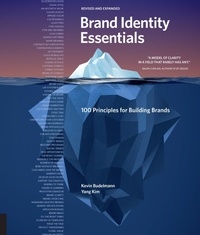
Brand Identity Essentials, Revised and Expanded
100 Principles for Building Brands
Published on 18. April 2019
232 pages
978-1-63159-709-1 (ISBN)
Description

Brand Identity Essentials, Revised and Expanded outlines and demonstrates basic logo and branding design guidelines and rules through 100 principles. These include the elements of a successful graphic identity, identity programs and brand identity, and all the various strategies and elements involved.
A company's identity encompasses far more than just its logo. Identity is crucial to establishing the public's perception of a company, its products, and its effectiveness-and it's the designer's job to envision the brand and create what the public sees. Brand Identity Essentials, a classic design reference now updated and expanded, lays a foundation for brand building, illustrating the construction of strong brands through examples of world-class design.
Topics include: A Sense of Place, Cultural Symbols, Logos as Storytellers, What is "On Brand?", Brand Psychology, Building an Online Identity, Managing Multiple Brands, Owning an Aesthetic, Logo Lifecycles, Programs That Stand Out, Promising Something, and Honesty is Sustainable
The new, revised edition expands each of the categories, descriptions, and selections of images, and incorporates emergent themes in digital design and delivery that have developed since the book first appeared.
Brand Identity Essentials is a must-have reference for budding design professionals and established designers alike.
A company's identity encompasses far more than just its logo. Identity is crucial to establishing the public's perception of a company, its products, and its effectiveness-and it's the designer's job to envision the brand and create what the public sees. Brand Identity Essentials, a classic design reference now updated and expanded, lays a foundation for brand building, illustrating the construction of strong brands through examples of world-class design.
Topics include: A Sense of Place, Cultural Symbols, Logos as Storytellers, What is "On Brand?", Brand Psychology, Building an Online Identity, Managing Multiple Brands, Owning an Aesthetic, Logo Lifecycles, Programs That Stand Out, Promising Something, and Honesty is Sustainable
The new, revised edition expands each of the categories, descriptions, and selections of images, and incorporates emergent themes in digital design and delivery that have developed since the book first appeared.
Brand Identity Essentials is a must-have reference for budding design professionals and established designers alike.
More details
Series
Edition
Revised Edition
Language
English
Place of publication
Beverly
United States
Publishing group
Quarto Publishing Group USA Inc
Edition type
Revised edition
Illustrations
300 color illustrations
File size
49,09 MB
ISBN-13
978-1-63159-709-1 (9781631597091)
Copyright in bibliographic data and cover images is held by Nielsen Book Services Limited or by the publishers or by their respective licensors: all rights reserved.
Schweitzer Classification
Other editions
Additional editions
Kevin Budelmann | Yang Kim
Brand Identity Essentials, Revised and Expanded
100 Principles for Building Brands
Book
04/2019
Rockport Publishers
€32.50
Shipment within 3-4 weeks
Persons
Kevin Budelmann and Yang Kim are the founders and co-owners of Peopledesign, a brand strategy and design firm in Grand Rapids, Michigan, helping clients establish strong, future-proof brand identities. Peopledesign has been recognized by ADC Global, AIGA, American Center for Design, American Graphic Design Awards, AR100, CMYK Magazine, Communication Arts, Coupe magazine, Creative Quarterly, Critique Magazine, GD:USA, Graphis, How, Inc. 5000, LogoLounge, Print, ReBrand, STA, Step: Inside Design, Type Directors Club, Webby Awards. Budelmann and Kim published the original edition of Essential Elements for Brand Identity with Rockport in 2010.
Content
- Cover
- Half Title
- Title
- Copyright
- CONTENTS
- Introduction
- Brand Identity Framework
- Essential Tools
- IMAGE
- 1. Illustrative logos
- 2. Visual style
- 3. An aesthetic niche
- COLOR
- 4. Color choices
- 5. Applied color
- 6. Color signals
- TYPOGRAPHY
- 7. Logotypes
- 8. Type choices
- 9. Type and meaning
- SHAPE
- 10. Logo forms
- 11. Graphic patterns
- 12. Shape meaning
- CONTRAST
- 13. Contrast in composition
- 14. Contrasting elements
- 15. Get different
- DIMENSION
- 16. Logos in real life
- 17. Physical space
- 18. A sense of place
- SYMBOLS
- 19. Cultural symbols
- 20. Symbol systems
- 21. Brands as symbols
- VOICE
- 22. The name game
- 23. Editorial style
- 24. Brand voice
- CONSISTENCY
- 25. Lay a foundation
- 26. Flexible systems
- 27. Staying on brand
- STORY
- 28. Set the stage
- 29. Consider each scene
- 30. Brand narratives
- TIME
- 31. Each moment matters
- 32. Total time
- 33. Opportunity cost
- Essential Decisions
- PSYCHOLOGY
- 34. Understand your customer
- 35. Deliver an experience
- 36. Brand psychology
- WIT
- 37. A reason to smile
- 38. Fun with programs
- 39. Stay human
- TRENDS
- 40. Watch trends
- 41. Relevant programs
- 42. Macro trends
- MEDIA
- 43. New opportunities
- 44. The right channel
- 45. Medium is the message
- PERSONALIZATION
- 46. Business of crowds
- 47. Bend without breaking
- 48. Customers own the brand
- PROCESS
- 49. Generate ideas
- 50. Develop good filters
- 51. Support the strategy
- PROTOTYPING
- 52. Making to think
- 53. Failing is learning
- 54. Prototype iteration
- MULTIPLES
- 55. Brand clarity
- 56. Brand layer cake
- 57. Managing multiple brands
- STANDARDS
- 58. Graphic specifications
- 59. Application rules
- 60. Brand bibles
- INVESTMENTS
- 61. Do the right thing
- 62. Economy of templates
- 63. Walk the talk
- OWNERSHIP
- 64. Protect trademarks
- 65. Iconic value
- 66. Own an aesthetic
- Essential Strategies
- CHANGE
- 67. Logo life cycles
- 68. Evolve with customers
- 69. Plan for change
- COMPETITION
- 70. Know competitors
- 71. Program differentiation
- 72. Competitive position
- ORIGINALITY
- 73. Seek timelessness
- 74. Take chances
- 75. Dial into human needs
- POSITIONING
- 76. Identify your customer
- 77. Stake a claim
- 78. Make tough choices
- USERS
- 79. Customers are people
- 80. Users versus markets
- 81. Universal design
- RESEARCH
- 82. Do your homework
- 83. Embrace constraints
- 84. Key insights
- COMMITMENT
- 85. Stick with a good idea
- 86. Confident programs
- 87. Decisive brands
- TOUCHPOINTS
- 88. Interactions are opportunities
- 89. Customer perspective
- 90. Experience planning
- SYSTEMS
- 91. Identify all the parts
- 92. Look for connections
- 93. Inputs and outputs
- INSPIRATION
- 94. Look for ideas everywhere
- 95. Work the problem
- 96. Inspiration in context
- PURPOSE
- 97. Design consequences
- 98. Behavior and belief
- 99. Net effect
- 100. Keep it simple
- Brand Audits
- Curriculum for Educators
- Acknowledgments
- Contributors
- Index
- A
- B
- C
- D
- E
- F
- G
- H
- I
- J
- K
- L
- M
- N
- O
- P
- R
- S
- T
- U
- V
- W
- X
- Y
- Z
