

A Guide to Close Binary Systems
1st Edition
Published on 12. May 2022
346 pages
978-1-351-66245-1 (ISBN)
Description

Introduction to Close Binary Systems provides a comprehensive survey and guide to the fast-moving field of multiple, specifically binary, stars, with an up to date account of research around 'close', i.e. interacting pairs. Such interactions allow direct quantification of stellar properties, opening up factual insights into basic building blocks of the Universe.
The book provides a much needed update for the seminal Close Binary Systems of Zdenek Kopal. Following a comparable plan, it presents relevant subject matter with an emphasis on building a framework of understanding to serve as a supporting resource for students and researchers.
The text starts from a general historical background and progresses into the main theoretical ideas supporting our prima facie interpretation of observations. The central chapters explore further into these observational methods, arranged according to the classic subdivisions of astrometry, spectroscopy and photometry. Optimal inversion of observational data into model parametrization is a theme through these chapters. Significant here is the problem of how non-uniqueness in modelling affects interpretation. The underlying issues of stellar evolution bearing on observational evidence become paramount in the last four chapters. The book proceeds step-by-step from directly understandable examples of unevolved pairs to the challenging cases where stars are found in more and more extreme conditions, leading up to the mergers of massive black hole pairs seen in the new field of gravitational wave astronomy.
This is a valuable reference for postgraduate and advanced undergraduate students working in mainstream areas of stellar astrophysics, with applications also to exoplanet research which shares some methodological features. Course designers for stellar astrophysics will find a useful selection of topics within this book.
Key features:
* Provides a well-explained and backgrounded, up-to-date account of close binary systems, in a fast-moving field of research that is growing in scientific importance
* Surveys a wide range of case-studies within the context of binary and multiple star systems
* Fills an acknowledged gap in current literature
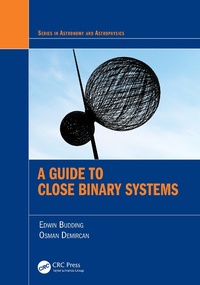
Cover Image: A public memorial to Zdenek Kopal in his home town (birthplace) of Litomysl in Czechia.
The book provides a much needed update for the seminal Close Binary Systems of Zdenek Kopal. Following a comparable plan, it presents relevant subject matter with an emphasis on building a framework of understanding to serve as a supporting resource for students and researchers.
The text starts from a general historical background and progresses into the main theoretical ideas supporting our prima facie interpretation of observations. The central chapters explore further into these observational methods, arranged according to the classic subdivisions of astrometry, spectroscopy and photometry. Optimal inversion of observational data into model parametrization is a theme through these chapters. Significant here is the problem of how non-uniqueness in modelling affects interpretation. The underlying issues of stellar evolution bearing on observational evidence become paramount in the last four chapters. The book proceeds step-by-step from directly understandable examples of unevolved pairs to the challenging cases where stars are found in more and more extreme conditions, leading up to the mergers of massive black hole pairs seen in the new field of gravitational wave astronomy.
This is a valuable reference for postgraduate and advanced undergraduate students working in mainstream areas of stellar astrophysics, with applications also to exoplanet research which shares some methodological features. Course designers for stellar astrophysics will find a useful selection of topics within this book.
Key features:
* Provides a well-explained and backgrounded, up-to-date account of close binary systems, in a fast-moving field of research that is growing in scientific importance
* Surveys a wide range of case-studies within the context of binary and multiple star systems
* Fills an acknowledged gap in current literature
Cover Image: A public memorial to Zdenek Kopal in his home town (birthplace) of Litomysl in Czechia.
More details
Series
Edition
1. Auflage
Language
English
Place of publication
London
United Kingdom
Publishing group
Taylor & Francis Ltd
Target group
College/higher education
Illustrations
13 Tables, black and white; 126 Line drawings, black and white; 6 Halftones, black and white; 132 Illustrations, black and white
ISBN-13
978-1-351-66245-1 (9781351662451)
Copyright in bibliographic data and cover images is held by Nielsen Book Services Limited or by the publishers or by their respective licensors: all rights reserved.
Schweitzer Classification
Other editions
Additional editions

Edwin Budding | Osman Demircan
A Guide to Close Binary Systems
Book
05/2024
1st Edition
CRC Press
€71.70
Shipment within 10-20 days
Edwin Budding | Osman Demircan
A Guide to Close Binary Systems
Book
05/2022
1st Edition
CRC Press
€272.70
Shipment within 10-20 days
Persons
Edwin Budding is a recently retired Honorary Research Fellow in the School of Chemical and Physical Sciences, at the Victoria University of Wellington, also the Carter Observatory, Wellington, and Department of Physics and Astronomy at the University of Canterbury, Christchurch, New Zealand. In recent years he has been a Visiting Professor at the Department of Physics at Canakkale 18th March University (COMU), Turkey. He has authored/edited five books, and been closely involved with the production of around 200 peer-reviewed articles, mostly in the field of close binary stars. In previous years he has held the presidency of the Royal Astronomical Society of New Zealand and editorship of its journal, as well as chairing Aotearoa-New Zealand's national astronomy committee.
Osman Demircan is the Founder and Director of the Canakkale University Observatory and Professor at the Canakkale Onsekiz Mart University (COMU), Turkey. From 2000 - 2010 he was the Vice Rector, Consultant, Dean and Vice Dean at COMU, having previously been Professor at Ankara University, Turkey. Prof. Demircan has authored four books and over 160 journal articles. His areas of research are on the astrophysics of close binary stars, the analysis of photometric and spectrographic data, and on exoplanet research, in particular transit observations and modelling.
Osman Demircan is the Founder and Director of the Canakkale University Observatory and Professor at the Canakkale Onsekiz Mart University (COMU), Turkey. From 2000 - 2010 he was the Vice Rector, Consultant, Dean and Vice Dean at COMU, having previously been Professor at Ankara University, Turkey. Prof. Demircan has authored four books and over 160 journal articles. His areas of research are on the astrophysics of close binary stars, the analysis of photometric and spectrographic data, and on exoplanet research, in particular transit observations and modelling.
Content
1. Introduction. 2. Statics. 3. Dynamics. 4. The Roche Model. 5. Visual and Astrometric Systems. 6. Spectroscopic Binaries. 7. Photometric Data Analysis. 8. Evolution Overview. 9. Binaries in Early Stages. 10. Moderately Evolced Systems. 11. Advanced Evolution.
