

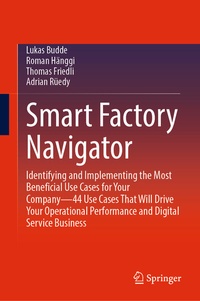
Smart Factory Navigator
Description

The digitization of factories promises great potential benefits. The implementation of the various technologies for the smart factory is extremely complex, requires new competencies and necessitates significant investments. The question is: How can an industrial company successfully manage this transformation? For this purpose, more than 500 published use cases were screened. These could be categorized into 44 relevant use cases, which we describe in detail in the book. Our research has also shown that strategy and goal orientation must be at the core of the change. Furthermore, the combination of employee knowledge and use of technology is central to success. This led to the creation of our smart factory implementation approach. In various research and consulting projects we were able to apply this process and realize successful implementations in different companies. This 7-step process starts with the selection of promising use cases, followed by a prioritization step, adaptationto the company-specific context and a detailing of the information needs for the different management levels. Stringent project management helps the user achieve positive results that can then be rolled out on a global scale. This process is not only applicable to the "actual factory" but can also be used to design smart services for the factory of tomorrow.
Content
Smart factory definition and characterization · The smart factory navigator · The smart factory framework · Description of the 44 use cases for the smart factory · Technology mapping in relation to the 44 use cases · Smart factory implementation process · Smart services for the smart factory
More details
Other editions
Additional editions
Persons
Dr. Lukas Budde is a Post-Doc Researcher and Lecturer for Production Management and Digitalization at the Institute for Technology Management at the University of St. Gallen (Switzerland). His research focuses on smart manufacturing and digital platform ecosystems in manufacturing companies.
Prof. Dr. Roman Hänggi is a Professor of Production Management and Industry 4.0 at the University of Applied Sciences OST (Switzerland). Lean Production and the Digitalization of factories drove him on during his 25 years of experience at all hierarchy levels in companies in Europe, USA and Asia.
Prof. Dr. Thomas Friedli is a Professor for Production Management at the University of St.Gallen (Switzerland). His main research interests are in the fields of managing operational excellence, global production management and the management of industrial services. He also is the editor, author or co-author of 15 books and various articles.
Adrian Rüedy is a Lecturer of Industry 4.0 at the University of Applied Sciences OST (Switzerland). With his practical experience in special machinery and plant engineering as a design engineer, he has a deep understanding of the processes and challenges in manufacturing.
Content
Introduction.- Smart Factory Navigator.- Smart Factory Framework.- Smart Factory Implementation Process.- Use Case Framework to Identify Digital Services for Commercialization.- Learning From Case Studies and Outlook.- References.
