

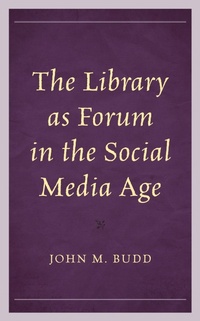
The Library as Forum in the Social Media Age
1st Edition
Published on 25. March 2022
1 pages
979-8-8818-5902-2 (ISBN)
Description

How do individuals in our country converse about thorny political matters? We know that these kinds of discussions can be fraught, but there are ways that the conversations can be thoughtful and civil. In this book, ways to ensure civil conversations are explored deeply. A major thrust of the book is that the library (writ large) can be the locus for informed conversations, typified by evidence and truth. We begin with a description of the library-what it is, what purposes it can serve, what contributions it can make to civil discourse. As we will see, the theme of liberty runs throughout the commentary.
Another chapter explores what discourse is, how discourse theory can inform civil conversations, and what kinds of discursive practices achieve the goal of civility. This is, admittedly, a tall order, but it is absolutely necessary to fulfill the promise of the book. The chapter further presents examples of topics that are components of political conversations today, as well as substantive sources that can inform those conversations. The final chapter returns to the library. The spirit and substance of providing a venue for civil conversation are discussed at some length. The conclusion presents how the library can be the exemplar for civil conversation. The audience for the book is not limited to librarians, but extends to all who are interested in, and committed to, reasoned discussion of the political issues that divide us today. Examples of topics of conversation conclude the last chapter. The purpose is to illustrate just how the fraught topics can be discussed in a civil and considered manner. The ultimate purpose of the book is to present a realistic manner by which political conversations can take place, fostered by libraries.
Another chapter explores what discourse is, how discourse theory can inform civil conversations, and what kinds of discursive practices achieve the goal of civility. This is, admittedly, a tall order, but it is absolutely necessary to fulfill the promise of the book. The chapter further presents examples of topics that are components of political conversations today, as well as substantive sources that can inform those conversations. The final chapter returns to the library. The spirit and substance of providing a venue for civil conversation are discussed at some length. The conclusion presents how the library can be the exemplar for civil conversation. The audience for the book is not limited to librarians, but extends to all who are interested in, and committed to, reasoned discussion of the political issues that divide us today. Examples of topics of conversation conclude the last chapter. The purpose is to illustrate just how the fraught topics can be discussed in a civil and considered manner. The ultimate purpose of the book is to present a realistic manner by which political conversations can take place, fostered by libraries.
More details
Other editions
Additional editions
John M. Budd
The Library as Forum in the Social Media Age
Book
03/2024
Rowman & Littlefield Publishers
€44.40
Shipment within 3-4 weeks
Person
John M. Budd is professor emeritus in the School of Information Science and Learning Technologies of the University of Missouri. He has also served on the faculties of the University of Arizona and Louisiana State University. He has been active in professional associations for more than thirty years, serving (among other offices) as chair of the American Library Association's Library Research Round Table. He has also served in many capacities in the Association for Library and Information Science Education, including as President. He has also served as President of Beta Phi Mu. Budd has been on several committees with the Association of Information Science and Technology, including twice on the publications committee. He has been a mentor to several individuals, but as members of ASIS&T and as doctoral students. He has been committed to service since the beginning of his career, first as an academic librarian and then as a library and information science faculty member for twenty-eight years. Budd has been a prolific author throughout his career. He has published well over 100 journal articles in some of the most prominent journals, including Library and Information Science Research, Journal of Information Science, Journal of Documentation, and JASIST. His publications also include a number of books, such as The Changing Academic Library, Six Issues Facing Libraries Today: Critical Perspectives, Democracy, Economic, and the Public Good: Informational Failures and Potential, and Higher Education's Purpose. He has presented more than 125 times at professional conferences.
His teaching and some of his writings have had a political focus. A paper published in Public Library Quarterly presented the gist of the ideas in this book. Moreover, he has written about discourse and discursive practices as they relate to library-related actions. Much of thought has centered on phenomenology and has incorporated this philosophy into his work for more than twenty-five years.
His teaching and some of his writings have had a political focus. A paper published in Public Library Quarterly presented the gist of the ideas in this book. Moreover, he has written about discourse and discursive practices as they relate to library-related actions. Much of thought has centered on phenomenology and has incorporated this philosophy into his work for more than twenty-five years.
Content
Preface
Introduction
Chapter 1: Libraries, Then and (Mostly) Now
Chapter 2: How Do We Talk to One Another?
Chapter 3: What Conversations Can Take Place in Libraries (and in What Ways)?
About the Author
Introduction
Chapter 1: Libraries, Then and (Mostly) Now
Chapter 2: How Do We Talk to One Another?
Chapter 3: What Conversations Can Take Place in Libraries (and in What Ways)?
About the Author
