

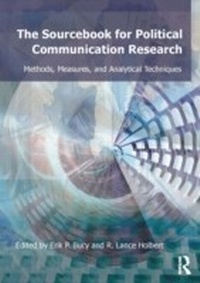
Sourcebook for Political Communication Research
Methods, Measures, and Analytical Techniques
1st Edition
Published on 3. June 2014
608 pages
978-1-317-70934-3 (ISBN)
Description

The Sourcebook for Political Communication Research will offer scholars, students, researchers, and other interested readers a comprehensive source for state-of-the-art/field research methods, measures, and analytical techniques in the field of political communication.
The need for this Sourcebook stems from recent innovations in political communication involving the use of advanced statistical techniques, innovative conceptual frameworks, the rise of digital media as both a means by which to disseminate and study political communication, and methods recently adapted from other disciplines, particularly psychology, sociology, and neuroscience. Chapters will have a social-scientific orientation and will explain new methodologies and measures applicable to questions regarding media, politics, and civic life. The Sourcebook covers the major analytical techniques used in political communication research, including surveys (both original data collections and secondary analyses), experiments, content analysis, discourse analysis (focus groups and textual analysis), network and deliberation analysis, comparative study designs, statistical analysis, and measurement issues.
The need for this Sourcebook stems from recent innovations in political communication involving the use of advanced statistical techniques, innovative conceptual frameworks, the rise of digital media as both a means by which to disseminate and study political communication, and methods recently adapted from other disciplines, particularly psychology, sociology, and neuroscience. Chapters will have a social-scientific orientation and will explain new methodologies and measures applicable to questions regarding media, politics, and civic life. The Sourcebook covers the major analytical techniques used in political communication research, including surveys (both original data collections and secondary analyses), experiments, content analysis, discourse analysis (focus groups and textual analysis), network and deliberation analysis, comparative study designs, statistical analysis, and measurement issues.
More details
Series
Language
English
Place of publication
London
United Kingdom
Publishing group
Taylor & Francis Ltd
Target group
College/higher education
Illustrations
21 s/w Tabellen
21 Tables, black and white
File size
3,42 MB
ISBN-13
978-1-317-70934-3 (9781317709343)
Copyright in bibliographic data and cover images is held by Nielsen Book Services Limited or by the publishers or by their respective licensors: all rights reserved.
Schweitzer Classification
Other editions
Additional editions
Erik P. Bucy | R. Lance Holbert
Sourcebook for Political Communication Research
Methods, Measures, and Analytical Techniques
Book
03/2013
1st Edition
Routledge
€121.92
Shipment within 15-20 days
Persons
Erik P. Bucy (PhD, University of Maryland, College Park, 1998) is an Associate Professor of Telecommunications and Adjunct Associate Professor in the Department of Political Science and School of Informatics at Indiana University, Bloomington. Bucy is the editor of Politics and the Life Sciences, and author, with Maria Grabe, of Image Bite Politics: News and the Visual Framing of Elections (Oxford, 2009). Bucy serves on the editorial boards of Human Communication Research, The Information Society, and Mass Communication and Society. He has held visiting and research appointments at the University of Michigan and Dartmouth College.
R. Lance Holbert (PhD, University of Wisconsin-Madison, 2000) is an Associate Professor in the School of Communication at The Ohio State University. He is the author of several articles on the use of structural equation modeling in the communication sciences. His most recent research has appeared in Journal of Communication, Communication Research, Communication Monographs, and Media Psychology. He serves on many editorial boards, including Journal of Communication, Communication Monographs, and the Journal of Broadcasting & Electronic Media.
R. Lance Holbert (PhD, University of Wisconsin-Madison, 2000) is an Associate Professor in the School of Communication at The Ohio State University. He is the author of several articles on the use of structural equation modeling in the communication sciences. His most recent research has appeared in Journal of Communication, Communication Research, Communication Monographs, and Media Psychology. He serves on many editorial boards, including Journal of Communication, Communication Monographs, and the Journal of Broadcasting & Electronic Media.
Content
Introduction
Advancing Methods and Measurement: Supporting Theory and Keeping Pace with the Modern Political Environment
Survey Methodology
Challenges and Opportunities of Panel Designs
The Rolling Cross-Section: Design and Utility for Political Research
Political Communication Survey Research: Challenges, Trends, Opportunities
Secondary Analysis and Meta Analysis
Secondary Analysis In Political Communication Viewed as Creative Act
Comparing the ANES and NAES for Political Communication Research
The Implications and Consequences of Using Meta-Analysis for Political Communication
Experimental Methods
Experimental Designs for Political Communication Research: Using New Technology and Online Participant Pools to Overcome the Problem of Generalizability
Expressing versus Revealing Preferences in Experimental Research
The Face as a Focus of Political Communication: Evolutionary Perspectives, Experimental Methods, and the Ethological Approach
Multi-Stage Experimental Designs in Political Communication Research
Content Analysis
Image Bite Analysis of Political Visuals
Identifying Frames in Political News
Content Analysis in Political Communication
Discourse Analysis
The Uses of Focus Groups in Political Communication Research
Genealogy of Myth in Presidential Rhetoric
Network and Deliberation Analysis
Methods for Analyzing and Measuring Group Deliberation
Porous Networks and Overlapping Contexts: Methodological Challenges in the Study of Social Communication and Political Behavior
Comparative Political Communication
Mediatization of Politics: Toward a Conceptual Framework for Comparative Research
International Applications of the Agenda-Setting Acapulco Typology
Political Communication Across the World: Methodological Issues Involved in International Comparisons
Statistical Techniques
Expanding the Use of Structural Equation Modeling (SEM) in Political Communication
Mediation and the Estimation of Indirect Effects in Political Communication Research
Time-Series Analysis and the Study of Political Communication
Measurement
Concept Explication in the Internet Age: The Case of Interactivity
Beyond Self-Report: Using Latency Measures to Model the Question Answering Process on Web-Based Public Opinion Surveys
What the Body Can Tell Us About Politics: The Use of Psychophysiological Measures in Political Communication Research
Conclusion
Looking Back and Looking Forward: Observations on a Rapidly Evolving Field
Advancing Methods and Measurement: Supporting Theory and Keeping Pace with the Modern Political Environment
Survey Methodology
Challenges and Opportunities of Panel Designs
The Rolling Cross-Section: Design and Utility for Political Research
Political Communication Survey Research: Challenges, Trends, Opportunities
Secondary Analysis and Meta Analysis
Secondary Analysis In Political Communication Viewed as Creative Act
Comparing the ANES and NAES for Political Communication Research
The Implications and Consequences of Using Meta-Analysis for Political Communication
Experimental Methods
Experimental Designs for Political Communication Research: Using New Technology and Online Participant Pools to Overcome the Problem of Generalizability
Expressing versus Revealing Preferences in Experimental Research
The Face as a Focus of Political Communication: Evolutionary Perspectives, Experimental Methods, and the Ethological Approach
Multi-Stage Experimental Designs in Political Communication Research
Content Analysis
Image Bite Analysis of Political Visuals
Identifying Frames in Political News
Content Analysis in Political Communication
Discourse Analysis
The Uses of Focus Groups in Political Communication Research
Genealogy of Myth in Presidential Rhetoric
Network and Deliberation Analysis
Methods for Analyzing and Measuring Group Deliberation
Porous Networks and Overlapping Contexts: Methodological Challenges in the Study of Social Communication and Political Behavior
Comparative Political Communication
Mediatization of Politics: Toward a Conceptual Framework for Comparative Research
International Applications of the Agenda-Setting Acapulco Typology
Political Communication Across the World: Methodological Issues Involved in International Comparisons
Statistical Techniques
Expanding the Use of Structural Equation Modeling (SEM) in Political Communication
Mediation and the Estimation of Indirect Effects in Political Communication Research
Time-Series Analysis and the Study of Political Communication
Measurement
Concept Explication in the Internet Age: The Case of Interactivity
Beyond Self-Report: Using Latency Measures to Model the Question Answering Process on Web-Based Public Opinion Surveys
What the Body Can Tell Us About Politics: The Use of Psychophysiological Measures in Political Communication Research
Conclusion
Looking Back and Looking Forward: Observations on a Rapidly Evolving Field
