
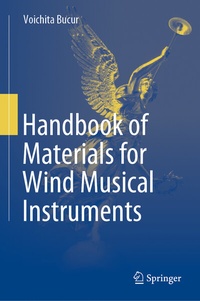
Handbook of Materials for Wind Musical Instruments
Description
Alles über E-Books | Antworten auf Fragen rund um E-Books, Kopierschutz und Dateiformate finden Sie in unserem Info- & Hilfebereich.
Part 1- Description of materials for wind instruments deals with wood species and materials for reeds used for making clarinet, oboe and bassoon- and, with metallic materials and alloys for - horn, trumpet, trombone, etc. Auxiliary materials associated with the manufacturing of wind instruments are felt, cork, leather and parchment.
Part 2 - Basic acoustics of wind instruments, in which are presented succinctly, some pertinent aspects related to the physics of the resonant air column. An important aspect discussed is related to the effect of wall material on the vibration modes of the walls of wind instruments. The methods for measuring the acoustical properties of wind instruments are presented.
Part 3 - Manufacturing of wind instruments, describes the technology used in manufacturing metallic tubes and pipes made of wood.
Part 4 - The durability and degradation of materials addresses data about methods for cleaning wind instruments, studies factors producing degradation of organ pipes, describes methods of conservation and restoration of brass instruments and of historical pipe organs. Finally, the properties of marble are described, being the only one nondegradable and sustainable material used for pipes for organs.More details
Other editions
Additional editions

Person
Content
System requirements
File format: PDF
Copy protection: Watermark-DRM (Digital Rights Management)
System requirements:
- Computer (Windows; MacOS X; Linux): Use the free software Adobe Reader, Adobe Digital Editions, or any other PDF viewer of your choice (see eBook Help).
- Tablet/Smartphone (Android; iOS): Install the free app Adobe Digital Editions or another reading app for eBooks, e.g., PocketBook (see eBook Help).
- E-reader: Bookeen, Kobo, Pocketbook, Sony, Tolino and many more (only limited: Kindle).
The file format PDF always displays a book page identically on any hardware. This makes PDF suitable for complex layouts such as those used in textbooks and reference books (images, tables, columns, footnotes). Unfortunately, on the small screens of e-readers or smartphones, PDFs are rather annoying, requiring too much scrolling.
This eBook uses Watermark-DRM, a „soft” copy protection. This means that there are no technical restrictions to prevent illegal distribution. However, there is a personalised watermark embedded in the eBook that can be used to identify the purchaser of the eBook in the event of misuse and to provide evidence for legal purposes.
For more information, see our eBook Help page.