

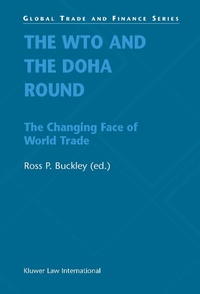
The WTO and the Doha Round
The Changing Face of World Trade
Published on 12. November 2003
318 pages
978-90-411-7903-6 (ISBN)
Description

The appointment of Dr. Supachai Panitchpakdi as Director-General of the World Trade Organization in 2002 reflects the changing power realities within the WTO. Coupled to this is the growing sense among developing countries that they have been cheated in the way the Uruguay Round commitments have been implemented and a return to unilateralism by the U.S. The world trading system thus stands at a crossroads. The success of the current Doha Round of trade negotiations hangs in the balance. This volume examines various ways in which the WTO might be reformed or improved and the chances of success in the Doha Round thus enhanced.
The WTO has an important role to play in managing globalization so that its benefits are shared far more equally among individuals than is today the case. This challenge must be met if we are not to slide backwards into a less interdependent, and far poorer, world.
Among the specific issues researched and analyzed here are:
- the U.S.-led return to a unilateralist and interventionist approach to global problems;
- the importance of the rules-based WTO system to developing nations as a crucial alternative to power politics;
- the failure to achieve enhanced access to developed world markets for agricultural products, textiles, clothing, and footwear;
- the relevance of GATS and TRIPS to the developing world;
- internal WTO governance issues, including the important role of the Secretariat as negotiator and mediator;
- the implementation phase of the dispute settlement understanding;
- the continuing resistance to linking trade and environment;
- the place of human rights in the international trading system; and
- the likely impact of the double scourge of AIDS and terrorism on flows of trade, capital, people, and knowledge.
It will quickly be observed that this book represents an approach to world trade theory that will not be welcome in all circles. Yet few will deny its enormous value as a "reality check." No concerned policy maker, official or academic can afford to ignore it.
The WTO has an important role to play in managing globalization so that its benefits are shared far more equally among individuals than is today the case. This challenge must be met if we are not to slide backwards into a less interdependent, and far poorer, world.
Among the specific issues researched and analyzed here are:
- the U.S.-led return to a unilateralist and interventionist approach to global problems;
- the importance of the rules-based WTO system to developing nations as a crucial alternative to power politics;
- the failure to achieve enhanced access to developed world markets for agricultural products, textiles, clothing, and footwear;
- the relevance of GATS and TRIPS to the developing world;
- internal WTO governance issues, including the important role of the Secretariat as negotiator and mediator;
- the implementation phase of the dispute settlement understanding;
- the continuing resistance to linking trade and environment;
- the place of human rights in the international trading system; and
- the likely impact of the double scourge of AIDS and terrorism on flows of trade, capital, people, and knowledge.
It will quickly be observed that this book represents an approach to world trade theory that will not be welcome in all circles. Yet few will deny its enormous value as a "reality check." No concerned policy maker, official or academic can afford to ignore it.
More details
Other editions
Additional editions
Book
11/2003
Kluwer Law International
€279.76
Shipment within 10-20 days
Content
- Cover
- Half Title Page
- Editorial Board
- Title Page
- Copyright Page
- Dedication
- Table of Contents
- Acknowledgments
- Contributors
- 1. Introduction: The Changing Face of World Trade and the Greatest Challenge Facing the WTO and the World Today
- Conclusion
- 2. Living up to the Promises of Global Trade
- 2.1 Introduction: 'Have We Got a Deal for You!'
- 2.2 Promises and Potential Benefits of Global Trade Liberalization
- 2.3 Threats to and Potential Damage from Global Trade Liberalization
- 2.3.1 Oxfam's fair trade campaign
- 2.3.2 Unfulfilled promises and power politics at Doha
- 2.4 'Making It so': Ethical Reasons for Keeping Our Word and Fulfilling the Promises of Trade Liberalization
- 2.4.1 Trade negotiations as simple trade writ large
- 2.4.2 Ethical reasons for not misleading
- 2.4.3 Asymmetric power
- 2.5 Pragmatic Reasons for 'Making It so'
- 2.5.1 Trade and development
- 2.5.2 Development and democracy
- 2.5.3 Democracy and peace
- 2.5.4 The costs of conflict
- 2.5.5 Hurdles for developing countries
- 2.6 Beyond the Nation State - Global Arguments for 'Making It so'
- 2.7 Conclusion
- 3. The Multilateral Trading System at Risk? Three Challenges to the World Trade Organization
- 3.1 The Decline of American Leadership
- 3.1.1 The shift away from multilateralism
- 3.1.2 The societal backlash against trade agreements
- 3.1.3 The preoccupation with dispute settlement
- 3.1.4 Light at the end the tunnel? or the coming train?
- 3.2 Accommodating Civil Society? NGOs and the WTO
- 3.2.1 NGO involvement since the GATT
- 3.2.2 Arguments in favour of NGO involvement
- 3.2.3 Arguments against NGO involvement
- 3.2.4 The way forward?
- 3.3 WTO Governance
- 3.3.1 Developing country concerns
- 3.3.2 Ownership and capacity-building
- 3.3.3 Reform of decision-making processes
- 3.4 Concluding Comments
- 4. The Post-Doha Trade Agenda: Questions About Constituents, Competence, and Coherence
- 4.1 Introduction
- 4.2 Who?
- 4.3 What?
- 4.4 Where?
- 4.4.1 The doctrinal dimension
- 4.4.2 The institutional dimension
- 4.5 Why?
- 4.6 How?
- 4.6.1 The 'who', 'what', and 'where' issues are not only central to the WTO's transition, but also raise fundamental questions about the nature of the international legal order
- 4.6.2 The 'who', 'what', and 'where' questions reveal myths about the trade system
- 4.6.3 The 'who', 'what', and 'where' questions contain an important expressive dimension
- 4.7 The Need for New Approaches
- 4.7.1 The limits of conventional decision-making processes
- 4.7.2 The limits of conventional understandings of the trade system
- 4.7.3 The limits of legalism
- 4.8 Conclusion
- 5. International Civil Servants and Multilateral Trade Negotiations
- 5.1 International Civil Servants
- 5.2 International Civil Servants at the GATT/WTO
- 5.3 Assisting the Negotiations
- 5.3.1 Preparatory stage
- 5.3.2 Negotiation stage
- 5.4 Conclusion
- 6. Dispute Settlement in the WTO: Questioning the 'Security' and 'Predictability' of the Implementation Phase of the DSU?
- 6.1 Introduction
- 6.2 History of International Trading Systems
- 6.2.1 The GATT
- 6.2.2 A new system: The WTO
- 6.3 Implementation Issues
- 6.3.1 Compliance in the WTO
- 6.3.2 The DSU implementation procedures: Cause for concern
- 6.4 Suggested Reforms
- 6.4.1 Clarifying the conflict between Articles 21.5 and 22
- 6.4.2 Improving the tools to scrutinizing and inducing prompt compliance
- 6.5 Conclusion
- 7. 'It's Not Easy Being Green': Trade and Environment Linkages beyond Doha
- 7.1 Introduction
- 7.2 The Trade-Environment Linkage
- 7.3 The Environmental Evolution in WTO Interpretation
- 7.4 Responses to the Greening of WTO Agreements
- 7.4.1 The Doha agenda
- 7.5 Ecological Sustainability in a Globalizing World
- 7.6 Conclusions
- 8. Dreaming of Red Mansions: Rights, China, and the WTO
- 8.1 Introduction
- 8.2 The Role of Rights in China's Accession Negotiations
- 8.3 Theory Linking Trade and Rights
- 8.4 Conclusion
- 9. Towards Post-establishment National Treatment of Foreign Investment Enterprises in China - From BITs to TRIMs
- 9.1 Introduction
- 9.2 China's Efforts to Create a Sound External Climate for Foreign Investment
- 9.2.1 The first stage: China's BITs
- 9.2.2 Second stage: China's participation in multinational conventions other than GATT/WTO
- 9.2.3 The highest stage: China's WTO accession
- 9.3. Limitations on the Scope of the Former Stages of China's External Framework
- 9.3.1 China's BITs bind only the contracting parties
- 9.3.2 Regional or multilateral cooperation is insufficient
- 9.4 The WTO Agreement on TRIMs binds All Members
- 9.4.1 National treatment under the WTO agreement on TRIMs
- 9.4.2 Dispute settlement procedures available
- 9.4.3 Trade Policy Review Mechanism (TPRM)
- 9.5 Towards Post-establishment National Treatment of FIEs in China
- 9.5.1 Demand for non-discrimination
- 9.5.2 National treatment in legal documentation
- 9.5.3 Discussion on post-establishment National Treatment to FIEs
- 9.6 Conclusion
- 10. Cultural and Political Contexts for the Future of World Trade
- 10.1 Introduction: The Global Potter
- 10.2 Globalization's Scope
- 10.3 Globalization's Multidimensionality
- 10.4 Globalization's Propagation
- 10.5 Conclusion: The World City
- 11. Lessons for the WTO from Recent EFTA Bilateral Free Trade Agreements
- 11.1 Summary
- 11.2 Historical Evolution of Bilateral and Multilateral Trade Negotiations
- 11.2.1 First generation agreements (1850-1910)
- 11.2.2 Second generation agreements (1960s and 1970s)
- 11.2.3 Third generation agreements (since the 1990s)
- 11.3 Relationship between the Global Frameworks and Regional Integration
- 11.4 Development and Inventory of the EFTA Third Country Agreements
- 11.5 WTO-plus Elements in EFTA Third Country Agreements
- 11.5.1 Does the WTO leave space for the negotiation of WTO plus elements?
- 11.6 Singapore Issues in EFTA Free Trade Agreements
- 11.6.1 The Singapore issues: new areas for global liberalization
- 11.6.2 Investment
- 11.6.3 Competition
- 11.7 Conclusion
- 12. The Twin Security Challenges of AIDS and Terrorism: Implications for Flows of Trade, Capital, People, and Knowledge
- 12.1 Introduction
- 12.2 Balancing Acts: Trade and Security in the NAFTA Region
- 12.3 Border Management Politics: Bridges Over Troubled Waters
- 12.4 People Movement: Crossing the Line
- 12.5 Movement of Goods: Get Me to the Plant on Time
- 12.6 Capital Movements: Doing the Laundry
- 12.7 Lovers in a Dangerous Time: AIDS and TRIPS
- 12.8 Brazil's AIDS Program: Ya gotta have HAART
- 12.10 The TRIPS Declaration: Ambiguous Clarity
- 12.11 The Declaration, the Decision and the Waiver: The Trilogy of the Ring
- 12.12 Conclusion
- Index
- Back Cover
