

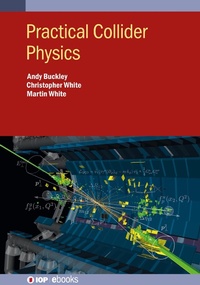
Practical Collider Physics
Description

Following the discovery of the Higgs boson in 2012, particle physics has entered its most exciting and crucial period for over 50 years. Particle colliders such as the Large Hadron Collider (LHC) at CERN provide the means to search for the next theory of particle physics by performing precise measurements of the Higgs boson, and by looking directly for particles that can solve current cosmic mysteries such as the nature of dark matter.
Practical Collider Physics provides a self-contained summary of all of the necessary theoretical, experimental and statistical knowledge required to analyse hadron collider data, focussing on the skills and techniques that are rarely covered in standard textbooks. Whilst the topics are kept accessible to honours-level undergraduates and masters students, they also serve as a useful primer for particle theorists who want an exposure to experimental methods to further their own understanding of the LHC, making Practical Collider Physics a fundamental text for anyone studying particle physics. The book covers topics including parton distribution functions, resummation, parton showers, hadronisation, and the underlying event and jet algorithms, all of which are vital for understanding the form and function of Monte Carlo generators. A detailed overview of the ATLAS and CMS detectors is also provided, along with their object-reconstruction algorithms, followed by a pedagogical introduction to computing and data-processing approaches, data-analysis basics, and detailed methods for high-precision measurements and particle searches.
More details
Other editions
Additional editions
Persons
Martin White is a Professor and Deputy Dean of Research in the Faculty of Sciences at the University of Adelaide, where he leads a group in particle astrophysics phenomenology, with connections to machine learning and novel data science techniques in Bayesian and frequentist inference. He teaches physics at undergraduate and masters level, and has developed a new interdisciplinary curriculum in data science.
Andy Buckley is a Senior Lecturer in particle physics in the School of Physics & Astronomy at the University of Glasgow. Most of his work is on experimental studies with the ATLAS experiment, part of the Large Hadron Collider at the CERN lab in Geneva. He also works with theorists on modelling of hadron collisions, and on ways of constraining the prospective models of new physics that they come up with.
Chris White: Chris White is a Reader in Theoretical Physics at Queen Mary University of London, where he lectures in particle physics theory. He has worked on various aspects of collider physics, including Monte Carlo simulation, the description of low momentum ("soft") radiation in QCD, and the behaviour of the top-quark and Higgs bosons. In recent years, he has studied new relationships between theories like QCD, and quantum gravity.
Content
Part I: Theory and methods for hadron colliders
Chapter 1: Introduction
Chapter 2: Quantum field theory for hadron colliders
Chapter 3: From theory to experiment
Chapter 4: Beyond the Standard Model
Chapter 5: Statistics for collider physics
Part II: Experimental physics at hadron colliders
Chapter 6: Detecting and reconstructing particles at hadron colliders
Chapter 7: Computing and data processing
Chapter 8: Data analysis basics
Chapter 9: Resonance searches
Chapter 10: Semi-invisible particle searches
Chapter 11: High-precision measurements
Chapter 12: Analysis preservation and reinterpretation
Chapter 13: Outlook
Part III: Appendix
A: Useful relative formulae
