

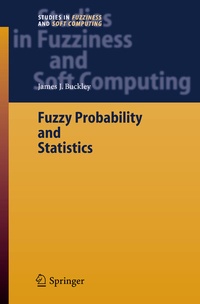
Fuzzy Probability and Statistics
Description

Reviews / Votes
From the reviews:
"The reviewed book is an interesting and well organized monograph on fuzzy statistics which can be recommended for specialists and non-specialists in the field of fuzzy sets research." (Krzysztof Piasecki, Zentralblatt MATH, Vol. 1095 (21), 2006)
More details
Other editions
Additional editions
Content
Chapter 1
Introduction (p. 1-2)
1.1 Introduction
This book is written in the following divisions: (1) the introductory chapters consisting of Chapters 1 and 2, (2) introduction to fuzzy probability in Chapters 3-5, (3) introduction to fuzzy estimation in Chapters 6-11, (4) fuzzy/crisp estimators of probability density (mass) functions based on a fuzzy maximum entropy principle in Chapters 12-14, (5) introduction to fuzzy hypothesis testing in Chapters 15-18, (6) fuzzy correlation and regression in Chapters 19-25, (7) Chapters 26 and 27 are about a fuzzy ANOVA model, (8) a fuzzy estimator of the median in nonparametric statistics in Chapter 28, and (9) random fuzzy numbers with applications to Monte Carlo studies in Chapter 29. First we need to be familiar with fuzzy sets. All you need to know about fuzzy sets for this book comprises Chapter 2. For a beginning introduction to fuzzy sets and fuzzy logic see [8]. One other item relating to fuzzy sets, needed in fuzzy hypothesis testing, is also in Chapter 2: how we will determine which of the following three possibilities is true M <, N, M >, N or M . N, for two fuzzy numbers M, N.
The introduction to fuzzy probability in Chapters 3-5 is based on the book [1] and the reader is referred to that book for more information, especially applications. What is new here is: (1) using a nonlinear optimization program in Maple [13] to solve certain optimization problems in fuzzy probability, where previously we used a graphical method, and (2) a new algorithm, suitable for using only pencil and paper, for solving some restricted fuzzy arithmetic problems.
The introduction to fuzzy estimation is based on the book [3] and we refer the interested reader to that book for more about fuzzy estimators. The fuzzy estimators omitted from this book are those for µ1 . µ2, p1 . p2, s1/s2, etc. Fuzzy estimators for arrival and service rates is from [2] and [4]. The reader should see those book for applications in queuing networks. Also, fuzzy estimators for the uniform probability density can be found in [4], but the derivation of these fuzzy estimators is new to this book. The fuzzy uniform distribution was used for arrival/service rates in queuing models in [4].
The fuzzy/crisp probability density estimators based on a fuzzy maximum entropy principle are based on the papers [5],[6] and [7] and are new to this book. In Chapter 12 we obtain fuzzy results but in Chapters 13 and 14 we determine crisp discrete and crisp continuous probability densities. The introduction to fuzzy hypothesis testing in Chapters 15-18 is based on the book [3] and the reader needs to consult that book for more fuzzy hypothesis testing. What we omitted are tests on µ1 = µ2, p1 = p2, s1 = s2, etc.
The chapters on fuzzy correlation and regression come from [3]. The results on the fuzzy ANOVA (Chapters 26 and 27) and a fuzzy estimator for the median (Chapter 28) are new and have not been published before. The chapter on random fuzzy numbers (Chapter 29) is also new to this book and these results have not been previously published. Applications of crisp random numbers to Monte Carlo studies are well known and we also plan to use random fuzzy numbers in Monte Carlo studies. Our first use of random fuzzy numbers will be to get approximate solutions to fuzzy optimization problems whose solution is unknown or computationally very difficult. However, this becomes a rather large project and will probably be the topic of a future book.
Chapter 30 contains selected Maple/Solver ([11],[13],[20]) commands used in the book to solve optimization problems or to generate the figures. The final chapter has a summary and suggestions for future research. All chapters can be read independently. This means that some material is repeated in a sequence of chapters. For example, in Chapters 15-18 on fuzzy hypothesis testing in each chapter we first review the crisp case, then fuzzify to obtain our fuzzy statistic which is then used to construct the fuzzy critical values and we finally present a numerical example. However, you should first know about fuzzy estimators (Chapters 6-11) before going on to fuzzy hypothesis testing.
A most important part of our models in fuzzy statistics is that we always start with a random sample producing crisp (non-fuzzy) data. Other authors discussing fuzzy statistics usually begin with fuzzy data. We assume we have a random sample giving real number data x1, x2, ..., xn which is then used to generate our fuzzy estimators. Using fuzzy estimators in hypothesis testing and regression obviously leads to fuzzy hypothesis testing and fuzzy regression.
