

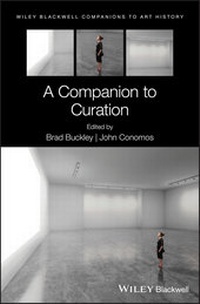
A Companion to Curation
Description

The definitive reference text on curation both inside and outside the museum
A Companion to Curation is the first collection of its kind, assembling the knowledge and experience of prominent curators, artists, art historians, scholars, and theorists in one comprehensive volume. Part of the Blackwell Companion series, this much-needed book provides up-to-date information and valuable insights on the field of curatorial studies and curation in the visual arts. Accessible and engaging chapters cover diverse, contemporary methods of curation, its origin and history, current and emerging approaches within the profession, and more.
This timely publication fills a significant gap in literature on the role of the curator, the art and science of curating, and the historical arc of the field from the 17th century to the present. The Companion explores topics such as global developments in contemporary indigenous art, Asian and Chinese art since the 1980s, feminist and queer feminist curatorial practices, and new curatorial strategies beyond the museum. This unique volume:
- Offers readers a wide range of perspectives on curating in both theory and practice
- Includes coverage of curation outside of the Eurocentric and Anglosphere art worlds
- Presents clear and comprehensible information valuable for specialists and novices alike
- Discusses the movements, models, people and politics of curating
- Provides guidance on curating in a globalized world
Broad in scope and detailed in content, A Companion to Curation is an essential text for professionals engaged in varied forms of curation, teachers and students of museum studies, and readers interested in the workings of the art world, museums, benefactors, and curators.
More details
Other editions
Additional editions
Persons
Brad Buckley is an artist, urbanist, activist, curator, and Professorial Fellow at the Victorian College of the Arts, University of Melbourne, Australia. He was previously Professor of Contemporary Art and Culture at Sydney College of the Arts, University of Sydney, and has authored and edited many books and essays on contemporary art.
John Conomos is an artist, critic, writer, and Associate Professor and Principal Fellow at the Victorian College of the Arts, University of Melbourne. His art practice cuts across a variety of media and has been exhibited extensively around the world including at the Tate Modern, London and at MoMA, New York. He has authored and edited numerous books on contemporary art and cinema.
Content
Series Editor's Preface x
About the Editors xi
Notes on Contributors xiii
Acknowledgments xvii
Foreword xviii
List of Illustrations xx
Introduction xxiv
Part I An Overview: The Origin and Provenance of Curating 1
1 A Selective History of Curating in Pittsburgh: The Recent Story of the Carnegie International 3
David Carrier
2 Curating Curiosity: Imperialism, Materialism, Humanism, and the Wunderkammer 23
Adam Geczy Copyrighted Material
3 Professionalizing the Field: The Case of the United States 43
Andrew McClellan
4 The Emergence of the Professional Curator 67
Carole Paul
Part II Movements, Models, People, and Politics 87
5 Curating as a Verb: 100 Years of Nation States 89
Juli Carson
6 Curating without Borders: Transnational Feminist and Queer Feminist Practices for the Twenty-first Century 111
Elke Krasny
7 Displacements and Sites: Notes on a Curatorial Method 134
Maria Lind
8 Africa, Art, and Knowing Nothing: Some Thoughts on Curating at the British Museum 143
Chris Spring
9 Curatorial Crisis 160
Martha Wilson
Part III The Curator in a Globalized World 169
10 "We Care as Much as You Pay" - Curating Asian Art 171
Thomas J. Berghuis
11 Museums Are Everywhere in China, There Is No Museum in China: (or, How Institutional Typologies Define Curatorial Practices) 193
Biljana Círic ¿
12 Curating the Contemporary in Decolonial Spaces: Observations from Thailand on Curatorial Practice in Southeast Asia 206
Gregory Galligan
13 Curated from Within: The Artist as Curator 232
Alex Gawronski
14 Decolonizing the Ethnographic Museum 262
Gerald McMaster
15 The Creature from the Id: Adventures in Aboriginal Art Curating 277
Djon Mundine
16 The Impact of Context Specificity in Curating amidst the Forces at Play in a Globalized World of Realms 291
Fatos¿ Üstek
17 The Neglected Object of Curation 306
Lee Weng-Choy
Part IV Beyond the Museum: Curating at the Frontier 323
18 Parallel Processing: Public Art and New Media Art 325
Sara Diamond
19 Approach to the Curatorship of Virtual Reality Exhibitions 360
Arnau Gifreu-Castells
20 Tracing the Ephemeral and Contestational: Aesthetics and Politics of The Living Archive 375
Eric Kluitenberg
21 Curating with the Internet 391
Sean Lowry
22 Arts and Science: The Intersection (Re)engineered 422
Melentie Pandilovski
Index 447
Notes on Contributors
Thomas J. Berghuis is a curator and art historian, based in Leiden, the Netherlands. His monograph on Performance Art in China was published in 2006 with Timezone 8 in Hong Kong. Berghuis has further published on contemporary art, new media art, experimental art, and curatorial practices in China and Indonesia. Exhibitions curated by Berghuis include Wang Jianwei: Time Temple at the Guggenheim Museum, New York (2014) and Suspended Histories at the Museum van Loon, Amsterdam (2013).
David Carrier is a philosopher who writes art criticism for artcritical.com, Brooklyn Rail, and hyperallergic. He has published books on the art museum, the art gallery, the world art history, the pictures of Sean Scully, the paintings of Nicolas Poussin, and the art criticism of Charles Baudelaire. His most recent books are Aesthetic Theory, Abstract Art, and Lawrence Carroll (Bloomsbury Academic, 2018) and, with Joachim Pissarro, Aesthetics of the Margins/The Margins of Aesthetics: Wild Art Explained (Penn State University Press, 2018).
Juli Carson is Professor of Art at UC Irvine. She is also Philippe Jabre Professor of Art History and Curating at the American University of Beirut, 2018-2019. Her books include: Exile of the Imaginary: Politics, Aesthetics, Love (Generali Foundation, 2007) and The Limits of Representation: Psychoanalysis and Critical Aesthetics (Letra Viva Press, 2011). The Hermenuetic Impulse: Aesthetics of an Untethered Past was published this year by PoLyPen, a subsidiary of b_books Press.
Biljana Ciric is an independent curator based in Shanghai and Belgrade. She was the co-curator of the 3rd Ural Industrial Biennial for Contemporary Art (Yekaterinburg, 2015), curator-in-residence at the Kadist Art Foundation (Paris, 2015), and a research fellow at Henie Onstad Kunstsenter (Høvikodden, 2016). Her most recent project was the Second Assembly, a seminar series related to the exhibition histories of China and Southeast Asia, with a focus on the 1990s, which was hosted by the Rockbund Art Museum in 2018.
Sara Diamond is President of OCAD University, Canada's, "University of the Imagination." She holds a PhD in Computing, Information Technology and Engineering. She is an appointee of the Order of Ontario and a recipient of the Queen's Diamond Jubilee Medal for service to Canada. She is the winner of the 2013 GRAND NCE Digital Media Pioneer Award, and Canada's Leading 150 women. Her research includes data visualization, public art policy, and media histories.
Gregory Galligan is an independent curator and art historian and director/co-founder of the nonprofit research platform THAI ART ARCHIVEST (f. 2010), in Bangkok. He lectures on global modern and contemporary art histories for the International Program in Design and Architecture (INDA), and cultural management and the history and theory of contemporary curatorial practice for the MA in Cultural Management (MACM) curriculum at Chulalongkorn University (Bangkok).
Alex Gawronski is an artist, writer, gallerist, and academic based in Sydney, Australia. Gawronski frequently focuses on the institutional dynamics that underwrite and determine how we see and consume art. He has founded and directed numerous independent artist spaces, currently KNULP in Sydney. In 2017, he participated in The National: New Australian Art, a survey of mid-career and established artists at the Art Gallery of New South Wales, Museum of Contemporary Art Australia and Carriageworks, Sydney, Australia.
Adam Geczy is an artist and writer who teaches at the University of Sydney. His Art: Histories, Theories and Exceptions (Berg, 2008) won the Choice Award for best academic title in art in 2009. Having produced over 16 books, recent titles include Artificial Bodies in Fashion and Art (Bloomsbury, 2017) and Transorientalism in Art, Fashion and Film (Bloomsbury, 2019). He is also editor of the JAPPC and ab-Original (both Penn State University Press).
Arnau Gifreu-Castells is a research affiliate at the Open Documentary Lab (Massachusetts Institute of Technology) and part of the i-Docs group (University of the West of England). He has published various books and articles in his research area, interactive and transmedia non-fiction, and specifically on interactive documentaries.
Eric Kluitenberg is a theorist, writer, curator, and educator working at the intersection of culture, politics, media, and technology. He is the Editor-in-Chief of the Tactical Media Files, an online documentation platform for Tactical Media. He was a Research Fellow at the Institute of Network Cultures, Amsterdam, and teaches cultural and media theory at the Art Science Interfaculty in The Hague, the Netherlands. His recent publications include (Im)Mobility (2011) and Acoustic Space #11, Techno-Ecologies (RIXC, 2012).
Elke Krasny, Professor at the Academy of Fine Arts Vienna. Her research, writing, and curating connects feminist praxis, spatial economies, urban analysis, and curating's historiographies. Publications include the 2017 essays "Exposed: The Politics of Infrastructure in VALIE EXPORT's Transparent Space" in Third Text and "The Salon Model: The Conversational Complex" in Feminism and Art History Now, edited by Horne and Perry. The volume Women's: Museum. Curatorial Politics in Feminism, Education, History, and Art appeared in 2013.
Maria Lind is a curator, writer, and educator based in Stockholm. She is the director of Tensta konsthall, Stockholm, and the artistic director of the 11th Gwangju Biennale. She was director of the graduate program, Center for Curatorial Studies, Bard College (2008-2010). Among her recent co-edited publications are Art and the F Word: Reflections on the Browning of Europe (Sternberg Press, 2014). She edited Abstraction as part of MIT's and Whitechapel Gallery's series Documents on Contemporary Art.
Sean Lowry is a Melbourne-based artist, writer, curator, and musician. He holds a PhD in Visual Arts from the University of Sydney and is currently Head of Critical and Theoretical Studies at Victorian College of the Arts, Faculty of Fine Arts and Music at the University of Melbourne. Lowry has exhibited extensively nationally and internationally, and his published writing appears in numerous journals and edited volumes. He is also Founder and Executive Director of Project Anywhere (www.projectanywhere.net). For more information, please visit www.seanlowry.com.
Andrew McClellan is Professor of Art History at Tufts University, US. He has written widely on eighteenth-century European art and the history of museums and art collecting. His books include: Inventing the Louvre: Art, Politics, and the Origins of the Modern Museum in Eighteenth-century Paris (University of California Press, 1999), Art and its Publics (Wiley-Blackwell, 2003), The Art Museum from Boullée to Bilbao (University of California Press, 2008), and, with Sally Anne Duncan, The Art of Curating: Paul J. Sachs and the Museum Course at Harvard (Getty Publications, 2018).
Gerald McMaster is a curator, artist, author, and professor and is a Tier 1 Canada Research Chair in Indigenous Visual Culture and Curatorial Practice at OCAD University, Toronto, Canada. McMaster has curated two international biennales: in 1995 he was Canadian commissioner to the Biennale di Venezia and in 2012 he was artistic co-director, with Catherine de Zegher, of the 18th Biennale of Sydney. In 2018, he was Curator for the Canadian Pavilion at the Biennale Architettura 2018 (Venice, Italy).
Djon Mundine, OAM, is a member of the Bandjalung people of northern New South Wales, Australia and is a curator, writer, artist, and activist. He has held prominent curatorial positions in national and international institutions. He was the concept artist of the Aboriginal Memorial at the National Gallery of Australia in 1988. In 2005-2006 he was Research Professor at the National Museum of Ethnology in Osaka, Japan. He is currently an independent curator of contemporary Indigenous art.
Melentie Pandilovski is an art theorist, historian, and curator. His research examines the links between art culture and science technology. He was previously director of Video Pool Media Arts Centre, Winnipeg, Canada and is currently Director of the Riddoch Art Gallery, Mount Gambier, Australia. He has curated more than 200 projects in Europe, Australia, and Canada. He is the editor (with Tom Kohut) of Marshall McLuhan & Vilém Flusser Communication & Aesthetics Theories Revisited (Video Pool, 2015).
Carole Paul is director of Museum Studies in the Department of the History of Art and Architecture at the University of California, Santa Barbara. Her current work concerns the history of museums and collections in the early modern period, especially in Rome. Her various publications include The First Modern Museums of Art: The Birth of an Institution in 18th- and Early-19th-Century Europe (Getty Publications, 2012). She is now writing a book on the Capitoline Museum in Rome.
Chris Spring is an artist, writer, and curator (www.chrisspring.co.uk). His research interests include contemporary African art...
