

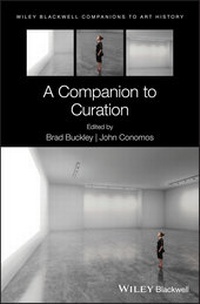
A Companion to Curation
Description

The definitive reference text on curation both inside and outside the museum
A Companion to Curation is the first collection of its kind, assembling the knowledge and experience of prominent curators, artists, art historians, scholars, and theorists in one comprehensive volume. Part of the Blackwell Companion series, this much-needed book provides up-to-date information and valuable insights on the field of curatorial studies and curation in the visual arts. Accessible and engaging chapters cover diverse, contemporary methods of curation, its origin and history, current and emerging approaches within the profession, and more.
This timely publication fills a significant gap in literature on the role of the curator, the art and science of curating, and the historical arc of the field from the 17th century to the present. The Companion explores topics such as global developments in contemporary indigenous art, Asian and Chinese art since the 1980s, feminist and queer feminist curatorial practices, and new curatorial strategies beyond the museum. This unique volume:
- Offers readers a wide range of perspectives on curating in both theory and practice
- Includes coverage of curation outside of the Eurocentric and Anglosphere art worlds
- Presents clear and comprehensible information valuable for specialists and novices alike
- Discusses the movements, models, people and politics of curating
- Provides guidance on curating in a globalized world
Broad in scope and detailed in content, A Companion to Curation is an essential text for professionals engaged in varied forms of curation, teachers and students of museum studies, and readers interested in the workings of the art world, museums, benefactors, and curators.
More details
Other editions
Additional editions
Persons
Brad Buckley is an artist, urbanist, activist, curator, and Professorial Fellow at the Victorian College of the Arts, University of Melbourne, Australia. He was previously Professor of Contemporary Art and Culture at Sydney College of the Arts, University of Sydney, and has authored and edited many books and essays on contemporary art.
John Conomos is an artist, critic, writer, and Associate Professor and Principal Fellow at the Victorian College of the Arts, University of Melbourne. His art practice cuts across a variety of media and has been exhibited extensively around the world including at the Tate Modern, London and at MoMA, New York. He has authored and edited numerous books on contemporary art and cinema.
Content
Series Editor's Preface x
About the Editors xi
Notes on Contributors xiii
Acknowledgments xvii
Foreword xviii
List of Illustrations xx
Introduction xxiv
Part I An Overview: The Origin and Provenance of Curating 1
1 A Selective History of Curating in Pittsburgh: The Recent Story of the Carnegie International 3
David Carrier
2 Curating Curiosity: Imperialism, Materialism, Humanism, and the Wunderkammer 23
Adam Geczy Copyrighted Material
3 Professionalizing the Field: The Case of the United States 43
Andrew McClellan
4 The Emergence of the Professional Curator 67
Carole Paul
Part II Movements, Models, People, and Politics 87
5 Curating as a Verb: 100 Years of Nation States 89
Juli Carson
6 Curating without Borders: Transnational Feminist and Queer Feminist Practices for the Twenty-first Century 111
Elke Krasny
7 Displacements and Sites: Notes on a Curatorial Method 134
Maria Lind
8 Africa, Art, and Knowing Nothing: Some Thoughts on Curating at the British Museum 143
Chris Spring
9 Curatorial Crisis 160
Martha Wilson
Part III The Curator in a Globalized World 169
10 "We Care as Much as You Pay" - Curating Asian Art 171
Thomas J. Berghuis
11 Museums Are Everywhere in China, There Is No Museum in China: (or, How Institutional Typologies Define Curatorial Practices) 193
Biljana Círic ¿
12 Curating the Contemporary in Decolonial Spaces: Observations from Thailand on Curatorial Practice in Southeast Asia 206
Gregory Galligan
13 Curated from Within: The Artist as Curator 232
Alex Gawronski
14 Decolonizing the Ethnographic Museum 262
Gerald McMaster
15 The Creature from the Id: Adventures in Aboriginal Art Curating 277
Djon Mundine
16 The Impact of Context Specificity in Curating amidst the Forces at Play in a Globalized World of Realms 291
Fatos¿ Üstek
17 The Neglected Object of Curation 306
Lee Weng-Choy
Part IV Beyond the Museum: Curating at the Frontier 323
18 Parallel Processing: Public Art and New Media Art 325
Sara Diamond
19 Approach to the Curatorship of Virtual Reality Exhibitions 360
Arnau Gifreu-Castells
20 Tracing the Ephemeral and Contestational: Aesthetics and Politics of The Living Archive 375
Eric Kluitenberg
21 Curating with the Internet 391
Sean Lowry
22 Arts and Science: The Intersection (Re)engineered 422
Melentie Pandilovski
Index 447
