

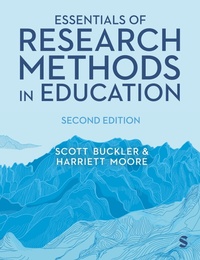
Essentials of Research Methods in Education
2nd Edition
Published on 28. March 2026
384 pages
978-1-0362-3874-2 (ISBN)
Description

This book provides pragmatic advice and guidance on how to undertake educational research.
Using the concept of research as a 'quest', it takes you on a journey from planning stages, through data collection to analysis, to writing up your findings, and at each stage, exploring the principles and practice that can support your own research projects.
This second edition has been carefully revised throughout to offer:
A more logical structure and better signposting of key topics to support your understanding of the research process.
Important ethical considerations throughout to demonstrate how research ethics are vital at every step.
Engaging and thought-provoking commentaries on how to progress in your 'research quest'.
Enhanced granular detail on different methodological approaches.
This is essential reading for students on all education courses that include a research methods module or project.
Using the concept of research as a 'quest', it takes you on a journey from planning stages, through data collection to analysis, to writing up your findings, and at each stage, exploring the principles and practice that can support your own research projects.
This second edition has been carefully revised throughout to offer:
A more logical structure and better signposting of key topics to support your understanding of the research process.
Important ethical considerations throughout to demonstrate how research ethics are vital at every step.
Engaging and thought-provoking commentaries on how to progress in your 'research quest'.
Enhanced granular detail on different methodological approaches.
This is essential reading for students on all education courses that include a research methods module or project.
More details
Edition
Second Edition
Language
English
Place of publication
London
United Kingdom
Publishing group
SAGE Publishing (Digital)
Target group
College/higher education
File size
6,41 MB
ISBN-13
978-1-0362-3874-2 (9781036238742)
Copyright in bibliographic data and cover images is held by Nielsen Book Services Limited or by the publishers or by their respective licensors: all rights reserved.
Schweitzer Classification
Other editions
Additional editions
Scott Buckler | Harriett Moore
Essentials of Research Methods in Education
Book
approx. 04/2026
2nd Edition
SAGE Publications Ltd
€152.30
Not yet published
Scott Buckler | Harriett Moore
Essentials of Research Methods in Education
Book
03/2026
2nd Edition
SAGE Publications Ltd
€135.50
Shipment within 15-20 days
Persons
Scott Buckler has been involved in education since the 1990s, fluctuating between primary teaching, secondary teaching (science, computing, psychology), and universities (education, sport, psychology). From teaching research methods across the expanse of education (from the primary years through to doctorates), Scott has been an advocate of high quality research, through facilitating an open mind while maintaining academic integrity.
His research has encompassed many areas, often with the theme of personal and professional growth, through the lens of transpersonal psychology. His PhD thesis was interdisciplinary, combining anthropology and psychology to explore the way that the martial arts lead to personal transformation. Professionally, Scott's research is predominantly in applied educational psychology, inclusive education, and research methods.
Scott is a Chartered Teacher and Chartered Psychologist.
Harriett Moore has a varied background within the field of both education and research. She studied animal behaviour at University College Chester (a college of Liverpool University) where she engaged with a wide selection of research methodologies, from observational approaches to applied research in a range of contexts. Her skills have transferred effectively into analysing human behaviour.
Harriett has been involved with education since the mid-2000s as a secondary teacher, IT Operations Manager, among other roles. Throughout her career, Harriett has engaged with applied research to help facilitate change and to inform a variety of audiences, continually challenging perspectives in the limitations of what people think is possible, and what can actually be achieved.
Harriett currently manages the school's Duke of Edinburgh Award Scheme and is a firm believer that education is much more than classroom based learning, rather requiring a "whole-person centred" approach. Her current research projects include teacher wellbeing, martial arts within the school setting, and student/staff perceptions on elearning.
His research has encompassed many areas, often with the theme of personal and professional growth, through the lens of transpersonal psychology. His PhD thesis was interdisciplinary, combining anthropology and psychology to explore the way that the martial arts lead to personal transformation. Professionally, Scott's research is predominantly in applied educational psychology, inclusive education, and research methods.
Scott is a Chartered Teacher and Chartered Psychologist.
Harriett Moore has a varied background within the field of both education and research. She studied animal behaviour at University College Chester (a college of Liverpool University) where she engaged with a wide selection of research methodologies, from observational approaches to applied research in a range of contexts. Her skills have transferred effectively into analysing human behaviour.
Harriett has been involved with education since the mid-2000s as a secondary teacher, IT Operations Manager, among other roles. Throughout her career, Harriett has engaged with applied research to help facilitate change and to inform a variety of audiences, continually challenging perspectives in the limitations of what people think is possible, and what can actually be achieved.
Harriett currently manages the school's Duke of Edinburgh Award Scheme and is a firm believer that education is much more than classroom based learning, rather requiring a "whole-person centred" approach. Her current research projects include teacher wellbeing, martial arts within the school setting, and student/staff perceptions on elearning.
Content
PART I Introduction to educational research
Ch1 Introduction
Ch2 Research perspectives and applied philosophy
Ch3 The importance of the sociocultural context
Ch4 The research process from start to finish
PART II Establishing and defining your research focus
Ch5 Identifying an appropriate research project
Ch6 The importance of ethics
Ch7 The literature review
Ch8 Different research designs
PART III Data collection methods and analysis
Ch9 Quantitative data collection methods
Ch10 Quantitative data analysis and presentation of findings
Ch11 Qualitative data collection methods
Ch12 Qualitative data analysis and presentation of findings
Ch13 Mixed methodologies and mixed approaches
PART IV Engaging with your own research
Ch14 Conducting and completing your research project
Ch15 Taking your research project further: presentation and publication
Ch1 Introduction
Ch2 Research perspectives and applied philosophy
Ch3 The importance of the sociocultural context
Ch4 The research process from start to finish
PART II Establishing and defining your research focus
Ch5 Identifying an appropriate research project
Ch6 The importance of ethics
Ch7 The literature review
Ch8 Different research designs
PART III Data collection methods and analysis
Ch9 Quantitative data collection methods
Ch10 Quantitative data analysis and presentation of findings
Ch11 Qualitative data collection methods
Ch12 Qualitative data analysis and presentation of findings
Ch13 Mixed methodologies and mixed approaches
PART IV Engaging with your own research
Ch14 Conducting and completing your research project
Ch15 Taking your research project further: presentation and publication
