

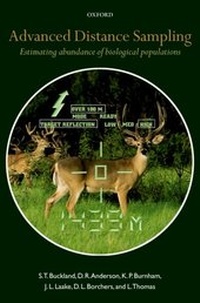
Advanced Distance Sampling
Estimating abundance of biological populations
1st Edition
Published on 19. August 2004
435 pages
978-0-19-154519-1 (ISBN)
Description

This advanced text focuses on the uses of distance sampling to estimate the density and abundance of biological populations. It addresses new methodologies, new technologies and recent developments in statistical theory and is the follow up companion to Introduction to Distance Sampling (OUP, 2001). In this text, a general theoretical basis is established for methods of estimating animal abundance from sightings surveys, and a wide range of approaches to analysis of sightings data is explored. These approaches include: modelling animal detectability as a function of covariates, where the effects of habitat, observer, weather, etc. on detectability can be assessed, estimating animal density as a function of location, allowing for example animal density to be related to habitat and otherlocational covariates, estimating change over time in populations, a necessary aspect of any monitoring programme, estimation when detection of animals on the line or at the point is uncertain, as often occurs for marine populations, or when the survey region has dense cover, survey design and automateddesign algorithms, allowing rapid generation of sound survey designs using geographic information systems, adaptive distance sampling methods, which concentrate survey effort in areas of high animal density, passive distance sampling methods, which extend the application of distance sampling to species that cannot be readily detected in sightings surveys, but can be trapped, and testing of methods by simulation, so that performance of the approach in varying circumstances can beassessed.
More details
Other editions
Additional editions
S.T. Buckland | D.R Anderson | K.P. Burnham
Advanced Distance Sampling
Estimating abundance of biological populations
Book
11/2007
Oxford University Press
€76.75
Shipment within 15-20 days
S.T. Buckland | D.R Anderson | K.P. Burnham
Advanced Distance Sampling
Estimating abundance of biological populations
Book
08/2004
Oxford University Press
€129.99
Shipment within 15-20 days
Content
- Intro
- Contents
- 1 Introduction to advanced distance sampling
- 2 General formulation for distance sampling
- 2.1 Introduction
- 2.2 CDS revisited
- 2.2.1 Conventional line transect estimator
- 2.2.2 Conventional point transect estimator
- 2.3 Horvitz-Thompson: a versatile estimator
- 2.3.1 Animals that occur as individuals
- 2.3.2 Animals that occur in clusters
- 2.3.3 CDS estimators
- 2.4 Maximum likelihood estimation
- 2.4.1 'Covered' animals
- 2.4.2 Random detection with known probability
- 2.4.3 CDS likelihoods
- 2.5 Summary so far and preview of advances
- 2.5.1 Summary
- 2.5.2 Preview of advances
- 2.6 Advanced methods for detection function estimation
- 2.6.1 Multiple covariate distance sampling
- 2.6.2 Mark-recapture distance sampling
- 2.6.3 Estimation when p(y) is unknown
- 2.7 Estimating animal density surfaces
- 2.7.1 The count method
- 2.7.2 The waiting distance method
- 2.7.3 Cluster size surface estimation
- 2.8 Survey design
- 2.8.1 Likelihood-based inference
- 2.8.2 Design-based inference
- 2.8.3 Adaptive distance sampling
- 2.9 Model selection
- 2.10 Summary
- 3 Covariate models for the detection function
- 3.1 Introduction
- 3.2 A conditional likelihood framework for distance sampling
- 3.3 Line transect sampling
- 3.3.1 The conditional likelihood
- 3.3.2 Incorporating covariates into semiparametric models for the detection function
- 3.3.3 Abundance estimation
- 3.4 Point transect sampling
- 3.5 Example
- 3.6 Discussion
- 4 Spatial distance sampling models
- 4.1 Introduction
- 4.2 Spatial line transect models
- 4.2.1 Deriving a likelihood
- 4.2.2 A likelihood based on inter-detection distances
- 4.2.3 Clustered populations
- 4.3 Practical implementations of spatial line transect models
- 4.3.1 A waiting distance model
- 4.3.2 A count model
- 4.4 Spatial distribution of Antarctic minke whales
- 4.5 Spatial point transect models
- 4.5.1 Deriving a likelihood
- 4.5.2 A point transect count model
- 4.6 Discussion
- 5 Temporal inferences from distance sampling surveys
- 5.1 Introduction
- 5.2 Concepts
- 5.2.1 Sampling and population variation
- 5.2.2 Sampling covariance
- 5.2.3 Empirical and process models
- 5.2.4 Trend
- 5.2.5 Abundance as a fixed or random quantity
- 5.3 Trend estimation from global abundance estimates
- 5.3.1 Graphical exploration
- 5.3.2 Linear trend models
- 5.3.3 Smoothing
- 5.3.4 Trend estimation when samples covary
- 5.4 Spatio-temporal analysis
- 5.4.1 Transect-level models of trend
- 5.4.2 Spatio-temporal modelling
- 5.5 Process models
- 5.5.1 State-space models
- 5.5.2 Generalizing state-space models
- 5.6 Other analysis methods
- 5.6.1 Time series methods
- 5.6.2 Quality control methods
- 5.7 Survey design
- 5.7.1 Repeating transects
- 5.7.2 Sample size
- 5.7.3 Planning long-term studies
- 6 Methods for incomplete detection at distance zero
- 6.1 Introduction
- 6.2 Likelihood and Horvitz-Thompson
- 6.2.1 Constant detection probability
- 6.2.2 Detection probability changing with distance
- 6.2.3 Independence issues
- 6.2.4 Multiple covariates
- 6.2.5 Unobserved heterogeneity
- 6.3 State and observation models
- 6.3.1 State models
- 6.3.2 Observation models
- 6.3.3 Observation configurations
- 6.4 Example data
- 6.5 Estimation for independent configuration
- 6.5.1 Distance only
- 6.5.2 Distance and covariates
- 6.6 Estimation for trial configuration
- 6.6.1 Distance and covariates
- 6.6.2 Distance, covariates, and responsive movement
- 6.7 Estimation for removal configuration
- 6.8 Dealing with availability bias
- 6.8.1 Static availability
- 6.8.2 Hazard-rate models for dynamic availability
- 6.8.3 Discrete availability: animal-based
- 6.8.4 Discrete availability: cue-based
- 6.8.5 Intermittent availability
- 6.8.6 Design-based availability estimation
- 6.9 Special topics
- 6.9.1 Uncertain duplicate identification
- 6.9.2 When should double-observer methods be used?
- 6.10 Field methods
- 6.10.1 Marked animals
- 6.10.2 Observation configuration
- 6.10.3 Data collection and recording
- 7 Design of distance sampling surveys and Geographic Information Systems
- 7.1 The potential role of GIS in survey design
- 7.2 Automated survey design
- 7.2.1 Point transect design
- 7.2.2 Line transect design using lines of fixed length
- 7.2.3 Line transect design using lines that span the full width of the survey region
- 7.2.4 Zigzag samplers
- 7.3 Estimation for uneven coverage probability designs
- 7.3.1 Objects that occur singly
- 7.3.2 Objects that occur in clusters
- 7.3.3 Variance estimation
- 7.4 Choosing between survey designs by simulation
- 8 Adaptive distance sampling surveys
- 8.1 Introduction
- 8.2 Design-unbiased adaptive point transect surveys
- 8.2.1 Survey design
- 8.2.2 Estimation
- 8.2.3 Simulated example
- 8.2.4 Discussion
- 8.3 Design-unbiased adaptive line transect surveys
- 8.3.1 Survey design
- 8.3.2 Estimation
- 8.3.3 Discussion
- 8.4 Fixed-effort adaptive line transect surveys
- 8.4.1 Survey design
- 8.4.2 Estimation
- 8.4.3 Simulation
- 8.4.4 Discussion
- 9 Passive approaches to detection in distance sampling
- 9.1 Introduction
- 9.2 Trapping webs
- 9.2.1 Density estimation
- 9.2.2 Including data from recaptures
- 9.2.3 Design of trapping webs
- 9.2.4 An example
- 9.2.5 A critique of the trapping web
- 9.3 Trapping line transects
- 9.3.1 Density estimation
- 9.3.2 Including data from recaptures
- 9.3.3 Design of trapping line transects
- 9.3.4 An example
- 9.3.5 A critique of the trapping line transect
- 9.4 Discussion and summary
- 10 Assessment of distance sampling estimators
- 10.1 Introduction
- 10.1.1 Notation
- 10.2 Estimation framework
- 10.3 Model and design
- 10.3.1 Model-based inference
- 10.3.2 Design-based inference
- 10.3.3 Distance sampling: a composite approach
- 10.4 Simulation framework
- 10.4.1 Testing the design
- 10.4.2 Testing the model
- 10.4.3 Testing the full line transect estimation procedure
- 10.5 Example: testing the design
- 10.5.1 Testing equal coverage designs for var( N)
- 10.5.2 A design without equal coverage probability
- 10.6 Example: non-uniformity within the strip
- 10.6.1 Estimation of N[sub(c)]
- 10.6.2 Asymptotic result when ? is estimated
- 10.7 Example: full estimation procedure
- 10.8 Trial by simulation: a completely model-based approach
- 10.9 Summary
- 11 Further topics in distance sampling
- 11.1 Distance sampling in three dimensions
- 11.1.1 Three-dimensional line transect sampling
- 11.1.2 Three-dimensional point transect sampling
- 11.2 Conventional distance sampling: full likelihood examples
- 11.2.1 Line transects: simple examples
- 11.2.2 Point transects: simple examples
- 11.2.3 Some numerical confidence interval comparisons
- 11.3 Line transect surveys with random line length
- 11.3.1 Introduction
- 11.3.2 Line transect sampling with fixed n and random L, under Poisson object distribution
- 11.3.3 Technical comments
- 11.3.4 Discussion
- 11.4 Models for the search process
- 11.4.1 Continuous hazard-rate models
- 11.4.2 Discrete hazard-rate models
- 11.4.3 Further modelling of the detection process
- 11.5 Combining mark-recapture and distance sampling surveys
- 11.6 Combining removal methods and distance sampling
- 11.6.1 Introduction
- 11.6.2 Combining removal methods with distance sampling
- 11.7 Point transect sampling of cues
- 11.7.1 Introduction
- 11.7.2 Estimation
- 11.8 Migration counts
- 11.8.1 Background
- 11.8.2 Modelling migration rate
- 11.8.3 Modelling detection probabilities
- 11.8.4 An example: gray whales
- 11.9 Estimation with distance measurement errors
- 11.9.1 Conventional distance sampling: g(0) = 1
- 11.9.2 Independent multiplicative measurement errors
- 11.9.3 Mark-recapture distance sampling: p(0) & 1
- 11.9.4 Maximum likelihood vs pdf correction approach
- 11.10 Relating object abundance to population abundance for indirect sampling
- 11.10.1 Introduction
- 11.10.2 Discrete-time modelling
- 11.10.3 Continuous-time modelling
- 11.10.4 Conclusions
- 11.11 Goodness of fit tests and q-q plots
- 11.11.1 Quantile-quantile plots
- 11.11.2 Kolmogorov-Smirnov test
- 11.11.3 Cramér-von Mises test
- 11.11.4 The Cramér-von Mises family of tests
- 11.12 Pooling robustness
- References
- Index
- A
- B
- C
- D
- E
- F
- G
- H
- I
- K
- L
- M
- N
- P
- Q
- R
- S
- T
- V
- Z
