

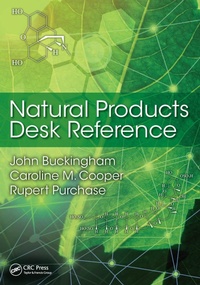
Natural Products Desk Reference
1st Edition
Published on 18. November 2015
253 pages
978-1-040-16222-4 (ISBN)
Description

Written by a group of experts affiliated with the prestigious Dictionary of Natural Products, this book provides a concise overview of the key structural types of natural products and their interrelationship. A structurally diverse group, ranging from simple aliphatic carbon chains to high molecular weight proteins, natural products can usually be classified into one or more groups. The text describes these major types, including flavonoids, carbohydrates, terpenoids, polyketides, and lipids, and it illustrates them with accurate chemical structures, demonstrating the biosynthetic relationships between groups. The book also covers nomenclature, stereochemistry, and ring numbering.
Reviews / Votes
"Because the science of natural products is so broad, it is difficult for any one individual to be familiar with all of its aspects. This is especially true for scientists and others who may encounter natural products as just one aspect of their work, and who may thus need a quick way to look up information on natural product structures and nomenclature, or on taxonomy. ...This handy desk reference was compiled by the same team of experts that produces the Dictionary of Natural Products, and it is extensively illustrated with representative chemical structures, making it both authoritative and accessible. It will be a valuable resource to all scientists whose work requires familiarity with natural products in all their diversity."-David G.I. Kingston, from the Foreword
"The Natural Products Desk Reference provides a concise discussion of the key types of natural products on the market, and surveys the types of ingredients and formulas that can be defined as 'natural'. From the classification and organization of natural products and their formulas to stereochemistry and compounds, tables, definitions, bibliographic references, and 'skeleton' illustrations of these natural products provide chemical abstracts and descriptions of multicellular organizations. College-level chemistry students as well as anyone interested in the physical makeup of natural products will find this a detailed, invaluable guide!" -James A. Cox, Editor-in-Chief, Midwest Book Review
More details
Edition
1. Auflage
Language
English
Place of publication
London
United Kingdom
Publishing group
Taylor & Francis Ltd
Target group
Professional and scholarly
ISBN-13
978-1-040-16222-4 (9781040162224)
Copyright in bibliographic data and cover images is held by Nielsen Book Services Limited or by the publishers or by their respective licensors: all rights reserved.
Schweitzer Classification
Other editions
Additional editions
John Buckingham | Caroline M. Cooper | Rupert Purchase
Natural Products Desk Reference
Book
07/2017
1st Edition
CRC Press
€282.73
Shipment within 10-20 days
John Buckingham
Natural Products Desk Reference
Book
12/2015
1st Edition
CRC Press
€176.50
Shipment within 15-20 days
Persons
John Buckingham is a former lecturer in organic chemistry at the University of London, London, United Kingdom. He has been involved with the Chapman & Hall/CRC chemical database since its inception in 1980, initially as a Chapman & Hall employee and more recently as editorial consultant. From the database, various editions of the Dictionary of Organic Compounds and the Dictionary of Natural Products (both of which have been for some years solely electronic) have been produced. In addition, he compiled (with W. Klyne and later with R. A. Hill) two editions and supplements of the Atlas of Stereochemistry and has coauthored several other specialist dictionaries in the Chapman & Hall/CRC series.
He is also the author of the popular science books Chasing the Molecule and Bitter Nemesis: The Intimate History of Strychnine.
Caroline M. Cooper completed her BSc in chemistry at King's College London in 1968, and then worked at Glaxo Research in Greenford. She contributes to the Dictionary of Organic Compounds, and, in 2011, she edited the second edition of Organic Chemist's Desk Reference, both published by CRC Press.
Rupert Purchase studied chemistry at the South-East Essex Technical College [Grad. RIC Part II (External), 1967] and the University of York (DPhil, 1972). He is a fellow of the Royal Society of Chemistry and a visiting fellow at the University of Sussex (2014-2017). Dr. Purchase contributes to The Combined Chemical Dictionary published by CRC Press, and is a freelance editor for Science of Synthesis: Houben-Weyl Methods of Molecular Transformations published by Georg Thieme Verlag, Stuttgart. He edited the Royal Society of Chemistry's (RSC) Environmental Chemistry Group Bulletin from 1995 to 2013 and was awarded the RSC's Long Service Award in 2011.
He is also the author of the popular science books Chasing the Molecule and Bitter Nemesis: The Intimate History of Strychnine.
Caroline M. Cooper completed her BSc in chemistry at King's College London in 1968, and then worked at Glaxo Research in Greenford. She contributes to the Dictionary of Organic Compounds, and, in 2011, she edited the second edition of Organic Chemist's Desk Reference, both published by CRC Press.
Rupert Purchase studied chemistry at the South-East Essex Technical College [Grad. RIC Part II (External), 1967] and the University of York (DPhil, 1972). He is a fellow of the Royal Society of Chemistry and a visiting fellow at the University of Sussex (2014-2017). Dr. Purchase contributes to The Combined Chemical Dictionary published by CRC Press, and is a freelance editor for Science of Synthesis: Houben-Weyl Methods of Molecular Transformations published by Georg Thieme Verlag, Stuttgart. He edited the Royal Society of Chemistry's (RSC) Environmental Chemistry Group Bulletin from 1995 to 2013 and was awarded the RSC's Long Service Award in 2011.
Content
The Natural Products Literature: Useful Review Series, Reference Works, and Databases. Primary Journals. Nomenclature. Stereochemistry. Natural World and Sources of Natural Products. Natural Product Skeletons: Occurrence and Classification of Natural Products. Structure and Nomenclature of Some Specialised Types of Natural Products. Chemical Hazard Information for Natural Products.
