

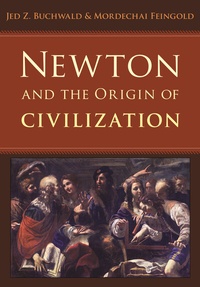
Newton and the Origin of Civilization
1st Edition
Published on 11. November 2012
544 pages
978-1-4008-4518-7 (ISBN)
Description

Isaac Newton's Chronology of Ancient Kingdoms Amended, published in 1728, one year after the great man's death, unleashed a storm of controversy. And for good reason. The book presents a drastically revised timeline for ancient civilizations, contracting Greek history by five hundred years and Egypt's by a millennium. Newton and the Origin of Civilization tells the story of how one of the most celebrated figures in the history of mathematics, optics, and mechanics came to apply his unique ways of thinking to problems of history, theology, and mythology, and of how his radical ideas produced an uproar that reverberated in Europe's learned circles throughout the eighteenth century and beyond.
Jed Buchwald and Mordechai Feingold reveal the manner in which Newton strove for nearly half a century to rectify universal history by reading ancient texts through the lens of astronomy, and to create a tight theoretical system for interpreting the evolution of civilization on the basis of population dynamics. It was during Newton's earliest years at Cambridge that he developed the core of his singular method for generating and working with trustworthy knowledge, which he applied to his study of the past with the same rigor he brought to his work in physics and mathematics. Drawing extensively on Newton's unpublished papers and a host of other primary sources, Buchwald and Feingold reconcile Isaac Newton the rational scientist with Newton the natural philosopher, alchemist, theologian, and chronologist of ancient history.
Jed Buchwald and Mordechai Feingold reveal the manner in which Newton strove for nearly half a century to rectify universal history by reading ancient texts through the lens of astronomy, and to create a tight theoretical system for interpreting the evolution of civilization on the basis of population dynamics. It was during Newton's earliest years at Cambridge that he developed the core of his singular method for generating and working with trustworthy knowledge, which he applied to his study of the past with the same rigor he brought to his work in physics and mathematics. Drawing extensively on Newton's unpublished papers and a host of other primary sources, Buchwald and Feingold reconcile Isaac Newton the rational scientist with Newton the natural philosopher, alchemist, theologian, and chronologist of ancient history.
All prices
More details
Other editions
Additional editions
Jed Z. Buchwald | Mordechai Feingold
Newton and the Origin of Civilization
Book
11/2012
Princeton University Press
€74.40
Article not available at the moment
Persons
Jed Z. Buchwald is the Doris and Henry Dreyfuss Professor of History at the California Institute of Technology. His books include The Zodiac of Paris: How an Improbable Controversy over an Ancient Egyptian Artifact Provoked a Modern Debate between Religion and Science (Princeton). Mordechai Feingold is professor of history at the California Institute of Technology. He is the author of The Newtonian Moment: Isaac Newton and the Making of Modern Culture.
Content
List of Illustrations vii
List of Tables xi
Acknowledgments xiii
Introduction 1
1 Troubled Senses 8
2 Troubled Numbers 44
3 Erudition and Chronology in Seventeenth-Century England 107
4 Isaac Newton on Prophecies and Idolatry 126
5 Aberrant Numbers: The Propagation of Mankind before and after the Deluge 164
6 Newtonian History 195
7 Text and Testimony 222
8 Interpreting Words 246
9 Publication and Reaction 307
10 The War on Newton in England 331
11 The War on Newton in France 353
12 The Demise of Chronology 381
13 Evidence and History 423
Appendix A Signs, Conventions, Dating, and Definitions 437
Appendix B Newton's Computational Methods 441
Appendix C Commented Extracts from Newton's MS Calculations 447
Appendix D Placing Colures on the Original Star Globe 464
Appendix E Hesiod, Thales, and Stellar Risings and Settings 468
Bibliography 489
Index 515
List of Tables xi
Acknowledgments xiii
Introduction 1
1 Troubled Senses 8
2 Troubled Numbers 44
3 Erudition and Chronology in Seventeenth-Century England 107
4 Isaac Newton on Prophecies and Idolatry 126
5 Aberrant Numbers: The Propagation of Mankind before and after the Deluge 164
6 Newtonian History 195
7 Text and Testimony 222
8 Interpreting Words 246
9 Publication and Reaction 307
10 The War on Newton in England 331
11 The War on Newton in France 353
12 The Demise of Chronology 381
13 Evidence and History 423
Appendix A Signs, Conventions, Dating, and Definitions 437
Appendix B Newton's Computational Methods 441
Appendix C Commented Extracts from Newton's MS Calculations 447
Appendix D Placing Colures on the Original Star Globe 464
Appendix E Hesiod, Thales, and Stellar Risings and Settings 468
Bibliography 489
Index 515

