

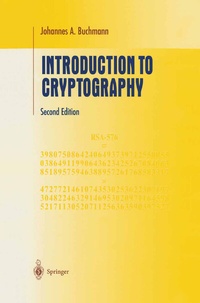
Introduction to Cryptography
Description

Cryptography is a key technology in electronic key systems. It is used to keep data secret, digitally sign documents, access control, and so forth. Users therefore should not only know how its techniques work, but they must also be able to estimate their efficiency and security. Based on courses taught by the author, this book explains the basic methods of modern cryptography. It is written for readers with only basic mathematical knowledge who are interested in modern cryptographic algorithms and their mathematical foundation. Several exercises are included following each chapter. This revised and extended edition includes new material on the AES encryption algorithm, the SHA-1 Hash algorithm, on secret sharing, as well as updates in the chapters on factoring and discrete logarithms.
Reviews / Votes
From the reviews:
Zentralblatt Math
"[......] Of the three books under review, Buchmann's is by far the most sophisticated, complete and up-to-date. It was written for computer-science majors - German ones at that - and might be rough going for all but the best American undergraduates. It is amazing how much Buchmann is able to do in under 300 pages: self-contained explanations of the relevant mathematics (with proofs); a systematic introduction to symmetric cryptosystems, including a detailed description and discussion of DES; a good treatment of primality testing, integer factorization, and algorithms for discrete logarithms, clearly written sections describing most of the major types of cryptosystems, and explanations of basic concepts of practical cryptography such as hash functions, message authentication codes, signatures, passwords, certification authorities, and certificate chains. This book is an excellent reference, and I believe that it would also be a good textbook for a course for mathematics or computer science majors, provided that the instructor is prepared to supplement it with more leisurely treatments of some of the topics."
N. Koblitz (Seattle, WA) - American Math. Society Monthly.
J.A. Buchmann
Introduction to Cryptography
"It gives a clear and systematic introduction into the subject whose popularity is ever increasing, and can be recommended to all who would like to learn about cryptography. The book contains many exercises and examples. It can be used as a textbook and is likely to become popular among students. The necessary definitions and concepts from algebra, number theory and probability theory are formulated, illustrated by examples and applied to cryptography." -ZENTRALBLATT MATH
"For those of use who wish to learn more about cryptography and/or to teach it, Johannes Buchmann has written this book. . The book is mathematicallycomplete and a satisfying read. There are plenty of homework exercises . . This is a good book for upperclassmen, graduate students, and faculty. . This book makes a superior reference and a fine textbook." (Robert W. Vallin, MathDL, January, 2001)
"Buchmann's book is a text on cryptography intended to be used at the undergraduate level. . the intended audiences of this book are 'readers who want to learn about modern cryptographic algorithms and their mathematical foundations . . I enjoy reading this book. . Readers will find a good exposition of the techniques used in developing and analyzing these algorithms. . These make Buchmann's text an excellent choice for self study or as a text for students . in elementary number theory and algebra." (Andrew C. Lee, SIGACT News, Vol. 34 (4), 2003)
From the reviews of the second edition:
"This is the english translation of the second edition of the author's prominent german textbook 'Einführung in die Kryptographie'. The original text grew out of several courses on cryptography given by the author at the Technical University Darmstadt; it is aimed at readers who want to learn about modern cryptographic techniques and its mathematical foundations . . As compared with the first edition the number of exercises has almost been doubled and some material . has been added." (R. Steinbauer, Monatshefte für Mathematik, Vol. 150 (4), 2007)
More details
Other editions
Additional editions
Previous edition
Person
Johannes A. Buchmann is Professor of Computer Science and Mathematics at the Technical University of Darmstadt, and an Associate Editor of the Journal of Cryptology. In 1985, he received a Feodor Lynen Fellowship of the Alexander von Humboldt Foundation. He has also received the most prestigious award in science in Germany, the Leibniz Award of the German Science Foundation (Deutsche Forschungsgemeinschaft).
