
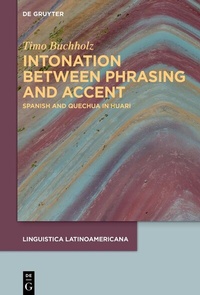
Intonation between phrasing and accent
Description
Alles über E-Books | Antworten auf Fragen rund um E-Books, Kopierschutz und Dateiformate finden Sie in unserem Info- & Hilfebereich.
Are our concepts from prosodic typology, like word stress, pitch accent, head-/edge-prominence, really that tightly linked to individual languages? How are meanings often signaled via intonation in European languages, like information structure and sentence type, expressed in communicative acts between speakers who are bilingual in such a European language, Spanish, and one in which many of these meanings are expressed by morphology, Quechua?
Based on semi-spontaneous dialogical elicitation data in both Spanish and Quechua gathered via fieldwork in the bilingual community of Huari, Peru, this work provides some challenging answers to these questions. Besides being the first detailed description of the prosody of a Central Quechuan language, it provides an in-depth study of the intonational systems and prosodic structures of the two languages and shows that their variation spaces overlap to a large extent, in turns exhibiting or not exhibiting evidence of word stress, pitch accents, lexical pitch accents in loanwords, and head- or edge-prominence.
More details
Other editions
Additional editions

Person
Timo Buchholz , University of Cologne, Germany.
System requirements
File format: ePUB
Copy protection: Watermark-DRM (Digital Rights Management)
System requirements:
- Computer (Windows; MacOS X; Linux): Use a reading software that can process the file format ePUB: e.g., Adobe Digital Editions or FBReader – both free (see eBook Help).
- Tablet/Smartphone (Android; iOS): Before downloading, install the free app Adobe Digital Editions (see eBook Help).
- E-reader: Bookeen, Kobo, Pocketbook, Sony, Tolino and many more (not Kindle).
The file format ePUB works well for novels and non-fiction books – i.e., „flowing” text without complex layout. On an e-reader or smartphone, line and page breaks automatically adjust to fit the small displays.
This eBook uses Watermark-DRM, a „soft” copy protection. This means that there are no technical restrictions to prevent illegal distribution. However, there is a personalised watermark embedded in the eBook that can be used to identify the purchaser of the eBook in the event of misuse and to provide evidence for legal purposes.
For more information, see our eBook Help page.