

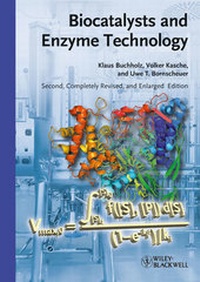
Biocatalysts and Enzyme Technology
2nd Edition
Published on 7. December 2012
XX, 606 pages
978-3-527-63292-3 (ISBN)
Description

This second edition of a bestselling textbook offers an instructive and comprehensive overview of our current knowledge of biocatalysis and enzyme technology.
The book now contains about 40% more printed content. Three chapters are completely new, while the others have been thoroughly updated, and a section with problems and solutions as well as new case studies have been added.
Following an introduction to the history of enzyme applications, the text goes on to cover in depth enzyme mechanisms and kinetics, production, recovery,
characterization and design by protein engineering. The authors treat a broad range of applications of soluble and immobilized biocatalysts, including wholecell
systems, the use of non-aqueous reaction systems, applications in organic synthesis, bioreactor design and reaction engineering. Methods to estimate the
sustainability, important internet resources and their evaluation, and legislation concerning the use of biocatalysts are also covered.
The book now contains about 40% more printed content. Three chapters are completely new, while the others have been thoroughly updated, and a section with problems and solutions as well as new case studies have been added.
Following an introduction to the history of enzyme applications, the text goes on to cover in depth enzyme mechanisms and kinetics, production, recovery,
characterization and design by protein engineering. The authors treat a broad range of applications of soluble and immobilized biocatalysts, including wholecell
systems, the use of non-aqueous reaction systems, applications in organic synthesis, bioreactor design and reaction engineering. Methods to estimate the
sustainability, important internet resources and their evaluation, and legislation concerning the use of biocatalysts are also covered.
More details
Other editions
Additional editions
Klaus Buchholz | Volker Kasche | Uwe Theo Bornscheuer
Biocatalysts and Enzyme Technology
Book
10/2012
2nd Edition
Wiley-Blackwell
€105.00
Shipment within 5-7 days
Persons
Born in 1941, Klaus Buchholz studied chemistry at the universities of Saarbrücken und Heidelberg, graduating in 1967. In 1969 he received his PhD from the TU Munich, after which he worked as a researcher at Dechema e.V. in Frankfurt/Main until 1982. In 1981 he qualified as a professor at the TU Braunschweig, where he then became department head at the Institute for Agricultural Technology and Sugar Industry. From 1988 onwards he was the provisional Head of the Institute, before becoming Professor for Technology of Carbohydrates at the Institute for Technical Chemistry in 1991. His main research areas include biocatalysts, enzymatic processes for the modification and synthesis of saccharides, environmental biotechnology, flow bed reactors with immobilized biocatalysts, and the synthesis of saccharide polymers.
Volker Kasche, born in 1939, studied chemistry, mathematics, and physics at the University of Uppsala, Sweden, receiving his degree in 1964. This was followed by a year as a NATO research fellow at Brandeis University, USA. He received his doctorate from the University of Uppsala in 1971, and in 1973 became Professor for Physical Biology at the University of Bremen, Germany. He has been Professor for Biotechnology at the TU Hamburg-Harburg, Germany, since 1986, focusing his research on fundamentals of equilibrium and kinetically controlled reactions catalyzed by free and immobilized hydrolases, the production, post-translational processing and purification of penicillin amidases and serine peptidases by affinity chromatography, as well as fundamentals of mass transfer in chromatography and enzyme technology.
Born in 1964, Uwe Bornscheuer studied chemistry at the University of Hanover, Germany, where he graduated in 1990. After receiving his PhD in 1993 from the Institute of Technical Chemistry at the same university, he spent a postdoctoral year at the University of Nagoya, Japan. He then joined the Institute of Technical Biochemistry, University of Stuttgart, Germany, where he qualified as a professor in 1998. He has been Professor for Technical Chemistry & Biotechnology at the University of Greifswald, Germany since 1999. Professor Bornscheuer's main research interest is the application of enzymes in the synthesis of optically active compounds and in lipid modification.
Volker Kasche, born in 1939, studied chemistry, mathematics, and physics at the University of Uppsala, Sweden, receiving his degree in 1964. This was followed by a year as a NATO research fellow at Brandeis University, USA. He received his doctorate from the University of Uppsala in 1971, and in 1973 became Professor for Physical Biology at the University of Bremen, Germany. He has been Professor for Biotechnology at the TU Hamburg-Harburg, Germany, since 1986, focusing his research on fundamentals of equilibrium and kinetically controlled reactions catalyzed by free and immobilized hydrolases, the production, post-translational processing and purification of penicillin amidases and serine peptidases by affinity chromatography, as well as fundamentals of mass transfer in chromatography and enzyme technology.
Born in 1964, Uwe Bornscheuer studied chemistry at the University of Hanover, Germany, where he graduated in 1990. After receiving his PhD in 1993 from the Institute of Technical Chemistry at the same university, he spent a postdoctoral year at the University of Nagoya, Japan. He then joined the Institute of Technical Biochemistry, University of Stuttgart, Germany, where he qualified as a professor in 1998. He has been Professor for Technical Chemistry & Biotechnology at the University of Greifswald, Germany since 1999. Professor Bornscheuer's main research interest is the application of enzymes in the synthesis of optically active compounds and in lipid modification.
Content
Preface
Introduction to enzyme technology
Basics of enzymes as biocatalysts
Enzyme discovery and protein engineering
Enzymes in organic chemistry
Cells designed by metabolic engineering as biocatalysts for multi-enzyme biotransformations
Enzyme production and purification
Application of enzymes in solution: Soluble enzymes and enzyme systems
Immobilization of enzymes (Including Applications)
Immobilization of microorganisms and cells
Characterization of immobilized biocatalysts
Reactors and process technology
Case study: The one-step enzymatic process to produce 7-ACA from cephalosporin C
Appendix I
The World of Biotechnology Information: Seven Points for Reflecting on Your Information Behavior
Appendix II
Solutions to exercises
Appendix III
Symbols, additional Symbols
Introduction to enzyme technology
Basics of enzymes as biocatalysts
Enzyme discovery and protein engineering
Enzymes in organic chemistry
Cells designed by metabolic engineering as biocatalysts for multi-enzyme biotransformations
Enzyme production and purification
Application of enzymes in solution: Soluble enzymes and enzyme systems
Immobilization of enzymes (Including Applications)
Immobilization of microorganisms and cells
Characterization of immobilized biocatalysts
Reactors and process technology
Case study: The one-step enzymatic process to produce 7-ACA from cephalosporin C
Appendix I
The World of Biotechnology Information: Seven Points for Reflecting on Your Information Behavior
Appendix II
Solutions to exercises
Appendix III
Symbols, additional Symbols
