

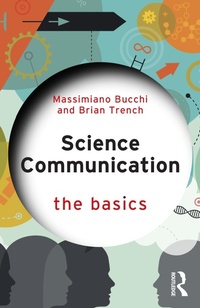
Science Communication
The Basics
1st Edition
Published on 2. April 2025
160 pages
978-1-040-32417-2 (ISBN)
Description

Science Communication: The Basics is an accessible yet critical introduction to science communication, which is viewed as the social conversation around science. It addresses why science communication matters, examines the evolution of theories and practices and explains concepts, myths, misunderstandings and challenges.
Massimiano Bucchi and Brian Trench navigate the foundations and key themes of science communication through numerous vignettes, examples, cases and arguments. They provide annotated recommended reading and a Lexicon summarising the understandings and uses of key terms in the field. Revealing science communication as a collective process and part of daily life, topics covered include science communication as part of culture and our understanding of ourselves and the world; the history of science communication and the development of 'modern science'; policy and theoretical approaches; the growth of professional practice, formal education and research in the field; evolving platforms for science communication; and quality, trust and ethical awareness in science communication.
Science Communication: The Basics is designed to be a concise primer and essential reading for newcomers to the field, including staff in research and policy institutions, students of the natural, human and social sciences, and general readers curious about the ways science is presented and perceived in society.
Science Communication: The Basics is the third in a triptych of works on science communication from the two authors. The other two works are the Routledge Handbook of Public Communication of Science and Technology, first published in 2008 and now in its third edition (2021), and a four-volume anthology of readings, The Public Communication of Science (2016), also published by Routledge.
Massimiano Bucchi and Brian Trench navigate the foundations and key themes of science communication through numerous vignettes, examples, cases and arguments. They provide annotated recommended reading and a Lexicon summarising the understandings and uses of key terms in the field. Revealing science communication as a collective process and part of daily life, topics covered include science communication as part of culture and our understanding of ourselves and the world; the history of science communication and the development of 'modern science'; policy and theoretical approaches; the growth of professional practice, formal education and research in the field; evolving platforms for science communication; and quality, trust and ethical awareness in science communication.
Science Communication: The Basics is designed to be a concise primer and essential reading for newcomers to the field, including staff in research and policy institutions, students of the natural, human and social sciences, and general readers curious about the ways science is presented and perceived in society.
Science Communication: The Basics is the third in a triptych of works on science communication from the two authors. The other two works are the Routledge Handbook of Public Communication of Science and Technology, first published in 2008 and now in its third edition (2021), and a four-volume anthology of readings, The Public Communication of Science (2016), also published by Routledge.
More details
Series
Edition
1. Auflage
Language
English
Place of publication
London
United Kingdom
Publishing group
Taylor & Francis Ltd
Target group
College/higher education
Professional and scholarly
Illustrations
1 Line drawings, black and white; 7 Halftones, black and white; 8 Illustrations, black and white
File size
1,50 MB
ISBN-13
978-1-040-32417-2 (9781040324172)
Copyright in bibliographic data and cover images is held by Nielsen Book Services Limited or by the publishers or by their respective licensors: all rights reserved.
Schweitzer Classification
Other editions
Additional editions
Book
04/2025
1st Edition
Routledge
€207.97
Shipment within 10-20 days
Book
04/2025
1st Edition
Routledge
€29.20
Shipment within 10-20 days
Persons
Massimiano Bucchi has been the editor-in-chief of the leading journal in the field, Public Understanding of Science (2016-2019). He is Professor of Science and Technology in Society and Director of Master SCICOMM at the University of Trento, Italy and has been visiting professor in Asia, Europe, North America and Oceania. He is the author of several books, published in over twenty countries, and a frequent contributor to newspapers and broadcasting. Among his books in English: Science in Society (2004); Geniuses, Heroes and Saints: The Nobel Prize and the Public Image of Science (2025).
Brian Trench, formerly Head of the School of Communications at Dublin City University, Ireland, has been the President (2014-2021) of the Public Communication of Science and Technology (PCST) network and reviews editor of the journal, Public Understanding of Science (2017-2025). He is a former journalist and has published and presented widely on science communication and related topics. He writes on science, radical and cultural history, including for the magazine, History Ireland.
Brian Trench, formerly Head of the School of Communications at Dublin City University, Ireland, has been the President (2014-2021) of the Public Communication of Science and Technology (PCST) network and reviews editor of the journal, Public Understanding of Science (2017-2025). He is a former journalist and has published and presented widely on science communication and related topics. He writes on science, radical and cultural history, including for the magazine, History Ireland.
Content
1. The Social Conversation around Science 2. Science Communication before There Was "Science Communication" 3. Science Communication Policy and Theory: Deficit as Default 4. How Science Communication Became a Thing 5. Actors and Platforms: The Who and Where of Science Communication 6. Understanding Different Viewpoints on Science Communication: More Complex, More Perplexing 7. Challenges and Priorities for Science Communication
