

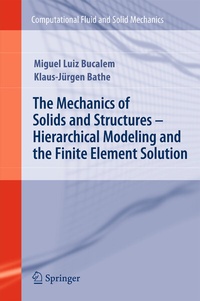
The Mechanics of Solids and Structures - Hierarchical Modeling and the Finite Element Solution
Description

In the recent decades, computational procedures have been applied to an increasing extent in engineering and the physical sciences. Mostly, two separate fields have been considered, namely, the analysis of solids and structures and the analysis of fluid flows. These continuous advances in analyses are of much interest to physicists, mathematicians and in particular, engineers. Also, computational fluid and solid mechanics are no longer treated as entirely separate fields of applications, but instead, coupled fluid and solid analysis is being pursued. The objective of the Book Series is to publish monographs, textbooks, and proceedings of conferences of archival value, on any subject of computational fluid dynamics, computational solid and structural mechanics, and computational multi-physics dynamics. The publications are written by and for physicists, mathematicians and engineers and are to emphasize the modeling, analysis and solution of problems in engineering.
Reviews / Votes
From the reviews:
"In this well-written work, Bucalem . and Bathe (MIT) present an approach based on hierarchical modeling of problems in solids and structures. It involves mathematical modeling of a physical problem and developing a solution based on well-established finite element methods. . Overall, an excellent presentation of hierarchical modeling of problems in solids and structures, useful for students in mechanical, civil, aerospace, and other engineering courses. Summing Up: Recommended. Engineering collections serving upper-division undergraduates, graduate students, and professionals/practitioners." (R. Kolar, Choice, Vol. 49 (5), January, 2012)
"The aim of this original book is to provide a rational, structured and modern framework for the modeling and analysis of engineering structures by presenting in one treatise both the basic mathematical models of solid and structural mechanics and modern reliable finite element procedures for the solution of these models. . this book not only gives valuable information regarding the linear analysis of solids, but also demonstrates universal concepts of analysis that are generally applicable." (P. Rochus, Mathematical Reviews, Issue 2012 h)
More details
Other editions
Additional editions
Content
Mathematical Models in the Finite Element Solution.- Fundamental Steps in Structural Mechanics.- The Linear 3-D Elasticity Mathematical Model.- Mathematical Models used in Engineering Structural Analysis.- The Principle of Virtual Work.- The Finite Element Process of Solution.- Hierarchical Modeling Examples.- Modeling for Nonlinear Analysis.
