

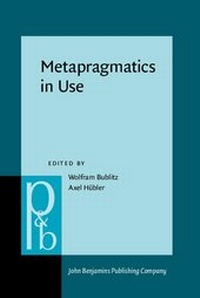
Metapragmatics in Use
1st Edition
Published on 12. December 2007
VIII, 301 pages
978-90-272-9124-0 (ISBN)
Description

This collection of papers fills a gap in current research on both metapragmatics and pragmatics in that it combines data-based pragmatic analysis with metapragmatic theory and focuses on the ways in which metadiscourse is actually used. The 12 contributions investigate speech acts and verbal (as well as non-verbal) expressions which highlight (meta-)linguistic aspects of ongoing discourse and thus provoke a deviation from the latter's original direction and purpose. All case studies discuss ways and means which interactants employ to resolve diverging pragmatic expectations in communication. The papers analyze authentic examples from English and other languages (and cultures), including Thai, Chinese and Japanese, and center around three principal domains of communication: ordinary everyday interaction, interaction in educational contexts and in specialized discourse. The introductory chapter locates the various contributions within a systematically broader theoretical framework. The wide scope of the collection, its empirical orientation and the reader-friendly form of presentation should appeal to anyone interested in pragmatics, whether scholar or student.
More details
Other editions
Additional editions
Wolfram Bublitz | Axel Huebler
Metapragmatics in Use
Book
12/2007
John Benjamins Publishing Co
€111.30
Shipment within 10-15 days
Persons
Content
- Metapragmatics in Use
- Editorial page
- Title page
- LCC data
- Table of contents
- Acknowledgements
- Introducing metapragmatics in use
- 1. Approaching metapragmatics
- 2. Forms of practice of metapragmatics
- 3. A systematics of metapragmatic functions
- 4. Preview of papers
- References
- Data sources
- Part A. Metapragmatics in everyday use
- "Don't blame me for criticizing you ...": A study of metapragmatic comments in Thai
- 1. Introduction
- 2. Defining metapragmatics
- 3. Thai conception of criticism
- 4. Disclaimers as a metapragmatic device
- 5. Thai disclaimers
- 6. "Don't blame me for criticizing you ."
- 7. Criticizing voice in disguise
- 8. Conclusion
- References
- Written Data Sources
- Facework and multiple selves in apologetic metapragmatic comments in Japanese*
- 1. Apologetic metapragmatic comments as aligning acts
- 2. Japanese AMC
- 3. Japanese AMC in computer-mediated communication: sources, method, data
- 4. AMC in context
- 5. Some further remarks on Japanese face
- 6. Summary and conclusions
- References
- Metapragmatic function of quotative markers in Japanese
- 1. Introduction
- 2. Echoic tte
- 3. Topic marking tte
- 4. Utterance-final tte and other quotative expressions
- 5. Concluding remarks
- References
- Data references
- Metapragmatic utterances in computer-mediated interaction
- 1. Scope and aims
- 2. Material and methods
- 3. Metapragmatic utterances in online interaction
- 4. Conclusion
- References
- Appendix
- On the metapragmatics of gestures
- 1. Introduction
- 2. Gestures as subject to topicalization
- 3. Gestural comments on gestural behavior
- 4. Gestural comments on selected aspects of an utterance
- 5. Conclusion
- References
- Sources
- Language shift in conversation as a metapragmatic comment
- 1. Language alternation in multilingual communities
- 2. Language shift as an act
- 3. The metapragmatic content of language shifts
- 4. The need for metapragmatic acts in multilingual inter-community communication
- References
- Part B. Metapragmatics in educational use
- Metapragmatic comments in institutional talk: A comparative analysis across settings
- 1. Introduction: A definition of metapragmatic comments (MPCs) and aims of this paper
- 2. 'Educational' contexts: Principal functions of MPCs
- 3. 'Media' contexts: Principal functions of MPCs
- 4. Conclusions
- References
- Metapragmatic expressions in physics lectures: Integrating representations, guiding processing, and assigning participant roles
- 1. Our topic
- 2. Background
- 3. Data and analysis
- 4. Findings
- 5. General discussion
- References
- Appendix A
- The acquisition of metapragmatic abilities in preschool children
- 1. Introduction
- 2. Setting the scene
- 3. Data and leading research questions
- 4. Findings and assessments
- 5. Conclusion
- References
- Part C. Metapragmatics in specialized use
- 'So your story now is that ...': Metapragmatic framing strategies in courtroom interrogation
- 1. Introduction
- 2. On the importance of the cooperative principle in court
- 3. Metapragmatic framing strategies in the Simpson interrogation
- 4. Functions of metapragmatic framing strategies in court
- 5. Concluding remarks
- References
- A metapragmatic examination of therapist reformulations
- 1. Introduction
- 2. Data and methods
- 3. Reformulation I: Rhetorical conjunctive relations
- 4. Reformulation II: Reported speech
- 5. Reformulation III: Transforming clause structure
- 6. The role of reformulations in the discursive unfolding of problems
- 7. Conclusion
- References
- Building common ground through metapragmatic comments in international project work
- 1. Introduction
- 2. Common ground and communicative success in intercultural communication
- 3. Data and method
- 4. Types of metapragmatic comments in intercultural project work
- 5. Metapragmatic comments and power
- 6. Conclusion
- References
- Appendix I: Task Sheet for Mini Project
- Appendix II: Key to transcription conventions
- Author index
- Subject index
- The Pragmatics & Beyond New Series
