

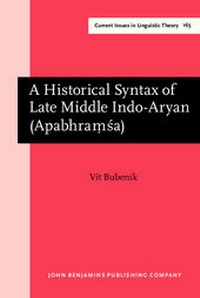
A Historical Syntax of Late Middle Indo-Aryan (Apabhram?sa)
1st Edition
Published on 15. October 1998
XXIV, 265 pages
978-90-272-7567-7 (ISBN)
Description

This monograph aims to close the gap in our knowledge of the nature and pace of grammatical change during the formative period of today's Indo-Aryan languages. During the 6th-12th c. the gradual erosion of the synthetic morphology of Old Indo-Aryan resulted ultimately in the remodelling of its syntax in the direction of the New Indo-Aryan analytic type.
This study concentrates on the emergence and development of the ergative construction in terms of the passive-to-ergative reanalysis and the co-existence of the ergative construction with the old and new analytic passive constructions. Special attention is paid to the actuation problem seen as the tug of war between conservative and eliminative forces during their development. Other chapters deal with the evolution of grammatical and lexical aspect, causativization, modality, absolute constructions and subordination.
This study is based on a wealth of new data gleaned from original poetic works in Apabhram?sa (by Svayam?bhadeva, Pus?padanta, Haribhadra, Somaprabha et al.). It contains sections dealing with descriptive techniques of Medieval Indian grammarians (esp. Hemacandra). All the Sanskrit, Prakrit and Apabhram?sa examples are consistently parsed and translated.
The opus is cast in the theoretical framework of Functional Grammar of the Prague and Amsterdam Schools. It should be of particular interest to scholars and students of Indo-Aryan and general historical linguistics, especially those interested in the issues of morphosyntactic change and typology in their sociohistorical setting.
This study concentrates on the emergence and development of the ergative construction in terms of the passive-to-ergative reanalysis and the co-existence of the ergative construction with the old and new analytic passive constructions. Special attention is paid to the actuation problem seen as the tug of war between conservative and eliminative forces during their development. Other chapters deal with the evolution of grammatical and lexical aspect, causativization, modality, absolute constructions and subordination.
This study is based on a wealth of new data gleaned from original poetic works in Apabhram?sa (by Svayam?bhadeva, Pus?padanta, Haribhadra, Somaprabha et al.). It contains sections dealing with descriptive techniques of Medieval Indian grammarians (esp. Hemacandra). All the Sanskrit, Prakrit and Apabhram?sa examples are consistently parsed and translated.
The opus is cast in the theoretical framework of Functional Grammar of the Prague and Amsterdam Schools. It should be of particular interest to scholars and students of Indo-Aryan and general historical linguistics, especially those interested in the issues of morphosyntactic change and typology in their sociohistorical setting.
More details
Other editions
Additional editions
Book
10/1998
John Benjamins Publishing Co
€116.60
Shipment within 10-15 days
Person
Content
- A HISTORICAL SYNTAX OF LATE MIDDLE INDO-ARYAN(APABHRAMSA)
- Editorial page
- Title page
- Copyright page
- PREFACE
- LIST OF ILLUSTRATIONS
- ABBREVIATIONS OF LANGUAGES AND DIALECTS
- ABBREVIATIONS OF PRIMARY LITERATURE
- ABBREVIATIONS OF GRAMMATICAL TERMS
- INTRODUCTION
- PART ONE. METHODOLOGY, SOCIOLINGUISTIC BACKGROUND AND APABHRAMSA LITERARY CORPUS
- CHAPTER ONE. METHODOLOGY AND THEORETICAL APPROACH
- 1.1 Previous studies of the late Middle Indo-Aryan period
- 1.2 The scope and aims of the present study
- 1.3 Methodology
- 1.4 Conceptual framework
- NOTES
- CHAPTER TWO. HISTORICAL, SOCIAL, AND LINGUISTIC BACKGROUND
- 2.1 Regional states in Northern India (6th - 12th century A.D.)
- 2.2 Sociolinguistic impact of foreign invasions and settlements on Northern India.
- 2.3 Literary languages of Medieval India (Sanskrit, Prakrits and Apabhramsa)
- 2.3.1 Classical Sanskrit
- 2.3.2 Prakrits
- 2.3.2.1 Prakrits used in poetry and Sanskrit plays
- 2.3.2.2 Prakrits used by Jainas
- 2.3.3 Apabhramsa
- Morphology:
- Morphosyntax:
- NOTES
- CHAPTER THREE. EVIDENCE FROM MEDIEVAL INDIAN GRAMMARIANS
- 3.1 Vararuci's Prakrtaprakasa
- 3.2 Descriptive technique of Hemacandra Suri (1088/1089-1172/1173)
- 3.3 Eastern grammarians
- Kramadisvara and Purusottama
- NOTES
- CHAPTER FOUR. LATE MIDDLE INDO-ARYAN VERNACULAR CORPUS
- 4.1 Eastern Apabhramsa: the Dohakosas of Kanha and Saraha
- 4.2 Apabhramsa songs in Kalidasa's Vikramorvaslya
- 4.3 Joindu's Paramatmaprakasa and Yogasara
- 4.4 Svayarnbhudeva's Paumacariu and Ritthanemicariu
- 4.5 Puspadanta's Harivamsapurana
- 4.6 Kanakamara's Karakandacariu
- 4.7 Dhanavala's Bhavisattakaha
- 4.8 Ramasimha's Pahudadoha
- 4.9 Haribhadra's Sanatkumaracarita
- 4.10 Somaprabha's Kumarapalapratibodha
- 4.11 Addahamana's Samdesa Rasaka
- NOTES
- PART TWO. GRAMMATICAL CHANGE DURING THE LATE MIDDLE INDO-ARYAN PERIOD
- CHAPTER FIVE. RESTRUCTURING OF THE NOMINAL SYSTEM AND THE EVOLUTION OF THE PHRASAL CASE
- 5.1 Erosion of the nominal case system
- 5.2 Source
- 5.3 Appurtenance
- 5.4 Reference
- 5.5 Location
- 5.6 Accompaniment/Instrumentality
- NOTES
- CHAPTER SIX. RESTRUCTURING OF THE PRONOMINAL SYSTEM AND THE EVOLUTION OF THE PHRASAL CASE
- 6.1 Late Middle Indo-Aryan Period (Apabhramsa)
- 6.1.1 Double-oblique system in Apabhramsa
- 6.1.2 Evidence of Apabhramsa literature
- 6.2 Early New Indo-Aryan Period
- 6.2.1 Emergence of oblique pronominal forms to host postpositions on par with the nouns.
- NOTES
- CHAPTER SEVEN. EVOLUTION OF GRAMMATICAL AND LEXICAL ASPECT
- 7.1 Grammatical aspect
- 7.1.1 Perfect (retrospective aspect)
- 7.1.2 Progressive aspect
- 7.2 Lexical aspect
- 7.2.1 Inception and completion
- 7.2.2 Version and ablation
- NOTES
- CHAPTER EIGHT. THE OLD SYNTHETIC AND THE NEW ANALYTIC PASSIVE
- 8.1 Inherited finite (synthetic) passive in -ijja-
- 8.1.1 Used in non-modal meaning
- 8.1.2 Used in modal meaning
- 8.1.2.1 Demand and deontic modality
- 8.1.2.2 Finite passive in relative clauses
- 8.1.2.3 Abilitative and cohortative meaning
- 8.1.2.4 Passive forms in the future tense
- 8.1.3 Imperfective passive participle in -anta
- 8.2 Inherited analytic be-passive
- 8.3 Innovative analytic jana "go"-passive
- 8.4 Non-finite passive with the past passive participle
- 8.4.1 The argument low in animacy as an agent
- 8.4.2 True agentless passive
- 8.4.3 The agent in the marked postverbal position
- 8.4.4 The avoidance of subject switching to maintain topic continuity
- 8.4.5 The goal as the vantage point for the narration
- NOTES
- CHAPTER NINE. THE EMERGENCE AND DEVELOPMENT OF THE ERGATIVE CONSTRUCTION
- 9.1 The functional theory of the origins of ergativity
- 9.2 The possessive and agentive construction in Middle Indo-Aryan
- 9.3 The tug of war between conservative and eliminative forces in the history of lndo-Aryan
- 9.3.1 The appearance of the absolutive case at the end of the MIA period
- 9.3.2 The diverging development of the ergative and the passive construction
- 9.3.3 The consequences of the cliticization of the pronominal suffixes and the copula to the tdi-form
- 9.4 Ergative interpretation of the constructions with the past passive participle in Apabhramsa
- 9.4.1 Word order in clauses with the ergative construction
- 9.4.2 Ergative construction in the 1st and 2nd person
- 9.4.3 Verbs of speaking in the 3rd person
- 9.4.4 Conjoining the intransitive and transitive predicates
- NOTES
- CHAPTER TEN. THE SCOPE OF THE CAUSATIVE
- 10.1 The functional theory of causativization
- 10.2 Finite causatives
- 10.2.1 Finite active causatives
- 10.2.2 Finite passive causatives
- 10.3 Non-finite causatives
- 10.3.1 Ergative (active) interpretation
- 10.3.2 Passive interpretation
- 10.4 Causativization in Sanskrit and Prakrits
- 10.4.1 Passivization on the goal
- 10.4.2 Passivization on the causee
- 10.4.3 Semantic restrictions on the passivization of causatives
- 10.4.4 Summary
- NOTES
- CHAPTER ELEVEN. MOOD AND MODALITY
- 11.1 Epistemic and deontic modality
- 11.2 The gerundive in statements of necessity and possibility
- 11.3 The gerundive in the function of inferential mode
- 11.4 The gerundive recategorized as future tense
- NOTES
- CHAPTER TWELVE. ABSOLUTE CONSTRUCTIONS
- 12.1 Absolute constructions in Old Indo-Aryan
- 12.2 Absolute constructions in Apabhramsa
- 12.2.1 Instrumental/Locative absolute
- 12.2.2 Genitive absolute
- 12.2.3 Nominative absolute
- CHAPTER THIRTEEN. COMPLEMENTATION AND RELATIVIZATION
- 13.1 The gerund with modal verbs
- 13.2 Dative of purpose with verbs of motion
- 13.3 The quotative particle ema
- 13.4 Relative clauses in Apabhramsa
- 13.5 Subordinate clauses introduced by relative pronouns
- 13.6 Subordinate clauses introduced by relative adverbs
- 13.6.1 Adverbial clauses of place
- 13.6.2 Adverbial clauses of time
- 13.6.3 Adverbial clauses of manner
- NOTES
- CHAPTER FOURTEEN. CONCLUSIONS
- 14.1 Grammatical change in Indo-Aryan languages during the Medieval period (6th - 12th century A.D.)
- 14.2 Sociolinguistic aspects of the history of lndo-Aryan languages during the Medieval period
- 14.3 A contribution of the present monograph to general historical linguistics
- 14.4 Epilogue
- EDITIONS OF PRIMARY LITERATURE
- REFERENCES AND SELECT BIBLIOGRAPHY
- INDEX OF ANCIENT AND MEDIEVAL GRAMMARIANS
- INDEX OF MODERN AUTHORS
- INDEX OF QUOTED PASSAGES
- INDEX OF LANGUAGES AND DIALECTS
- INDEX OF SUBJECTS
