

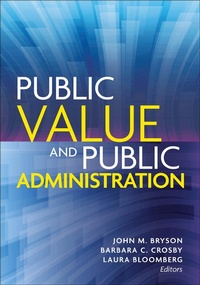
Public Value and Public Administration
Description

Governments and nonprofits exist to create public value. Yet what does that mean in theory and practice?
This new volume brings together key experts in the field to offer unique, wide-ranging answers. From the United States, Europe, and Australia, the contributors focus on the creation, meaning, measurement, and assessment of public value in a world where government, nonprofit organizations, business, and citizens all have roles in the public sphere. In so doing, they demonstrate the intimate link between ideas of public value and public values and the ways scholars theorize and measure them. They also add to ongoing debates over what public value might mean, the nature of the most important public values, and how we can practically apply these values. The collection concludes with an extensive research and practice agenda conceived to further the field and mainstream its ideas.
Aimed at scholars, students, and stakeholders ranging from business and government to nonprofits and activist groups, Public Value and Public Administration is an essential blueprint for those interested in creating public value to advance the common good.
More details
Other editions
Additional editions
Persons
John M. Bryson is McKnight Presidential Professor of Planning and Public Affairs at the Hubert H. Humphrey School of Public Affairs, University of Minnesota.
Barbara C. Crosby is an associate professor at the Hubert H. Humphrey School of Public Affairs, University of Minnesota.
Laura Bloomberg is associate dean at the Hubert H. Humphrey School of Public Affairs, University of Minnesota.
Content
Preface
Introduction
John M. Bryson, Barbara C. Crosby, and Laura Bloomberg
1. Discerning and Assessing Public Value: Major Issues and New Directions
John M. Bryson, Barbara C. Crosby, and Laura Bloomberg
Part I: Helping Managers Focus on Creating Public Value
2. Political Astuteness as an Aid to Discerning and Creating Public Value
Jean Hartley, John Alford, and Owen Hughes
3. Building Deliberative Capacity to Create Public Value: The Practices and Artifacts of the Art of Hosting
Jodi Sandfort and Kathryn S. Quick
4. Joining Minds: System Dynamics Group Model Building to Create Public Value
George Richardson, David F. Anderson, and Luis F. Luna-Reyes
5. Weighing the Public Value of Alternative Methods of Providing Public Services: Toward a Contingency Framework
John Alford
6. The Creation of Public Value through Step-Change Innovation in Public Organizations
Jean Hartley
Part II: Measuring and Assessing Public Value
7. How Can Cost-Benefit Analysis Help Create Public Value?
Clive Belfield
8. Creating a Public Value Account and Scorecard
Mark H. Moore
9. Public Value Mapping
Jennie Welch, Heather Rimes, and Barry Bozeman
10. Public Value: Turning a Conceptual Framework into a Scorecard
Timo Meynhardt
Chapter 11. In the Eye of the Beholder: Learning from Stakeholder Assessments of Public Value
John C. Thomas, Theodore H. Poister, and Min Su
Part III: Measuring and Managing Performance
12. Creating Public Value Using Performance Information
Alexander Kroll and Donald P. Moynihan
13. Putting Public Value to Work: A Framework for Public Management Decision Making
Anthony M. Cresswell, Meghan Cook, and Natalie Helbig
14. Shared Responsibility for the Common Good: Measuring Public Value across Institutional Boundaries
Enrico Guarini
Conclusions
John M. Bryson, Barbara C. Crosby, and Laura Bloomberg
References
List of Contributors
Index
